
Big, Beautiful Bullshit
Trump’s “Big, Beautiful Bill” may sneak past the House after the Freedom Caucus blinked, yet again. But that’s just the start of the challenges it faces.


The House Budget Committee finally cleared the GOP’s Big Beautiful Bill. And it went down just like every other performative, far right opposition we’ve seen.
Political observers have long figured that the Freedom Caucus would cave under pressure. Rep. Chip Roy (R-TX) is known for making big scenes, or even impassioned speeches to the cameras. He lambasts his colleagues as wastrels, making it seem like he really cares about the deficit and cutting spending. But then, lacking any real guts or principles, he and his fellow caucus members give in right as the votes are called.
That has been the pattern to date, and it played out again last night. After tanking the budget in a performative huff on Friday, the four Freedom Caucus holdouts on the House Budget Committee predictably folded late Sunday night, voting “present” instead of “no” on the House version of the GOP budget bill. It wound up passing by a vote of 21 to 16, sending the bill on to the Rules Committee to prepare for a floor vote later this week.
These GOP reps understand something most people witnessing the House budget drama don’t fully grasp: They can put on a show at zero cost because the “Big, Beautiful Bill” ultimately still has to head to the Senate. There, GOP lawmakers remain far apart from their House counterparts. Trillions apart, in fact.
In fact, it’s fair to say that nothing that the House does right now—whether it’s deep cuts to Medicaid and SNAP benefits, the canceling of green energy projects, or blowing a huge hole in the deficit yet again—really matters in the end. The Senate is going to change this Big Beautiful Bill, and probably by a lot.
Let’s open the congressional slaughterhouse doors and walk through the political sausage-making process. By the end of today’s piece, I hope you feel better informed about what we are being asked to ingest!
Reconciled… to an opening salvo.
The House has quite a high opinion of itself when it comes to the budget and the reconciliation process. But this view of its own power is grossly inflated.
The normal rules of the Senate say that in order for the body to pass a bill or resolution, it must overcome a filibuster, meaning at least 60 votes to end debate so the matter can be voted on.
But the normal filibuster rule doesn’t apply in a very specific situation: reconciliation. It’s a fancy word for a budgetary process in which various congressional committees “reconcile” the difference between existing laws and appropriations and the fiscal targets in the budget blueprint.
We recently saw various House committees craft legislation to meet those targets. Key among those was the House Energy and Commerce Committee, which proposed a way to cut over $700 billion out of Medicaid, as it was tasked to do.
The House Budget Committee is where all the various pieces of legislation from the different committees get stitched together into a single bill. So the successful vote last night, after an embarrassing setback on Friday, was a key one, at least from Speaker Johnson’s perspective. He now has a bill he can send to the House Rules Committee, which decides the “rules” by which the bill is voted on by the entire chamber.
But House passage of the bill means only that it is sent on to the Senate for consideration as a “privileged” bill not subject to the filibuster. And there are some rules governing what it can contain.
For starters, the bill has to conform to the procedural requirements of the Budget Act of 1974. As one former House staffer explained,
[I]f the House includes provisions that don’t comply with the Budget Act, this is called a fatality — it means the entire measure is no longer privileged in [the] Senate, defeating the whole point of the exercise.
That means the bill can’t contain provisions other than fiscal ones, i.e., those that change existing revenue, spending or the debt limit. The whole point is for the House to craft a bill that conforms to the Senate’s procedural requirements. The House staffer importantly noted, “[R]econciliation is designed to make it easier for the Senate to pass legislation — not to empower the House to dictate the terms.”
This means the bill will arrive from the House, but the Senate GOP will basically treat it as an opening bid. They understand that this is about as good as the House claims it can do by cobbling together a majority, but the Senate GOP won’t really care that much. They run the Senate, and they will have the upper hand from here on the bill.
Senate Republicans will debate the bill for weeks and proceed to revise it, likely considerably. They have to do all this before the debt ceiling limit gets hit, which is predicted around mid-July.
And the sausage that comes out of the political mill might look very different from the raw meat that went into the grinder.
Trouble ahead in the GOP-controlled Senate
The Senate GOP presently has neither the appetite nor the votes to cut Medicaid or other programs by such huge amounts. This was apparent when the Senate passed its version of the budget blueprint.
Below are the top line numbers for the Senate’s reconciliation instructions to its committees, put together by the Bipartisan Policy Center. You’ll see that the Senate has earmarked almost no money to be cut in this version, while increases in expenditures are mighty large, requiring a debt limit increase of $5 trillion to pay for extending the Trump tax breaks for the wealthy.
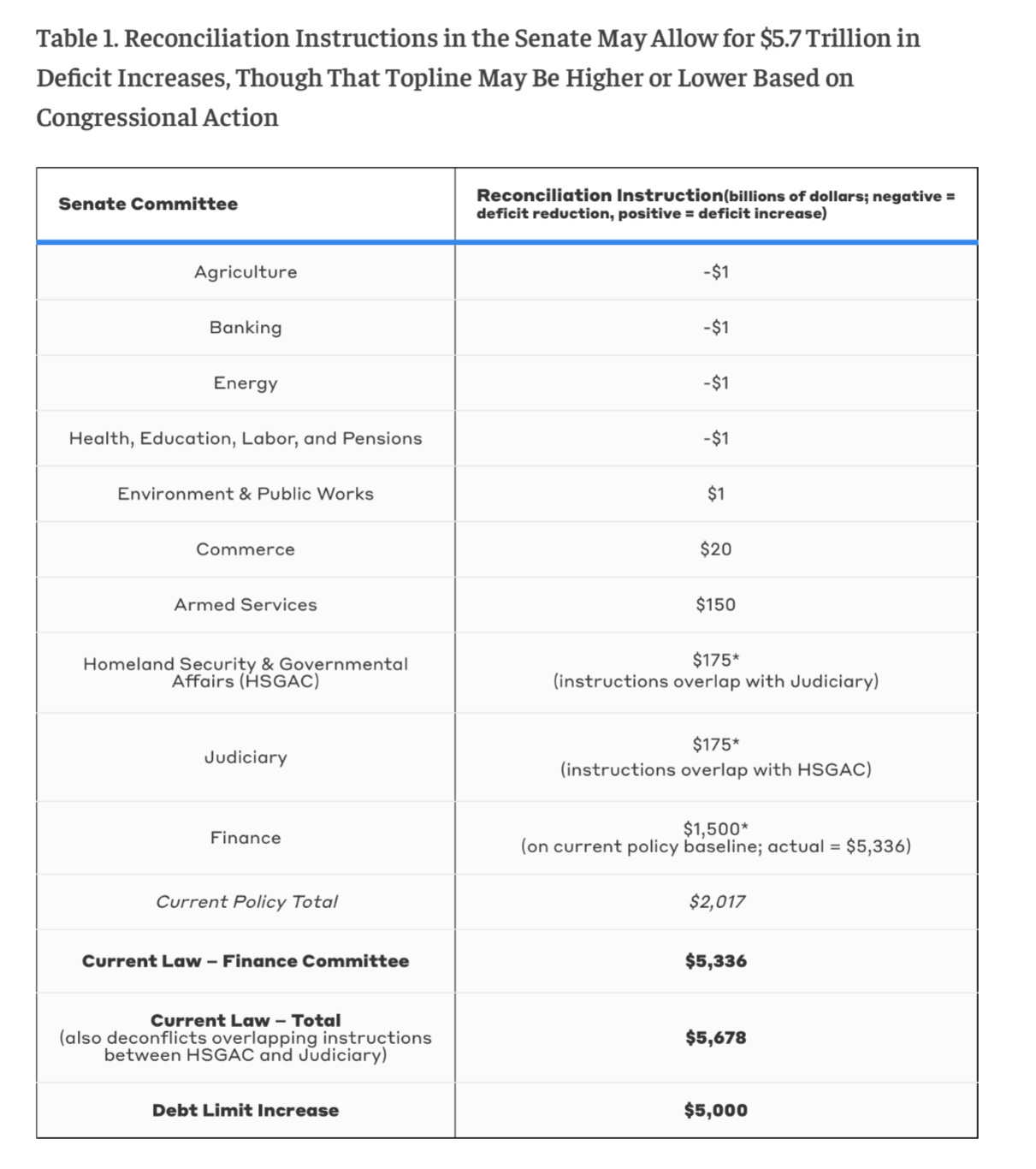
A lot of the increase comes from the Finance Committee, which has an actual bottom line cost of $5.3 trillion despite some accounting trickery by the GOP, which claims it is only a $1.5 trillion increase. Nice try, but no.
Compare those top line numbers to the House version below, which enumerates gigantic cuts to Medicaid (under Energy and Commerce), Education and Agriculture. These collectively create a $1 trillion smaller debt increase, but it’s still $4 trillion.
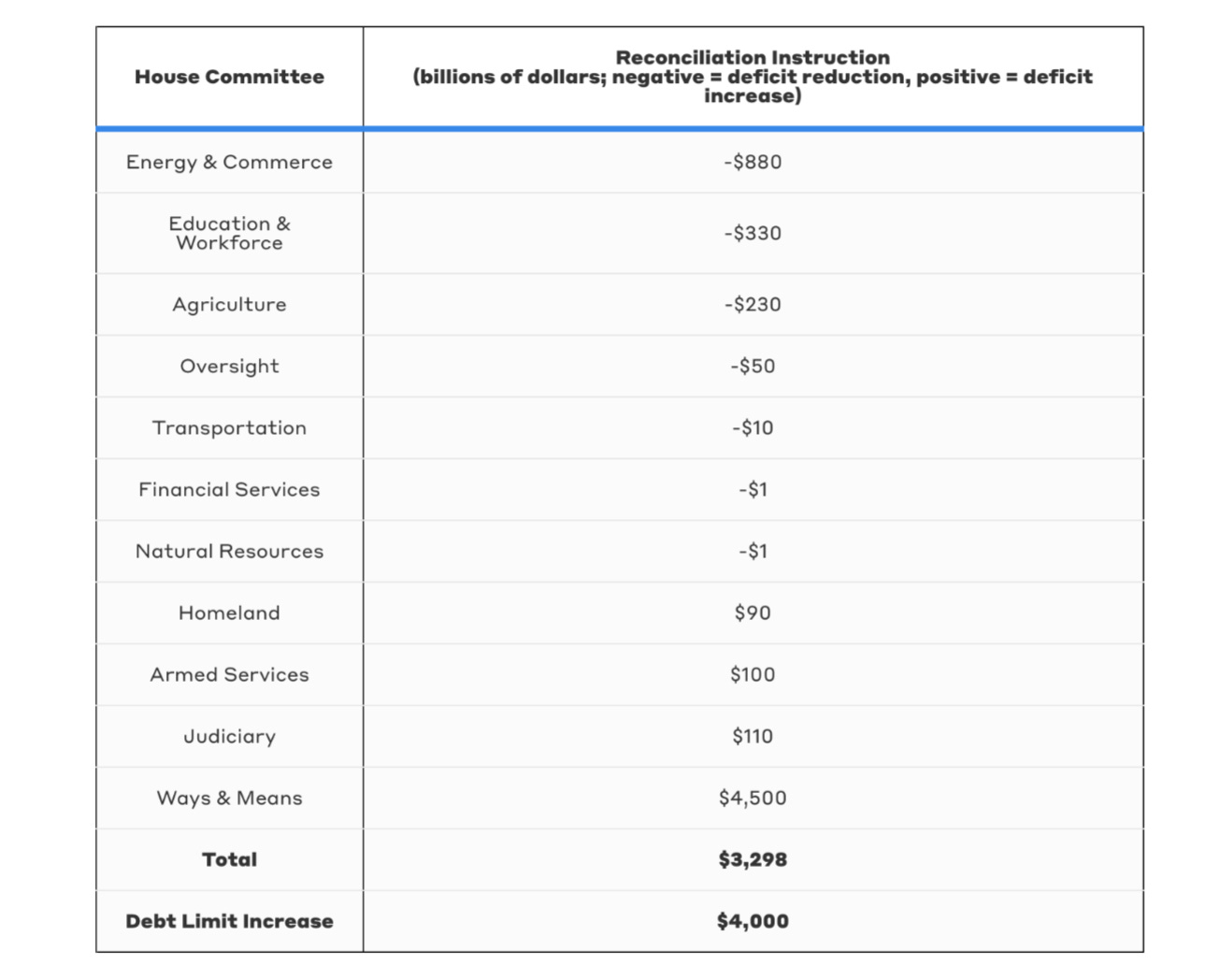
Some GOP senators such as Josh Hawley (R-MO) have expressed opposition to such large cuts to healthcare funding for the poor. “I’m not going to support this bill from the House, in this form. I think it’s clear it’s got to change before it can pass the Senate,” Hawley told CNN last Wednesday, adding that “No Republican should support that” because the GOP is the “party of the working class.”
Sen. Hawley is keenly aware that his own state would face a gigantic shortfall in revenue because of state constitutional requirements. As NPR explained,
Missouri voters passed a constitutional amendment expanding Medicaid in 2020 to 138% of the federal poverty level, which is about $26,650 a year for a family of three. The federal government currently pays for 90% of the roughly $3 billion cost to cover about 325,000 participants in the program.
Dave Dillon of the Missouri Hospital Association said there’s nothing in the amendment that would allow the Department of Social Services to stop taking in Medicaid expansion applicants if the federal government reduces its share toward funding the program.
If the federal government reduces funds for Medicaid, the state of Missouri will be required by its own state constitution to pick up the slack and the cost. It would likely run out of funds quickly—an example of how red states and their residents are highly dependent on the federal government.
Other senators such as Lisa Murkowski (R-AK) have reservations about slashing green energy projects that are already underway in her home state. She wrote a letter to Senate Majority Leader John Thune (R-SD), signed by Sens. John Curtis (R-UT), Thom Tillis (R-NC), and Jerry Moran (R-KS), warning that “termination” of certain clean energy tax credits enacted in 2022 “would create uncertainty, jeopardizing capital allocation, long-term project planning, and job creation in the energy sector and across our broader economy.”
The Senate has its deficit hawks, too. Sens. Rand Paul (R-KY) and Ron Johnson (R-WI) have both indicated that they won’t support the bill because it increases the deficit too much. They have called for more cuts to expenditures, even though it would also be possible to simply allow the Trump tax cuts to expire.
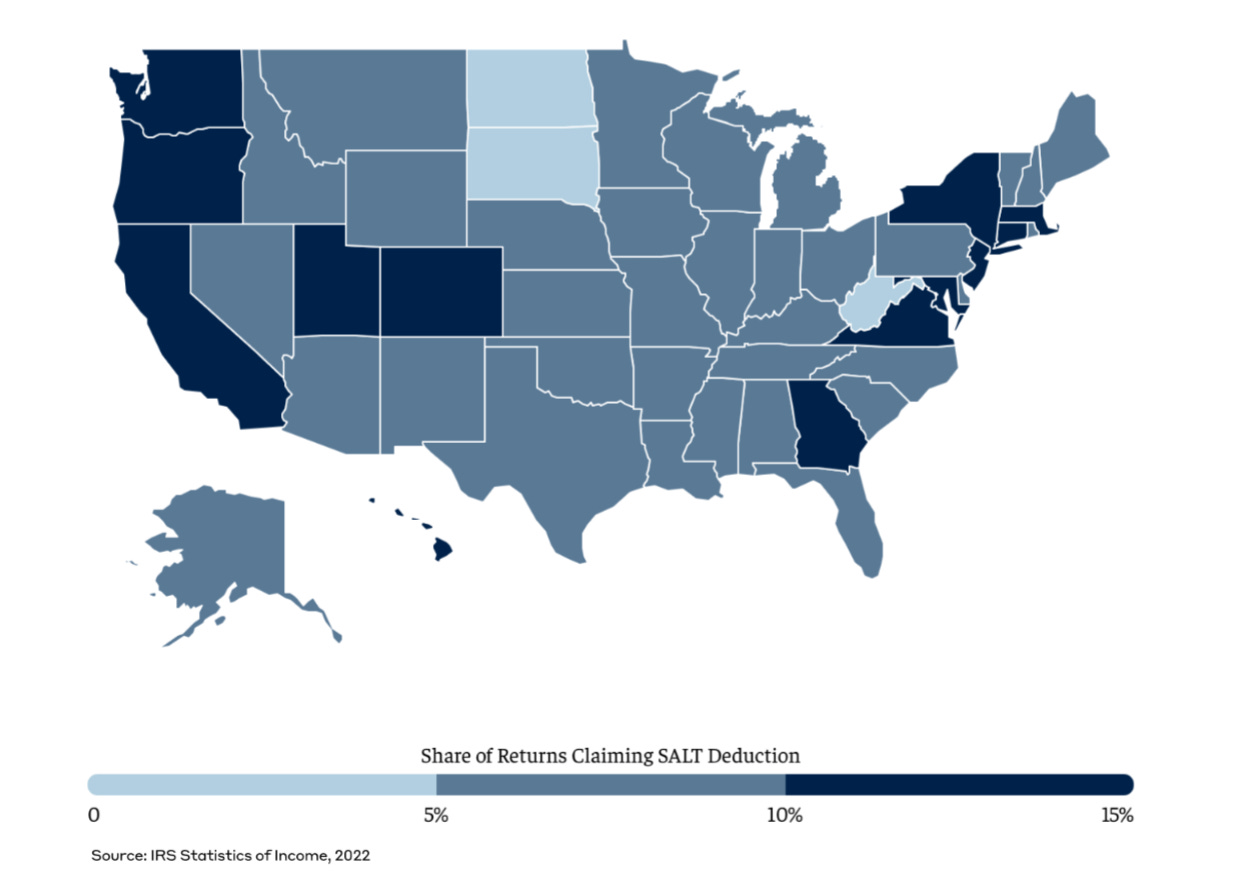
GOP House members in wealthy swing districts have been pressing hard for a lifting of the so-called “SALT” deduction for state and local taxes, which is currently capped at $10,000 annually. The House version of the budget bill will likely contain a lifting of the cap to $30-40,000. But this move won’t carry much weight with the GOP in the Senate because there are zero Republicans senators from the rich coastal states.
Paying a political price
The upshot of all of this is becoming clearer.
For Speaker Johnson to get some kind of bill passed in the House, it will necessarily contain steep cuts to Medicaid and SNAP while ballooning the deficit—just not as much as the GOP Senate proposal does.
But Republicans who approve the bill—and it will need to be nearly all of them—will be tarred with their vote come next November, especially if any big cuts to Medicaid survive Senate opposition. Some cuts stand a chance of making it through.
But if, as expected, the Senate GOP undoes the worst of these cuts—an outcome that will be more likely if there is significant public pressure—then all the House’s hand wringing and posturing will have been for naught.
Worse still, House Republicans will have voted on a budget that was doomed from the get-go, shooting themselves in the foot by exposing their most vulnerable members to political attack ads, all for no good reason.
This is the political cost of Trump’s bizarre insistence that there be one “Big, Beautiful Bill” for his party to to vote up or down on, and for GOP congressional leadership’s insistence that it could put off the reckoning over the two very disparate versions of the bill until the very end.
More capable and experienced Republican leadership would have spotted the problem long ago and worked to avoid it, for example by bringing the two chambers far closer in their goals and top line budget numbers earlier in the year.
The task ahead for Democrats is now super clear: Capitalize on the GOP’s draconian proposed cuts to things like healthcare and food stamps for the poor. Democrats can paint the GOP as the party that voted to strip millions of their healthcare, close rural hospitals and force granny out of the nursing home and back in with the family, all to give billionaires like Elon Musk bigger tax cuts.
With enough public pressure from constituents, the GOP, particularly in the Senate, could backtrack on the biggest of the proposed cuts this summer. That would earn a big political win for Democrats this year, even while preserving strong political attacks for use in the midterms next year.
I wish the media would find another term to label this bill with. Repeating MAGA's "Big, Beautiful Bill," even in quotes, pounds a positive thought into people's heads--the ones who are not especially paying attention, anyway.
Pieces of slime have to do everything under cover of darkness - and then lie about transparency. The only thing transparent is they are cruel and greedy asses.