
Electoral Wipeout
Tuesday’s stunning results in Wisconsin and Georgia, and what they could mean for November

Because of insane developments in Iran on Tuesday evening, I didn’t get a chance to write about this week’s election results. But let’s put it out there proudly: Democrats had a good night on Tuesday.
A very good night.
In Wisconsin, the liberal candidate for the state Supreme Court won by 20 points (!) in a state historically decided by less than a single percentage point over the last three presidential elections.
In Georgia, the Democrat running in one of the reddest congressional districts in the country moved the needle 25 points (!!) to the left from where Trump finished in 2024.
Republicans ultimately held that Georgia seat, but in Wisconsin, Democrats flipped a conservative court seat and expanded the liberal majority to 5-2. In both states, the results tell a story that should have the GOP worried well into November.
Let’s walk through what happened and why it matters.
Georgia: A YUGE swing in Trump Country
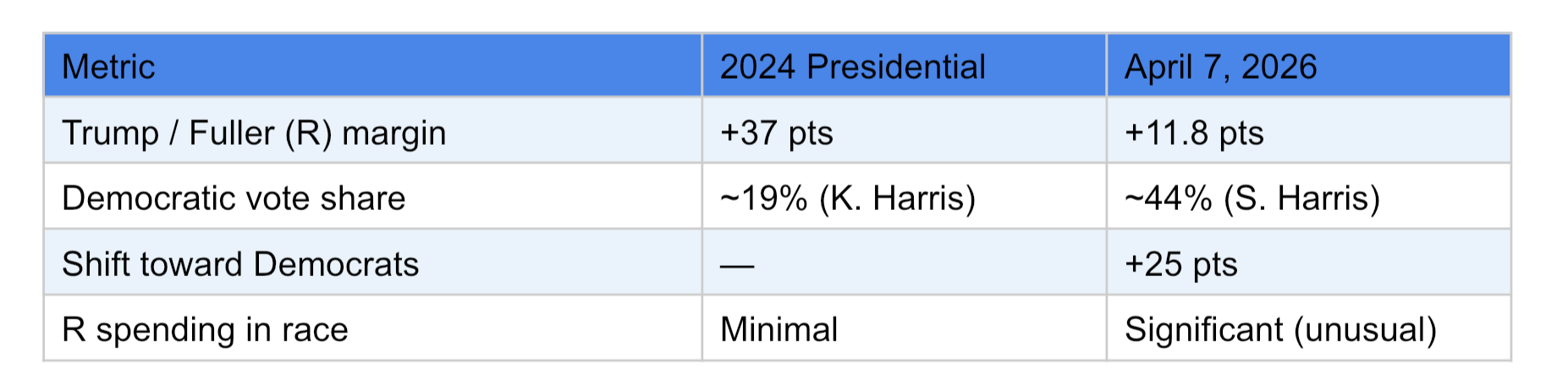
Start with the number 25. That’s the number of points the needle moved to the left in GA-14. We don’t expect to see movement like that in a congressional district, let alone one as deep-red as northwest Georgia’s 14th that Donald Trump carried by 37 points just 16 months ago.
Democrat Shawn Harris, a retired Army brigadier general and cattle rancher running for the first time, lost to Trump’s handpicked Republican Clay Fuller. But he moved the district so far from the 2024 presidential baseline that CNN recognized it as the largest Democratic overperformance in a House special election since Trump first took office.
This happened even as national Republicans made the very unusual decision to spend real money defending a seat they should have had on cruise control. Trump even traveled to the district to rally for Fuller in February.
Consider what a 25-point shift means when applied to the seats that will decide House control. As the New York Times noted, nearly two dozen House Republicans won their 2024 races by 10 points or less. A shift of two and a half times that magnitude in November would turn toss-ups into Democratic pickups.
The geographic details of the race make the picture even clearer. According to the Times, all 10 of the district’s counties shifted blue by double digits compared with 2024. Shawn Harris even won Cobb County, the district’s most suburban corner, outright with 58 percent of the vote.
Moreover, the Democratic vote share actually grew from March’s primary to April’s runoff, from about 40 percent combined Democratic in the first round to 44 percent for Harris alone, even as Republicans threw money at the race. Momentum was moving in the wrong direction for the GOP in this race, just as it has been everywhere we look.
Harris put it plainly on election night: “If Democrats, independents and Republicans can do this in a ruby-red district, the Democrats can win anywhere.” Georgia Democrats are already pointing to Tuesday as a boost for Sen. Jon Ossoff, who faces re-election this fall in a state Trump won by just two points.
Here are some of the top-line numbers and takeaways for GA-14:
Wisconsin: Dems consolidate control of the state Supreme Court
If Georgia’s result shook the confidence of House Republicans for November, Wisconsin’s results will stir their anxieties about the decade ahead.
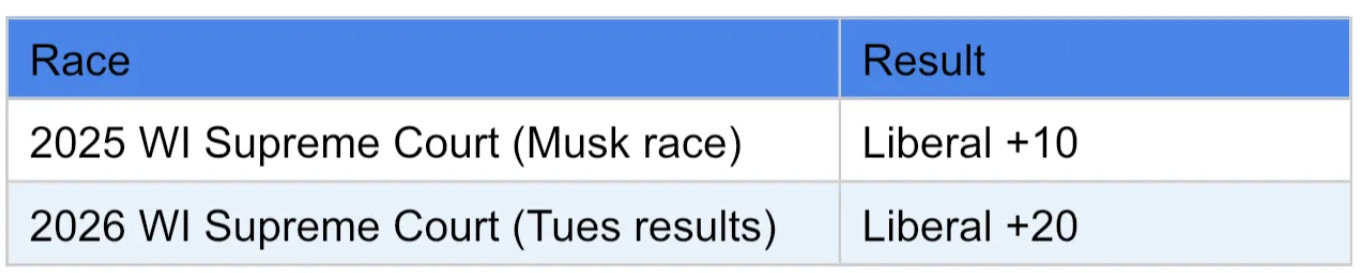
In the race for an open seat on the state Supreme Court, Democratic-backed appeals court judge Chris Taylor won by roughly 20 points, expanding the liberal majority from 4-3 to 5-2. That is the largest margin in a competitive Wisconsin Supreme Court race since 2000.
Her overperformance against the 2024 Democratic presidential baseline was 21 points, and she improved by 10 points over last year’s liberal victory. If you recall, that was the race where Elon Musk got involved, spent $25 million, and was trounced anyway. The 2025 race drew over $100 million in total spending. The 2026 race drew only about $6.5 million, with Democrats outspending Republicans on TV ads nine to one. Their candidate won by 21 points and didn’t need a celebrity villain.
Wisconsin Supreme Court: Moving strongly leftward under Trump
As the Washington Post reported, liberals are now positioned to hold their majority until at least 2030. They could pick up yet another seat as early as next year, when a retiring conservative justice means another seat will need to be filled. In any event, the liberals’ hold on the court is secured through the next presidential election. That could matter a lot: If 2028 produces election disputes in Wisconsin, as is likely, this is the court that will resolve them. It’s the same court that upheld Joe Biden’s victory in 2020 by a one-vote margin. That margin is now 5-2.
Contrary to popular assumption, the blue shift wasn’t largely confined to liberal enclaves. In the rural “Driftless Area” of southwest Wisconsin, full of blue-collar, small-town communities that swung hard toward Trump in 2016 and again in 2024, the movement on Tuesday was equally dramatic. Trump the “conservative” had carried that region roughly 54 to 46 percent in 2024, an 8-point Republican margin. On Tuesday, the liberal Taylor carried those same communities roughly 60 to 39 percent—a 21-point margin.
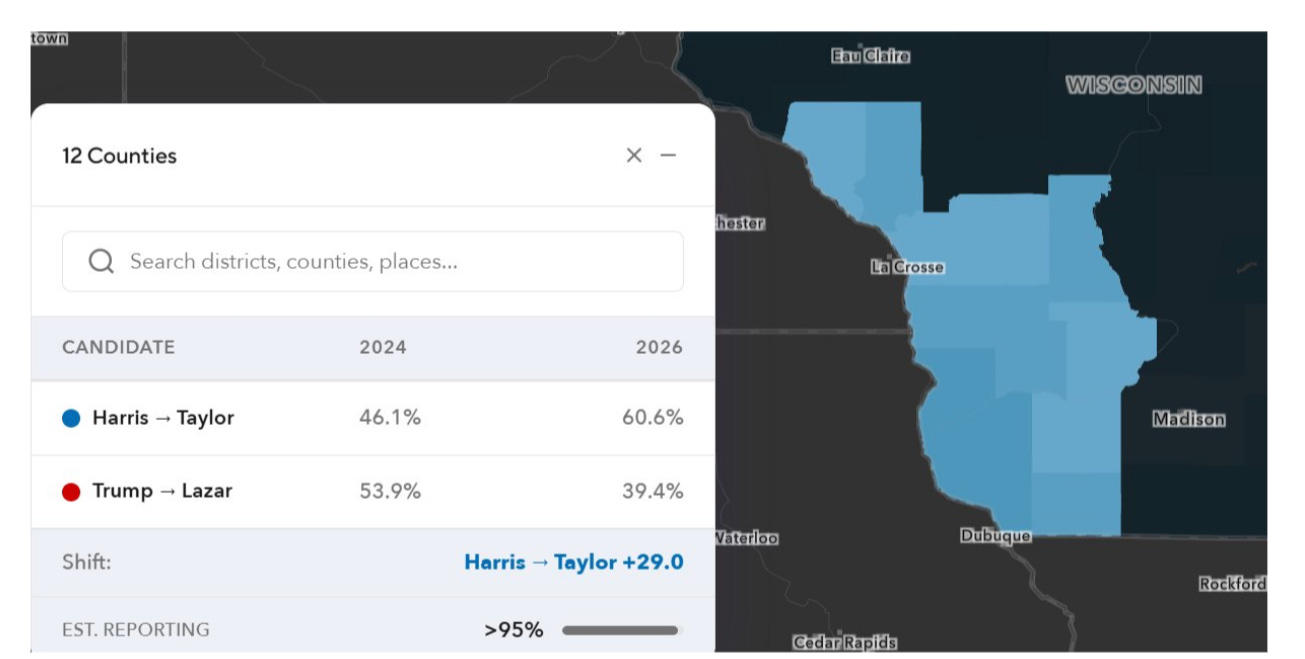
That’s a whopper of a swing, about 29 points in a single year in rural, working-class Wisconsin. The collapse of the GOP is not just a story about college-educated suburbs drifting left. The rural realignment that handed Trump the state is showing real cracks.
The practical stakes are significant. The Wisconsin Supreme Court is expected to rule on abortion restrictions, a challenge to the union-busting legislation conservatives rammed through a decade ago, and, most consequentially, two pending lawsuits over Wisconsin’s congressional district map. That map, which is heavily gerrymandered in favor of the GOP, currently apportions six of the state’s eight congressional seats to Republicans.
Those redistricting cases are expected to reach the state’s highest court, though probably not before November. But a fair reapportionment in 2030 could offset some of the seats Democrats are expected to lose to red states as a result of the census.
Waukesha: the story within the story
County-level results in Wisconsin deserve their own moment because they illuminate just how structural this shift is.
Waukesha County has been the Republican Party’s single largest source of votes in Wisconsin for generations. As recently as 2012, Mitt Romney carried it with 67 percent of the vote. On Tuesday, the Republican-backed state Supreme Court candidate managed just 54 percent. That’s four points less than even the conservative candidate who got trounced statewide last year.
The New York Times put the math plainly: Given Democratic strength in Milwaukee and Madison, Republicans must deliver a big margin in Waukesha to have any shot at winning statewide. Now that margin is evaporating.
Then there’s the Waukesha city mayoral race, which understandably drew almost no national coverage, but which has emerged as a bellwether. And hoo, boy. The Democrat Alicia Halvensleben defeated Republican state Rep. Scott Allen to become mayor of one of the most reliably Republican cities in the state.
To their credit, Democrats have been organizing in Waukesha County for years with an eye toward state legislative seats this fall. Tuesday was evidence that organizing pays off.
Ben Wikler, the former Wisconsin Democratic Party chair, cited Trump and his economic policies as a primary driver of the shift away from the GOP. He told the Times, “Since the 2025 Supreme Court rout, Trump has only gotten more extreme and unhinged, daily life has become even less affordable, and the voters most closely tracking the news have reached volcanic levels of outrage.”
A much larger pattern
Tuesday’s results didn’t come out of nowhere. They are the latest and sharpest data points in a trend that has held across every special and off-cycle election since Trump returned to the White House.
According to The Downballot, Democrats have improved upon their 2024 presidential margins by an average of 11 percent in special elections so far in 2026 and roughly 13 percent since the start of 2025. Seven U.S. House of Representatives special elections have been held in the past 15 months. Democrats improved their vote share in every one of them, with an average gain of about 15 percent.
The pattern has held beyond special elections. Democrats won commanding victories in the New Jersey and Virginia governors’ races in the 2025 general election. They’ve flipped 30 red-state legislative seats to blue while Republicans have flipped none. Primary turnout is surging in some of the most Republican states in the country. In Texas last month, a record 2.3 million votes were cast in the Democratic primary—more than in the Republican primary. In North Carolina, it’s the same story, where 174,000 more North Carolinians voted in the Democratic primary than in the Republican one. And in Mississippi, Democratic primary turnout was up over 52 percent from the last comparable Senate primary.
G. Elliott Morris, who tracks these numbers closely, pointed to what he called “the Iran factor.” Tuesday was the first real election since Trump started the war against Iran on February 28. The swings in Wisconsin and Georgia, 21 and 25 points respectively, are roughly double the 2025-2026 special election average. Pre-election polls had Taylor winning Wisconsin by about seven points; she won by 20. Notably, undecided voters broke toward the Democrat by something between 20 to 30 points. That indicates voters who hadn’t made up their minds yet are breaking against the party in power.
What November could look like
CNN’s Harry Enten discussed the historical numbers on air Wednesday and arrived at a striking conclusion: Five out of five times since the 2005-2006 cycle, the party outperforming in special elections went on to win the House. Democrats are currently performing better than they did in 2017-2018, the cycle that produced a 40-seat blue wave.
Prediction markets have taken notice. Bettors have put Democrats at 51 percent to take back not just the House, but the Senate as well. It’s up, as Enten put it, “like a rocket.” Prediction markets swing wildly, so perhaps this alone is not yet enough for Democrats to hope to reclaim the majority. But if trends hold, even the Senate could come into play.
The stakes in Wisconsin and Georgia are high. In Wisconsin, Rep. Derrick Van Orden’s 3rd Congressional District is a Cook Political Report toss-up. And in Georgia, the open governor’s race and the Ossoff Senate seat are both competitive. Democratic enthusiasm just got a significant boost in both states.
Meanwhile, Trump’s approval rating sits at a record low of some 39 percent as an average across polls, driven by an unpopular war in Iran, rising gas prices, and economic anxiety that shows no sign of easing. While the party in power nearly always loses ground in midterms, in 2026, the Republicans appear to be losing it faster than usual.
There’s another dimension to Tuesday’s results: what they mean for the state of Florida and its congressional delegation. Gov. DeSantis has called a special redistricting session on April 20, following through on Trump’s push for Republican-controlled states to redraw their congressional maps. His express goal is to squeeze more Republican seats out of a state that already sends 20 Republicans and just 8 Democrats to Congress.
The present electoral environment, however, is making some Republicans in Florida very nervous. In March, Democrats flipped two Florida state legislative seats. One of those was Trump’s own Palm Beach House district that he had won by 11 points in 2024. Given these results, Rep. Greg Steube warned, “I think the Legislature needs to be very cognizant of the fact that if they get too aggressive … you could put incumbent members at risk.” Rep. Daniel Webster put it more simply: “Don’t do it.”
Their concern has a name: the dummymander. It’s when you try to help yourself with an aggressive redistricting and wing up hurting your own party instead because you’ve underestimated how strong the political winds could blow.
UCF political science professor Aubrey Jewett told NPR that while redistricting will probably go forward, “it will not be quite as aggressive as it would have been.” That’s because when you redraw safe seats to capture more territory, you make those seats more competitive in the process. Hakeem Jeffries has already issued his warning: “We will crush House Republicans in November if DeSantis tries to gerrymander the Florida congressional map.” In this environment, that’s not an idle threat.
All caveats, of course
There are of course limits to what we can read into Tuesday’s results. Special elections are not general elections. Turnout is lower and more self-selected. The environment can shift between April and November. As one analyst noted about the GA-14 election, “I would be very cautious about reading too much into the results of a low-turnout runoff when trying to predict what will happen in November 2026.”
That caution is real. Democrats still have organizational work to do, primaries to win, funds to raise, and a challenging Senate map to navigate. Special elections can flatter and then disappoint.
And yet, the breadth and depth of these wins are hard to dismiss. The pattern has held across more than three dozen races, two governors’ elections, a string of state legislative flips, and primary turnout surges in some of the deepest red states in the country.
Democrats lost a congressional seat in one of the reddest districts in Georgia on Tuesday…and the party still celebrated because the shift told them what they needed to know. When you’re closing 37-point gaps to high single digits, winning a Supreme Court seat by 20 in a state decided by less than a point three times running, flipping the mayor’s office in a Republican stronghold, and watching undecided voters choose your party by margins that pollsters couldn’t predict — the direction of the country is coming into clear focus.
The exits are getting crowded
I want to close by highlighting a quieter story running alongside Tuesday’s stunning results.
According to Rolling Stone, only 374 of the 435 House members are currently seeking reelection. That’s the lowest number in the 21st Century and the second lowest since 1946. As The Hill reported, 36 House Republicans have already announced they won’t seek reelection, surpassing the previous record of 34 set in the 2018 cycle, the last time Democrats flipped the House. That number is expected to keep growing.
DCCC spokesperson Justin Chermol put it plainly: “’Republicans know they are going to lose in November. By retiring now, they’re avoiding the inevitable humiliation of losing their seats.”
Tuesday gave a few more of them something to mull as they look ahead to the rest of 2026 with growing dread.
Proud Waukeshanian here! We did it!
Hope that the ever-evolving WI electorate moving left will herald the eventual end of Ron Johnson's Senate seat, as he just squeaked by his last time out, but it does appear that an attractive Dem candidate will send Ron off to write his memoirs — or have them ghostwritten, more likely.