
Evasion Ain’t Persuasion
Three Republican officials faced basic questions this week from lawmakers and reporters. None would answer.

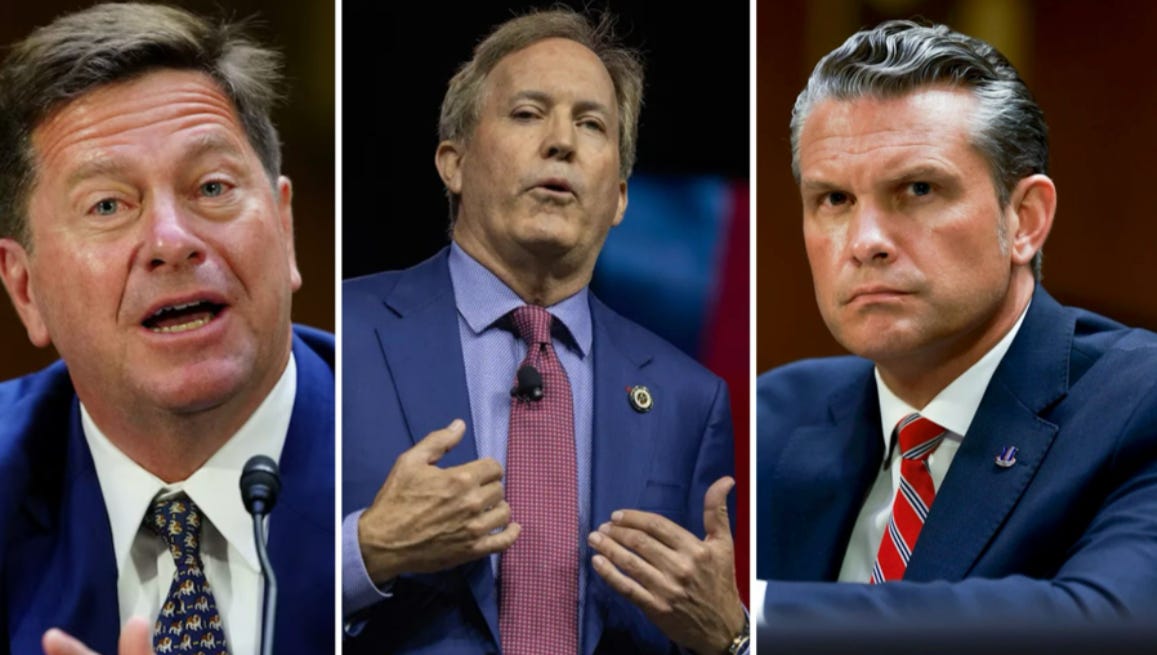
On July 15, Senate Intelligence Committee members asked Trump’s nominee for director of national intelligence, Jay Clayton, who won the 2020 election.
On July 21, a Fort Worth reporter asked Texas Attorney General Ken Paxton why he had voted from an address where he no longer lives. Another asked about his multiple houses purportedly purchased on a government salary.
That same day, Sen. Jon Ossoff (D-GA) asked Defense Secretary Pete Hegseth whether his March claim that Iran’s military had been “destroyed” was accurate. Hegseth had a different word ready. It wasn’t “wrong.”
In each case, these Republican leaders chose not to answer. Instead, they dissembled or shut down. They calculated that evasion was better than providing an actual answer. But those evasions carry political costs for the White House that are beginning to compound.
The humiliation of Jay Clayton
Jay Clayton spent 30 years in corporate law before Trump named him to lead the nation’s intelligence community, including a stint as SEC chairman in Trump’s first term and, more recently, U.S. attorney for the Southern District of New York. None of that prepared him for a question about the 2020 election.
Sen. Ossoff asked him directly who won the election that year. “I’m not gonna do this with you,” Clayton said. Sen. Angus King (I-ME) tried a different approach, asking Clayton to state plainly who had won. Clayton described what happened to the office, not the man: “He went through our processes, and Joe Biden became the president of the United States.” King told him that wasn’t an answer. The best Clayton would offer was that Biden was certified as the winner, not that he had won.
Ossoff pressed a third time, telling Clayton he wasn’t being “honest or forthright.” Clayton sat in silence.
Ossoff then went for the throat. He asked Clayton what we were all thinking at that moment: whether it was humiliating to be unable to answer the question while seeking to lead America’s intelligence community.
The reason Clayton couldn’t answer was clear: He couldn’t draw the ire of the president who had just named him to the post, so he chose to grovel and debase himself before Congress and the nation. It will be all Clayton is remembered for, despite all his professional achievements.
All hat, no cattle Paxton
Ken Paxton has been Texas attorney general since 2015, and for nearly as long he has warned voters that misrepresenting a residence on election records is illegal. Yet a joint investigation by The Texas Tribune and ProPublica found that Paxton voted in six elections over the past two years from a Collin County address where he no longer lives. Three election lawyers told the outlets he may have violated the same law his own office has cited in enforcement warnings.
Separately, Paxton has somehow acquired 15 properties worth about $9 million across four states while serving on a government salary, amid both a Senate campaign and a divorce, according to a New York Times investigation.
It’s small wonder Paxton doesn’t want to face reporters. On July 21, Paxton stood at a Fort Worth podium flanked by sheriffs, unironically insisting he was there to talk law enforcement. A reporter raised Democratic opponent James Talarico’s point about Paxton owning 15 homes and asked Paxton to respond. Paxton didn’t.
A second reporter then asked him to clear up why he voted in Collin County. Paxton had already tried to redirect the gathering once, telling reporters, “Can we keep this to law enforcement today?” So, on the residency question—the one that touches state election law directly—he didn’t try to answer at all. Instead, his press liaison cut in and ended the event, telling reporters Paxton was “gonna get out of here.”
Hegseth’s credibility was “functionally destroyed”
Defense Secretary Pete Hegseth has previously described the state of Iran’s military in stark terms: its missile program was “functionally destroyed,” with launchers, production facilities and stockpiles “depleted and decimated, and almost completely ineffective.”
He was echoing the president. Trump had told the country days earlier that “Iran’s Navy is gone, their Air Force is in ruins.” And in an April 11 post, Trump declared the U.S. had “completely destroyed Iran’s Military, including their entire Navy and Air Force, and everything else.”
These boasts have been at odds with what has happened on the ground. In the months since, Iran has kept fighting. Last week, on July 17 and 18, Iranian missile and drone attacks struck a U.S. base in Jordan, killing Pvt. Isabella Gonzales, 19, and 1st Lt. Tyler James Feehan, 25. A third soldier from the attack, Sgt. Angel S. Rampersad, 28, was initially listed as missing and has since been identified as dead. A fourth service member, Sgt. Michael Emmanuel Swinton, 30, of Fayetteville, North Carolina, was killed days later during the controlled detonation of an unexploded Iranian drone in northern Iraq. The Pentagon has reported nearly 100 troops wounded over the preceding two weeks.
It was within this context—a war that appears to have resumed and taken the lives of four service members in a matter of days—that Hegseth appeared before the Senate Appropriations Committee on July 21. He was there to request $67.1 billion in emergency Pentagon funding, part of an $87.6 billion supplemental package, including $21 billion for munitions and $17.3 billion for operations.
Senators wanted to know how a military he’d described as destroyed just months earlier was still costing the Pentagon that much to fight in July. Sen. Ossoff quoted Hegseth’s own words back to him and asked whether the earlier claims had been accurate, yes or no. Hegseth tried twice to answer a different question, about Iran’s capacity to challenge the United States, but Ossoff cut him off both times, telling him, “That’s not what I asked you, Mr. Secretary.”
Sen. Patty Murray (D-WA) read him his own April statement word for word and asked him to square it with the war’s continued cost. Hegseth’s answer walked the claim back without naming it: “I acknowledge they still have capabilities, no doubt.”
So, not really destroyed, Mr. Secretary? Is that correct?
Here’s the exchange with Sen. Ossoff in which it’s clear Hegseth has been cornered:
A calculation that will backfire
Clayton, Paxton and Hegseth were not asked to speculate. Each was asked to confirm something already established: a certified election result, public voting and property records, or a defense secretary’s own previous statements. In each case, the facts were available, unambiguous and already established. Yet in each case, the official under questioning chose not to acknowledge them.
None of the three men disputed the underlying facts. Clayton did not argue the election was stolen; he simply would not say the word “won.” Hegseth did not argue Iran’s military was indeed obliterated; he simply would not admit he had been wrong before. And Paxton did not dispute that he voted from an address where he doesn’t live; he simply refused to discuss it and left the room.
The evasions differed in method but not in function. Each avoided the specific word or admission that would make the contradiction undeniable on the record, without going so far as to state something false outright.
These men appeared unprepared, but they shouldn’t have been. Clayton had time to rehearse an answer about the 2020 election, a question repeatedly posed to Trump’s nominees. Hegseth’s March and April statements about Iran were public record, and he could and should have anticipated having them quoted back to him. And Paxton knew the Tribune/ProPublica story had been out for two weeks before reporters asked about it in Fort Worth. Each of them walked into the room knowing the question was coming, yet each decided the safer path was silence, deflection or an early exit.
In each case, that was a political calculation. Somewhere between the truthful answer and the podium, each official weighed what it would cost to state the truth plainly against what it would cost to appear cagey and shady. All three decided that a public evasion, awkward and visible as it was, would inflict less damage than the alternative: contradicting a president who has spent six years disputing 2020, undercutting a war narrative the White House has staked its credibility on, or answering for conduct that cuts against a law-and-order brand.
Back when I was a full-time litigator, I would often advise witnesses against being so obviously and painfully evasive. Videos of their testimony, I warned, would almost certainly be played back to a judge or jury, and the witness’s credibility would be shot. After all, anyone who tries so hard not to answer a question probably has something to hide.
Beyond that come two natural follow-up questions: What’s so bad that the witness had to squirm and evade in such an embarrassingly obvious way? And if they’re hiding this, what else are they hiding?
When the Trump White House looks at its low approval numbers, particularly among independents, it has to grapple with two kinds of problems. First, there is the underlying horrible state of affairs, from the high cost of living to yet another foreign war Trump promised would not happen on his watch. Second, there’s a vibes problem: the total lack of respect the regime and its cronies show the American public when they try to evade accountability. By refusing to take ownership of the problems, their decisions or their corrupt or illegal behavior, they have earned the badge not just of bad government but of bad actors.
The first set of problems is fixable. You can end a war, eventually. Prices may stabilize, eventually.
But the second is trickier, once people see you for who you really are. These officials will never get the stench of their sycophantic fealty to Trump off them. And the public, at least outside of the MAGA cult, will draw the correct and logical conclusion that they are there to serve Trump and themselves first, not the public at large.
May the voters pay them all back for their disservice, dissembling and disrespect this November.
"Hegseth’s credibility was “functionally destroyed”."
Wow! I didn't know that he HAD any!
No one with an ounce of integrity would even consider working for Trump, so sadly nothing surprising here.