

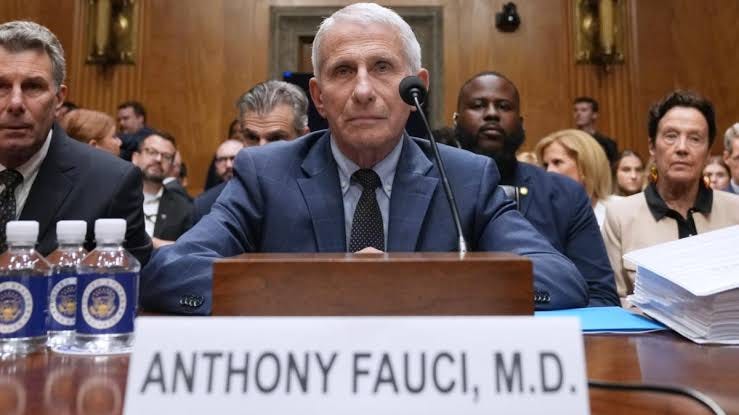
Six years after COVID-19 first appeared, Sen. Rand Paul is still trying to prove the virus emerged from a laboratory—and that Dr. Anthony Fauci is somehow responsible for it. On Wednesday, that effort arrived before the Senate Homeland Security and Governmental Affairs Committee that Paul now chairs. Paul had subpoenaed Fauci, now a retired government scientist, to testify, and used a private diary he’d somehow obtained as further “evidence” of Fauci’s culpability.
Legal scholars observing the hearing saw a familiar pattern. Frank O. Bowman III, a University of Missouri emeritus law professor, told PolitiFact he had no doubt Paul and like-minded Republicans would comb anything Fauci said for the slightest hint of error or inconsistency and refer him for prosecution. That, Bowman said, had just happened to Jack Smith, the special counsel who investigated Trump’s efforts to overturn the 2020 election. Once such a referral reaches the Justice Department, Bowman noted, it would be taken up by officials with a track record of pursuing the president’s political adversaries, pointing to the cases involving former FBI Director James Comey and former Federal Reserve Chairman Jerome Powell.
Days before Fauci’s hearing, House Judiciary Committee Chair Jim Jordan (R-OH) formally referred Smith to the Justice Department, accusing him of lying to Congress about how his investigators handled lawmakers’ phone records during that same 2020 election probe. Smith’s attorney called the referral an effort to “weaponize the justice system” against “a career, nonpartisan public servant.” CBS News reported that legal experts doubt the case holds up at all.
Given what had just happened to Smith, Fauci understandably met the Senate hearing with mostly silence. He invoked his Fifth Amendment right more than 100 times, the first time in more than 250 congressional appearances that he had done so. Sen. Paul and his allies hoped this would show that Fauci has something to hide. Instead, it showed, at least to any fair-minded viewer, that the Republican Party remains morally bankrupt, even among Republicans who occasionally break with Trump, like Sen. Paul.
Paul’s case against Fauci ultimately rests on three separate, weak claims: that the pardon Fauci received from President Biden strips him of the right to invoke the Fifth Amendment; that Fauci’s diary documents a private belief in the lab-leak theory he concealed from the public; and that NIH funding produced the virus that caused the pandemic.
It’s important that we dismantle these claims piece by piece.
Paul’s legal argument falls short
In his opening statement, Fauci laid out his reasoning before declining to answer a single question. He pointed to Paul’s history of publicly calling for his prosecution, his repeated public criticism and Paul’s decision to release his unredacted diary. He concluded that the hearing’s sole purpose was to get him to say something Paul could use to make good on his pledge to see Fauci “behind bars.” Fauci argued that anyone who had followed Paul’s “unhinged obsession with me” would reach the same conclusion.
Fauci contrasted that accusation with his own institutional record, noting that in nearly 40 years as NIAID director he had testified before or briefed congressional committees well over 200 times. This, he argued, was a history that demonstrated his respect for legitimate oversight.
For every question that followed in Wednesday’s hearing, however, he gave the same answer: on the advice of counsel, he was invoking his Fifth Amendment right. Paul warned Fauci mid-hearing that obstructing a congressional investigation carries legal consequences and that there would be “repercussions” for his refusal to answer. Speaking to reporters afterward, Paul said he had hoped for something closer to contrition. He said he had wanted to hear Fauci acknowledge that judgment errors were made, but he heard none of that from the scientist.
Democrats on the committee were not silent in the face of this assault. They defended Fauci’s right to invoke the privilege and used their time to attack the premise of the hearing itself. Sen. Richard Blumenthal (D-CT) called the proceeding “a perjury craft for criminal prosecution going forward” and agreed that Fauci invoking the Fifth was “the more prudent course.” Ranking member Gary Peters (D-MI) argued the hearing would discourage future public servants from taking on similar work, warning that “today’s hearing, unfortunately, does real damage.”
Before the hearing had even ended, Paul announced the next step: a committee vote on whether to hold Fauci in contempt of Congress, scheduled for Aug. 5. Speaking to reporters afterward, Paul framed his reasoning around the pardon Fauci had received from President Biden, arguing that Fauci’s immunity from criminal liability meant he had no need to invoke the Fifth Amendment in the first place. He added that whether the privilege even applies once a pardon is in place is itself a legal question, one he expects courts may ultimately have to decide.
But as the Washington Examiner reported, legal experts pushed back on the idea that Biden’s pardon settles the matter. Defense attorney Neama Rahmani noted that the pardon was retroactive, not prospective, meaning it does nothing to shield Fauci from future exposure created by his current testimony. “It’s not a license to commit crimes,” he said. “Biden’s pardon doesn’t apply to future conduct.” That means, logically, that the pardon can’t strip Fauci of his Fifth Amendment right to remain silent because there is a real risk of criminal prosecution—especially a targeted, politicized one, as we just saw with Jack Smith—over anything he says today.
Hans von Spakovsky, a senior legal fellow at the conservative Advancing American Freedom, agreed. He argued that Fauci’s exposure didn’t end with the pardon. There was risk in the hearing itself because any prosecution over allegedly false statements made Wednesday would concern new conduct, not conduct the pardon already covers. Von Spakovsky also pointed to a second problem: A presidential pardon reaches only federal offenses. It cannot stop a state from prosecuting the same underlying conduct. Fauci needed to keep possible prosecution by zealous red state AGs in mind, too.
UCLA law professor emeritus Eugene Volokh, writing separately in Reason, made a related point: The Fifth Amendment privilege legally disappears only once there is no realistic prospect of prosecution by any federal or state government, not merely the one that issued the pardon.
Florida Attorney General James Uthmeier, a Republican, underscored this risk to Fauci not long after the hearing. He criticized Fauci’s “lack of candor” on X and said his office was opening an investigation, without offering specifics.
Legal reporters covering the hearing also directly cautioned against any blanket pardon framing. MS NOW’s legal desk called the claim that a pardon erases Fifth Amendment rights an oversimplification of what remains “a potentially complicated legal fight” whose precise scope only courts are positioned to resolve.
Paul himself, notably, conceded the same uncertainty, even while pursuing the contempt referral. He acknowledged that it remains an open question whether Fauci could be prosecuted for contempt at all. He later went further in comments to reporters, admitting that all he can do is recommend prosecution; he cannot initiate it himself.
Notably, the hearing landed the same week the Trump White House issued a policy barring federal funding for what it terms dangerous “gain-of-function” research—the kind of research Paul is trying to pin on Fauci. It also follows the April indictment of David Morens, a former Fauci adviser, on charges of concealing federal records related to research grants and the origins of COVID-19. Fauci himself was not charged in that case, but he must have had it clearly in mind when he appeared before Paul’s committee.
The documentary evidence is weak sauce
Paul’s campaign against Fauci rests on two distinct claims that often get conflated but ought to be considered separately.
The first is a funding classification dispute, namely whether NIH-backed research at the Wuhan Institute of Virology met the government’s definition of “gain-of-function work” and therefore whether Fauci lied to Congress by denying that it did.
The second is a broader allegation of concealment: that Fauci and his colleagues privately entertained the lab-leak theory while publicly dismissing it.
On the first claim, the core disagreement is highly technical and far narrower than it sounds. Gain-of-function research refers broadly to laboratory work that deliberately enhances a pathogen’s biological properties, most consequentially its transmissibility or its ability to cause more severe disease. Congress’s own research service defines it as any genetic change, natural or induced, that confers a new or enhanced ability on an organism. The term entered public policy debates in 2011 over NIH-funded studies that made H5N1 avian flu more transmissible in mammals. Not all such research is regulated the same way; federal oversight has historically applied only to a narrower set of experiments meeting specific risk criteria, which is where the Paul-Fauci dispute actually lives.
Paul claims the NIH funded gain-of-function research in Wuhan and that Fauci lied when he denied it. Fauci’s position has been that the research in question did not meet the government’s formal regulatory definition of gain-of-function. During the Biden administration, NIH made a related argument publicly, saying the specific bat-coronavirus research conducted in Wuhan didn’t constitute risky gain-of-function work because the viruses studied were “genetically far distant” from the one that caused the pandemic.
That dispute over classification is genuine and unresolved. Paul has pressed it since 2021, and Fauci has denied it just as consistently. But it is a fight over how to label a specific category of research, not a fight over a hidden fact Paul has since uncovered.
The second claim—that Fauci covered up private doubts—is the one Paul’s newly released diary was meant to prove. The diary’s path to Paul’s committee involved a health secretary with his own history with Fauci. RFK Jr., a longtime Fauci critic, said he had located the diary on government servers after an eight-month search and handed it to Paul and Wisconsin Sen. Ron Johnson. Neither HHS nor Paul’s committee notified Fauci before releasing it. (Some ambiguity remains about the handoff. Paul posted the documents publicly over the weekend, took them down Monday evening and reposted them Tuesday morning with redactions. NPR reported it was still unclear, even after Kennedy’s account, exactly how Paul obtained the material in the first place.)
In total, Paul published a 1,141-page tranche of diary entries, from December 2019 through December 2022, claiming they “completely undermine the official narrative that Fauci and other public health officials espoused.”
Not so. As a Reuters review of the documents shows, the entries instead reveal that Fauci privately wrestled with open questions about the virus’s origins in the pandemic’s early days, alongside growing alarm over rising case counts and deaths. Fauci has said publicly and consistently that he kept an open mind about the lab-leak possibility throughout and denies that he ever downplayed it or misled the public. Reuters found his positions were consistent with what the diary shows—undercutting the claim that his private views diverged sharply from his public statements.
The most specific tension the diary reveals is something far less than a scandalous lab-leak cover-up, despite Paul’s spin. Fauci privately doubted that the pandemic began at the Wuhan wet market specifically, even as he publicly called the outbreak a “direct result” of unsanitary market conditions. Fauci was skeptical of the precise mechanism of spillover; the diary was not evidence that he believed in and somehow hid a lab-leak origin.
In the entries, Fauci specifically wrote that he was “almost certain” the virus evolved naturally through a species jump, while adding that he kept an open mind about a lab leak. He cautioned that two alternatives being possible does not make them equally probable.
Reporting on the diary’s release has been consistent on one point: there is no entry in which Fauci states that he believed the lab-leak theory and then concealed that belief. As the Reuters report noted, there does not appear to be any admission that Fauci ever truly believed in the lab-leak theory.
Paul’s science ain’t sciencing
Paul’s argument that Fauci’s private hedging amounts to evidence of concealment runs into pushback from scientists who study exactly this kind of early-pandemic uncertainty. Gigi Gronvall, a biosecurity expert and immunologist, told NPR that entertaining multiple origin theories privately while pandemic knowledge was still developing is not unusual. It reflects ordinary scientific practice rather than guilt.
Felicia Goodrum, a virologist at Dartmouth College, made a similar point, describing the early questioning reflected in the diary as normal scientific exploration at a moment when very little about the virus was understood. It was not, as she put it, some signal of guilt that officials knew something they weren’t disclosing.
Beyond the question of what Fauci privately believed, there’s a separate question of whether the gain-of-function funding theory holds up on its own scientific terms. Robert Garry, a virologist at Tulane University, disputes the theory because there is no actual evidence for it. He noted that no laboratory, including the Wuhan Institute of Virology, possessed a precursor virus genetically close enough to SARS-CoV-2 to have engineered the pathogen that caused the pandemic.
That assessment lines up with NIH’s own public defense of the research it funded in Wuhan: the agency has said the specific bat coronaviruses studied there were genetically far distant from the virus that caused COVID-19.
Paul’s framing often implies the intelligence community has converged on the lab-leak theory. But the record is far more mixed than he describes. The FBI did assess in 2023 that a lab leak likely caused the pandemic. The CIA shifted its own assessment in January 2025 to conclude a lab leak was the more likely explanation, but held that view with only “low confidence.” Four other U.S. intelligence agencies, along with the National Intelligence Council, continue to assess natural spillover as the more likely origin.
In other words, two U.S. intelligence agencies back the lab-leak theory with low-to-moderate confidence, but no evidence supporting it has actually been made public.
Where the threats stand
For all the legal and political pressure aimed at both men, neither case has yet produced anything more than threats. Paul’s own contempt effort remains just a possible referral, not a conviction.
Rep. Jim Jordan’s referral against Smith carries the same limitation. Criminal referrals are recommendations, and ABC News noted that they do not always lead to prosecution. But with this Justice Department eager to advance Trump’s political agenda, the referrals feel more like cover for politicized prosecutions.
These are both very stale allegations, and they are apparently being resurrected to find something to stir up the GOP base before the midterms. Smith’s alleged false statements trace back to a December 2025 deposition about a 2020 election investigation. Fauci’s alleged “lies” and “cover-up” trace back to congressional testimony given as early as 2021 about decisions made in the opening weeks of a pandemic that started in 2019. Six years on, Republicans controlling congressional committees and the Justice Department are still working to convert disputed testimony about years-old events into criminal cases, without securing an indictment in either case. Only a political motivation can make any sense of this.
Former prosecutors told CBS News the Justice Department would face an uphill battle proving Smith committed a crime at all, saying the referral against him lacks evidence. No prosecutor has yet made an equivalent case against Fauci. What exists instead, six years after COVID-19 first appeared, is a classification dispute over grant paperwork, a diary that shows a scientist keeping an open mind rather than hiding a settled belief, and an intelligence community still divided on how the pandemic began.
Maybe that creates enough smoke for a corrupted DOJ to hide its bad faith intentions, but we should see it for what it is. And we should all understand exactly why Fauci was right to give the GOP exactly nothing to try to tie around his neck.
For his decades of work to protect the American (and global) public from harmful infections, Dr. Fauci should be celebrated, not subjected to this kind of abuse. Shame on Rand Paul and his confederates for staging this wasteful and disrespectful spectacle.
Failed Ophthalmologist Rand Paul has nothing better to do as a Senator than to obsessively express his lifelong indignation against the many, know-it-all Academic Scientists (the latest, Dr. Anthony Fauci) who challenged him during his Medicine Career, and made him feel small.