
From ICE…To Slush
Is the GOP finally pushing back against the worst of Trump’s agenda?

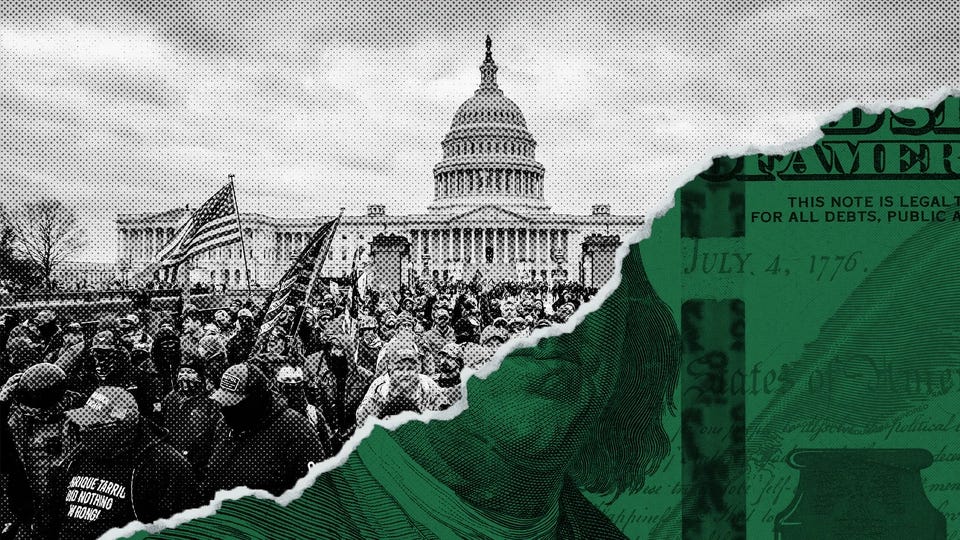
Trump keeps creating big headaches for his own party as we tick closer to November’s midterms. The public outcry over ICE had not even cooled before Trump launched a war of choice in Iran. And rather than address soaring gas prices, Trump announced he would seek $1 billion in public funding for his ballroom and would (checks notes) hand billions in public funds to criminals and insurrectionists through an unsupervised federal “victims” slush fund.
That announcement, along with anger over Trump’s primary challenges to intraparty critics in Congress, was too much for some lawmakers, who control the balance of power in a closely divided Congress.
On three separate questions in a few days, GOP lawmakers have said no, or close enough to no that it counts. This isn’t a dam breaking. But it is a dam beginning to crack.
Finding their balls over the ballroom
We know the disturbing history here. Trump demolished the historic East Wing of the White House last year to make way for a 90,000 square-foot structure—roughly the size of two football fields—that he claimed would be funded by “patriot donors,” including multinational tech giants and defense contractors.
The project is deep into construction, but Trump has two problems that Congress could solve for him. First, courts have raised serious questions about whether he had the legal authority to build on public land without congressional authorization. Second, the price tag has ballooned so far past its original estimates that he now wants public money to cover the gap, despite earlier promises that it would be privately funded.
Republican committee chairs with direct jurisdiction over White House property matters have gone silent. Rep. Bruce Westerman (R-AR) and Sen. Mike Lee (R-UT), who chair the relevant congressional energy and natural resources committees, declined to comment. Rep. Mike Simpson (R-ID), who chairs the House Interior appropriations panel, said the project wasn’t “in his purview.” Even Rep. Andy Ogles (R-TN)—the stalwart Trump ally who has proposed putting Trump’s face on Mount Rushmore and tried to change the Constitution to allow Trump a third term—told Politico he wasn’t aware of any legislation in process to authorize the ballroom.
Then came the funding ask. Senate Republicans, at the president’s behest, attempted to slip $1 billion for White House “security”—including $220 million specifically for ballroom security—into a larger budget bill. But four Republican senators publicly said no: Bill Cassidy of Louisiana, Susan Collins of Maine, Lisa Murkowski of Alaska, and Thom Tillis of North Carolina.
Then came the procedural hurdles. Senate Parliamentarian Elizabeth MacDonough ruled late Saturday that the $1 billion provision violated the Byrd Rule, the strict Senate requirement that reconciliation bill provisions have a direct budgetary impact and fall within the jurisdiction of the committees that drafted them. Thune’s office initially responded with a shrug: “Redraft. Refine. Resubmit,” framing it as a routine procedural setback. Trump, less sanguine, raged at MacDonough on Truth Social and demanded she be fired.
But as the week went on, the vote count problem became undeniable. Intraparty anger over the ballroom funding grew through Wednesday, and Politico reported it would be cut from the bill entirely. Sen. John Kennedy of Louisiana told reporters Republicans simply didn't have the votes.
The opacity of the project is a particular irritant to senators. Trump originally said the ballroom would cost $100 million and be privately funded. The price tag has since increased tenfold, and the project has expanded to include a multi-level underground complex. Cassidy, who told CNN this week he’d be voting no on the funding, captured the confusion precisely: “There’s no architectural plans. There is no environmentals. There’s no engineering. There’s no sense of—when we ask—how did it happen to cost exactly a billion. It could cost a lot less, it could cost a lot more. I just don’t get it.”
A $1.776 billion fund for… very aggrieved people
As much as the American people hate the ballroom, they’re going to hate the new insurrection slush fund even more.
The Department of Justice announced on May 18 the creation of a $1.776 billion “Anti-Weaponization Fund”—the dollar amount a none-too-subtle nod to the year of American independence—to compensate individuals who claim they were improperly investigated or targeted by the federal government. The fund grew out of a settlement of Trump’s lawsuit against the IRS over the leaking of his tax records, though the negotiated deal was cleverly crafted to keep the questions separate to avoid judicial review of the fund as part of the settlement’s terms.
Acting Attorney General Todd Blanche, who previously served as Trump’s personal defense attorney, said the fund would operate through a five-member commission reviewing claims of “lawfare.”
The first claimant to file was Michael Caputo, a longtime Trump ally and former HHS spokesperson, who is seeking $2.7 million. Enrique Tarrio, the former Proud Boys leader convicted of seditious conspiracy and sentenced to 22 years in prison for his role in organizing the January 6 attack before being pardoned by Trump, told Reuters he planned to apply, estimating he deserved between $2 million and $5 million. “I’m not greedy,” Tarrio said. “But my life was all f—ed up because of this.”
The pushback, even from within the GOP, came fast. Rep. Brian Fitzpatrick of Pennsylvania, a former FBI supervisory special agent representing a purple district that Democrats have targeted for 2026, sent a letter to Blanche raising “urgent concern” about the fund’s legal authority, funding source, eligibility standards and lack of congressional oversight. “This is not a unilateral executive decision,” Fitzpatrick told reporters. “If you’re dealing with appropriated money, that’s got to come through us.” He told reporters his plan: “We’re gonna try to kill it.”
Trump publicly warned Fitzpatrick that it “doesn’t work out well” for people who break from his agenda. Hours later, Fitzpatrick introduced a bipartisan bill with Democratic Rep. Tom Suozzi of New York called the Bipartisan Transparency for American Taxpayers Act, which would bar federal funds from being used to pay any claims submitted to the fund. These two sponsors understand that Congress holds the power of the purse, and the executive branch cannot manufacture a multibillion dollar compensation program without an appropriation from Congress.
The Senate fallout was even more dramatic. Blanche was dispatched to a Republican caucus lunch on Thursday to sell the fund to GOP senators. The meeting had been scheduled as a tribute to this weekend’s Indianapolis 500, complete with regional food and race regalia courtesy of Indiana Sen. Todd Young.
It did not go well. The session ran well over two hours, with the majority of Republican senators venting anger and pressing Blanche on the fund’s legal basis, who would qualify, and how the commission overseeing payouts would work. They left with fewer answers than when they arrived.
Sen. Lisa Murkowski told reporters the fund had been dropped like “a bomb in the middle of a pretty well planned out reconciliation bill.” Sen. Ron Johnson called it “a galactic blunder.” Sen. Thom Tillis called it “stupid on stilts,” then elaborated: “Taxpayer dollars will compensate someone who assaulted a police officer, got convicted—and now we’re going to pay him for that? This is absurd.”
Sen. Bill Cassidy, who by this point had already broken with Trump on the ballroom and the Iran war, tweeted that “people are concerned about paying their mortgage or rent, affording groceries and paying for gas, not about putting together a $1.8 billion fund for the president and his allies to pay whomever they wish with no legal precedent or accountability.”
Susan Collins, who said she opposed the fund in part because it could pay Jan. 6 rioters who had assaulted law enforcement, told the Times after the meeting: “It is in real trouble—and it should be.” Even barely-standing-on-his-own Mitch McConnell, the longest-serving Senate Republican leader in history, issued a statement that left nothing to interpretation: “So the nation’s top law enforcement official is asking for a slush fund to pay people who assault cops? Utterly stupid, morally wrong—take your pick.”
The collateral damage from the slush fund push was immediate. Senate Republicans had been on track to pass a $72 billion reconciliation package to fund ICE and Border Patrol—a top Trump immigration priority—before the Memorial Day recess. But the slush fund blew up that timeline. Thune sent his members home without a vote, punting the ICE and Border Patrol funding to June. A senior Republican aide told NBC News the ICE funding package “would have been passed, if not for the actions of the administration.”
What if they threw a war and Congress said no?
The most consequential break came Tuesday. It has been nearly three months since Trump first announced “major combat operations” against Iran on February 28, launching a massive joint U.S.-Israeli campaign against Iranian military, government, and infrastructure sites. He did not seek or obtain a declaration of war from Congress. He did not consult congressional leadership in advance. Congress has been voting on war powers resolutions to reassert its authority ever since and losing—until this week.
On Tuesday, four Republican senators—Paul, Collins, Murkowski and a newly liberated Cassidy—voted to advance a war powers resolution on Iran out of committee on a 50-47 discharge vote, the first step toward forcing Trump to end a war that Congress never authorized. The resolution still faces significant obstacles, including a final Senate vote, the House, and a near-certain presidential veto. But the votes are tightening as the war drags on, gas prices soar ahead of the summer driving season and the 2026 midterms approach.
In the House, the picture is now equally volatile. Even before this week, the fractures were showing. Rep. Don Bacon of Nebraska—a pro-interventionist centrist who had voted against past Iran war powers resolutions—told Axios he felt “very split” on the upcoming vote. “It’s a tough vote, because we have the Constitution and Article One authorities,” Bacon said. “The President doesn’t like it. Granted, he would prefer not to have Congress.” Rep. Jared Golden of Maine, the last Democratic holdout who had previously voted against Iran war powers resolutions, announced he would vote yes, noting it was past the 60-day threshold under the War Powers Act at which a president must terminate unauthorized military operations.
A war powers resolution on Iran deadlocked 212-212 last week, with Fitzpatrick, Thomas Massie of Kentucky, and Tom Barrett of Michigan crossing party lines to support it. A tie vote in the House means a measure fails—but only barely.
Then on Thursday night, House Republican leadership abruptly pulled a second Iran war powers resolution from the floor before its scheduled vote. The tell was a basic procedural vote on an unrelated bill—the Smithsonian American Women’s History Museum—that went down 204-216, with eight Republicans absent and six voting with the Democrats.
Leadership recognized the building mutiny and yanked the war powers resolution before it could come to the floor. Rep. Gregory Meeks of New York, the resolution’s sponsor, told reporters: “No question about it, we would have succeeded.”
Speaker Johnson then sent the House home for the long holiday weekend.
Why now, and what it means
The breaks described above aren’t random, and they aren’t all the same. They fall into roughly three categories, each with its own, often cynical logic. Together they tell a story about where the cracks in Republican unity are appearing.
The first crack is institutional—a belated defense of Congress’s core prerogatives against an executive that has been systematically routing around them. The war powers fights, the slush fund pushback and the ballroom authorization battle all touch on Congress’s core prerogatives, including the power to declare war and the power of the purse. When the White House makes an end run around Congress, it creates an opportunity for objection that even “loyal” Republicans can raise without appearing to oppose Trump on policy. Fitzpatrick, for example, isn’t arguing that alleged victims of government overreach don’t deserve redress, though that’s probably why he’s opposed. He’s arguing that Congress has to be the one to appropriate the money.
The second is self-preservation, and it’s doing a lot of heavy lifting. Fitzpatrick represents a swing district. The 2026 midterms are just six months away, and paying January 6 rioters with taxpayer money, slipping $1 billion for a gilded ballroom into a budget bill, and running an unauthorized war with no clear endgame are not winning themes in competitive districts. Even Karl Rove, writing in the Wall Street Journal this week under the headline “Gerrymandering Isn’t Enough for the GOP”—made the electoral case explicitly: “The more undisciplined the White House messages on war and the economy, the more at risk GOP candidates will be,” Rove wrote. “Gerrymandering helped Republicans. But the president’s actions are helping Democrats. That could give Democrats the House.”
The third category is, in a karmic—comic?—twist, entirely of Trump’s own making. Trump’s habit of kneecapping lawmakers who displease him has a paradoxical consequence. It removes the one lever that kept them in line. Primary them out or push them into retirement, and you’ve freed them. Sen. Bill Cassidy voted on Tuesday to advance the Iran war powers resolution after losing his Louisiana Senate primary last week—in large part because Trump endorsed his opponent. He is now in the final seven months of his Senate term, with no primary to fear, no future campaign to protect, and no more patience for a president who worked to end his career. Thom Tillis of North Carolina, who publicly opposed ballroom funding, announced he would not seek reelection after bucking Trump on the Big Beautiful Bill’s Medicaid cuts. Collins and Murkowski have long-established independence and safe enough seats to sustain it. These are not profiles in courage, exactly—they’re profiles in having nothing left to lose. But the effect is the same.
The professionals inside the Republican operation are not blind to any of this. One senior Senate Republican operative, speaking anonymously to Politico this week, put it bluntly: “Those so-called victories over the last couple weeks are just a mirage. They are self-owns. We’re not actually beating Democrats, and we’re not actually advancing legislation.”
Despite this pushback, we should remain clearheaded about what this does and doesn’t mean. Most Republicans remain firmly in line, even if the majorities on these votes are thin. The ballroom may yet get its billion. The slush fund may survive. The war powers resolution may never pass.
Yet the midterm pressures are only going to build. Something changed in the Republican caucus this week, and the cracks in the GOP dam are deepening and spreading.
NOVEMBER CAN’T GET HERE FAST ENOUGH! I’m so sick of and exhausted by this corruption! It’s so massive, so thoroughly pervasive, so “outraging” that I feel like I must have died and no one told me, and now I’m in hell. I’m not kidding. I was even pinching myself after trump was re-elected, wishing I was having a nightmare. (I’ve had to stop with the pinching. The bruises were starting to resemble trump’s mottled skin tones and I want NOTHING in common with that minion of Satan.)
"Despite this pushback, we should remain clearheaded about what this does and doesn’t mean. Most Republicans remain firmly in line, even if the majorities on these votes are thin. The ballroom may yet get its billion. The slush fund may survive. The war powers resolution may never pass."
Those still "in line" are showing their desperation by being firmly "in line". This is a decidedly defensive position and I would argue that most are more desperately looking for an off-ramp. Also, we must never forget that Trump's modus operandi (thank you Roy Cohen) is to double down, which as I've said before, only works until it doesn't (see Senator McCarthy and HUAC). Politics is a blood sport, but to succeed one must know when to use the carrot and not just the stick. Trump is incapable. He will alienate even more people offering more potential off ramps until he self-destructs. It's what he does. Always.