
“I don’t really care, do U?”
Trump’s recent indifference to very important matters needs to be seen for what it truly is.

In 2018, first lady Melania Trump boarded Air Force One bound for the Texas border, where migrant children were being held in cages under her husband’s “zero-tolerance” policy. On the back of her jacket, in large stenciled letters, appeared the words: “I really don’t care, do U?”
The White House claimed it was just a jacket. But it was nevertheless a jacket on the back of the First Lady, headed toward children in detention camps.
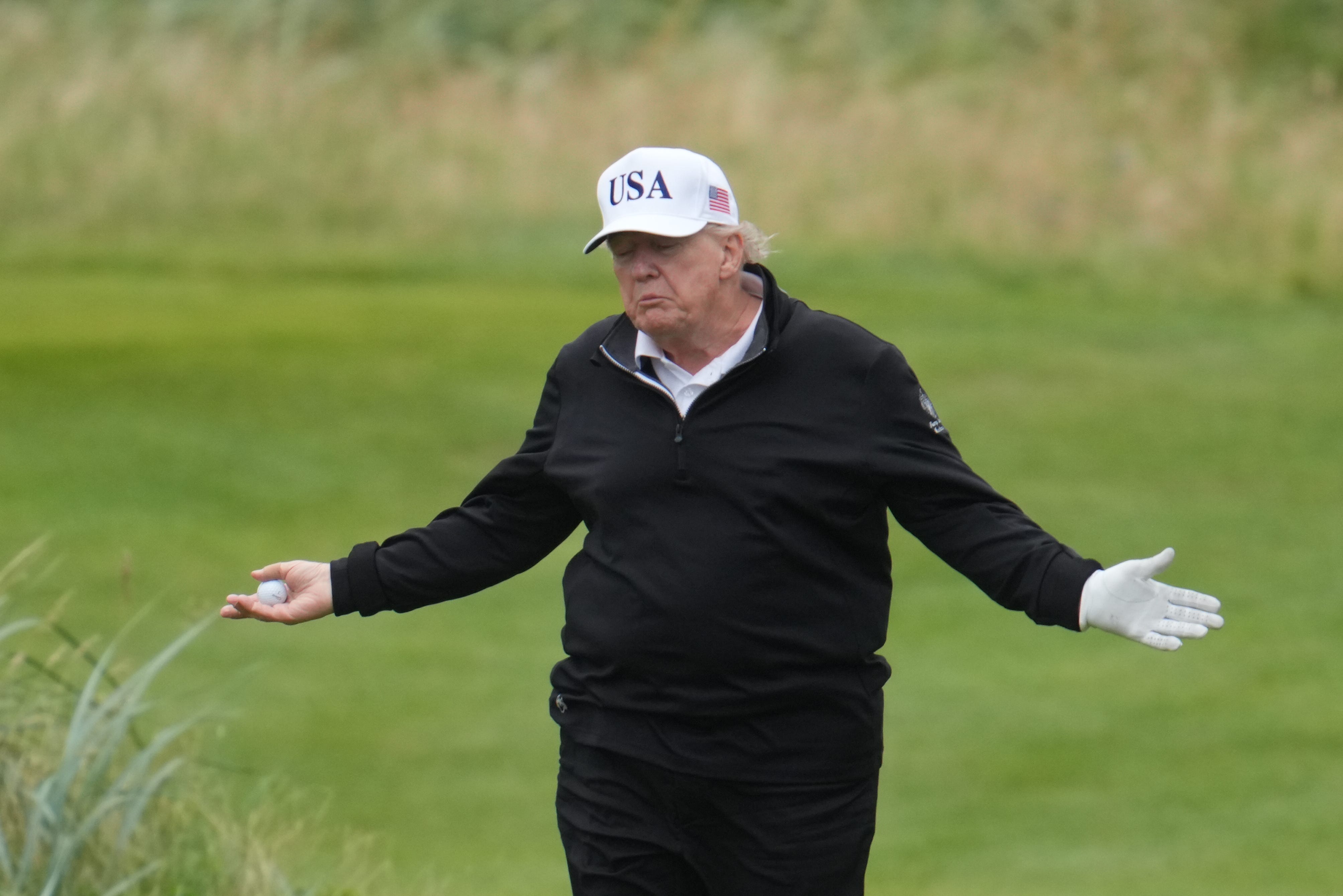
In 2026, it’s her husband drawing headlines for his “I don’t really care” messaging. We’re being trolled again—or manipulated, or both.
Trump has recently volunteered three remarkable statements. Asked whether Americans’ financial pain motivated him to strike a deal in the Iran war, Trump replied, “Not even a little bit. I don’t think about Americans’ financial situation. I don’t think about anybody.” When his approval rating on the economy cratered to historic lows, he told the New York Post, “I don’t care about polling. I have to do the right thing.” And when asked at a Cabinet meeting whether the midterms might pressure him toward a faster resolution of the Iran war, he declared, “I don’t care about the midterms.”
If you’re feeling vaguely unsettled, or even outright confused, hearing a president insist so nonchalantly that he doesn’t care about these objectively important things, remember this: Donald Trump is a con man, and we the public are his marks. His goal is to rob us blind and get away with as much as he can, plain and simple. And nearly everything he does can be understood through that basic framing.
In my youth, I learned how to play three-card monte, a sleight-of-hand game where the dealer can make nearly everyone watching guess the wrong face-down card. So I know a confidence game when I see one. Trump is running a similar shell game, one in which we never find the ball called accountability. He’s moving three shells around on his table and, transfixed, we lean in hoping to keep our eye on it.
“Aha! There it is!” But when he lifts the shell we’ve pointed to, accountability has vanished.
Trump uses three principal shells to hide the ball, each suited to a different challenge or setback. Together, they form a system, one deliberately constructed and consistently maintained to ensure that he never loses. He has engineered a reality in which losing, by definition, cannot happen.
The first shell: “Joe Biden! Democrats! NATO!”
This is Trump’s standard opening trick, and it costs him nothing to use. The basics are straightforward: when something goes wrong, it’s always someone else’s fault. The damage was inherited, or in some cases even engineered, by his enemies.
On the economy, the scapegoat is Joe Biden. White House Deputy Chief of Staff James Blair built the entire official economic framing around the supposed “hole” left by Trump’s predecessor, and it’s so prevalent that it appears not just in Trump’s rambling Truth Social posts but in official White House briefings.
On the war, the assigned villains are traitorous Democratic critics, Iran’s leaders or our feckless Western allies. The “Dumocrats” are undermining him. The mullahs failed to agree to a deal fast enough. Our NATO partners refused to send aid.
On the midterms, it’s Republican state senators who refused to redistrict mid-decade to wipe out more Democratic seats in places like Indiana. Trump was so angry about the Indiana senators that he made it his personal mission to primary and remove as many of them as he could.
But the shell has limits, and Trump knows it. Gas is up more than 40 percent since the Iran war that Trump himself chose to start. Trump understands that such a visible marker can’t be easily traced back to his predecessor, who left office eighteen months ago.
Time to shuffle in another shell.
The second shell: “The numbers are fake, the system is rigged!”
When assigning blame no longer does the trick, Trump moves quickly to denial. For him, it operates at two levels, depending on how bad the situation has become.
At the smaller scale, he discredits the data. A bad number is not evidence of a bad outcome; it is evidence of a bad actor. When more than three in four Americans told pollsters they were anxious about their finances, Trump responded on Fox News that the polling was “fake” and a “con job by the Democrats.” When his approval on the Iran war sank, the polls again were wrong. When his economic approval fell to its lowest recorded level—worse than during the peak of COVID in his first term—the methodology was biased.
At the larger scale, when individual numbers prove too stubborn to dismiss, he attacks the legitimacy of the entire system that produced them. The 2020 election demonstrates this. Trump didn’t construct his “rigged” narrative after he lost; he built it beforehand. That way if he won, the people had spoken. But if he lost, the people had been overridden.
The result was the same in either case: Trump could not truly lose, because losing had been redefined as something that only happens through fraud.
He’s running the same con with the 2026 midterms. In January, Trump told Reuters the country “shouldn’t even have an election” this year. He’d done so much, he argued, that the exercise was beside the point. Press secretary Karoline Leavitt said he was joking.
Maybe. But the joke seeded something real. Trump had placed the idea in the mind of his supporters that whatever result November produces exists within a system of questionable legitimacy. Seen in this light, his multiple attacks on our elections—including executive orders on voter ID and mail-in ballots, redistricting efforts across multiple states, and attempted nationwide voting rule changes, some blocked in court, others still moving—all serve the same function. If November goes badly for Trump, as is expected, the system is to blame and Trump is the victim, once again.
The third shell: “I didn’t want your stupid vote anyway.”
This is Trump’s last resort, and what we are seeing more frequently now. It’s the most revealing Trump move because he deploys it only when all else has failed: He couldn’t pass the blame, the numbers wouldn’t stop being terrible, and he couldn’t sufficiently delegitimize the system. The mistakes and damage are too visible and too self-inflicted. His solution? Retroactively “un-want” the goal.
He achieves this by announcing, in public, that the failed outcome was never even what he was after. You can’t hold him accountable, after all, for failing to achieve something he never wanted in the first place.
It is the most transparently childlike move in his repertoire, one every schoolyard bully who fails spits out at the end. “Oh yeah? I didn’t need your stupid lunch money anyway!” He’s just saying it from the White House.
Americans’ financial pain was never his metric, he claimed; it was only ever about Iran’s nuclear program. Bad polls don’t matter, only doing the right thing. And elections? They don’t weigh on his thinking on the war at all: “I don’t care about the midterms.”
This behavior has a name in the literature: pre-emptive surrender. Trump is conceding a goal in order to escape accountability for failing to achieve it. The surrender always arrives after failure becomes likely but before it becomes certain. It is a timed exit from accountability, executed in plain sight and, in classic gaslighting form, designed to make us feel like we’re the confused ones.
We wind up spending our energy wondering whether the indifference is genuine. That debate—does he care or doesn’t he?!—works as a great distraction, allowing him to palm the accountability ball and hide it from view yet again.
The tell
Trump claims not to care, but his behavior shows otherwise.
Take redistricting. When Indiana state senators refused to go along with his redistricting push, Trump raged on Truth Social, singling out two legislators by name and warning they could cost Republicans the House majority. “A VERY BIG DEAL!” Trump warned. He threatened—and brutally carried out—primary challenges against any Republican who voted the “wrong” way.
When dismissing his Iran war numbers, Trump’s response was a tell, too. He told the New York Post, “I think that the polling is very good, but I don’t care about polling.” In other words, he cares enough to consider the polling and to call it “good” even when it is most decidedly not. But his caring stops the moment the poll isn’t to his liking.
But the con is working. Politico reporters Alex Gangitano, Eli Stokols, and Megan Messerly wrote in March, “Fourteen months into a second term defined by the president’s heightened ambition and a dearth of dissenting voices, Trump remains in what can only be defined as YOLO mode.”
The New York Times ran a headline that read, “Trump’s Self-Indulgence Deepens G.O.P. Fears in Midterms,” reporting:
A little more than five months ahead of the midterm elections, President Trump seems to be focused on virtually anything other than keeping Republican control of Congress.
The collective framing assumes genuine indifference from Trump, not manipulation. That of course is exactly where Trump wants the conversation to land. The ball can’t possibly be under the “I don’t care” shell, right?
This takes us back to my first point: We should remember that this is all part of a scheme designed to rob the public blind while hiding the accountability ball. While it’s been going on, the Trump family balance sheet, by Sen. Bernie Sanders’s accounting, has grown by roughly $4 billion since the 2024 election.
Melania’s notorious sentiment from 2018 has now migrated from the back of a jacket to Trump cabinet meetings. Eight years later, it’s become a core part of his three-shell game. But once you see his tricks clearly, his shrugs over very important matters stop being so confusing. They start looking exactly like what they are: a con in progress.
My shock is that anyone EVER believed his shell game. None of the three shells you list moved or fooled me one bit towards believing him. Indeed, the first time I ever even noticed he was on the planet, I was a kid in Philadelphia. I remember he was in the middle of some bankruptcy or scandalous real estate rip-off, and he was being interviewed; he was so pompous, arrogant, smarmy and disingenuous, I disliked him immediately. I knew nothing about him but in my gut, I didn’t trust him. I couldn’t believe he was considered so successful by grown-ups.
That feeling has blossomed into full-blown hate this past decade or so, much in the last year. Full-blown hatred is new to me - I’ve never felt it so thoroughly and personally til now.
To be honest, I don’t like the feeling at all, so I avoid listening or looking at trump very long at a time. (Otherwise, I’d be totally broke by now from replacing all the TVs, computers and radios I’d smashed.)
One of the things that concerns me is that if the Republicans commit voter fraud in some key districts, the second shell, “The numbers are fake, the system is rigged" becomes part of the strategy in that it makes it more difficult for Dems to cry foul. I'd call this strategy brilliant, but I don't think it was its original intent, and nothing he does deserves to wear the air of "brilliance."