
In Shambles
The White House’s deplorable policies—including extrajudicial killings, informant handovers, and brazen lies about defendants—have finally caught up to it.

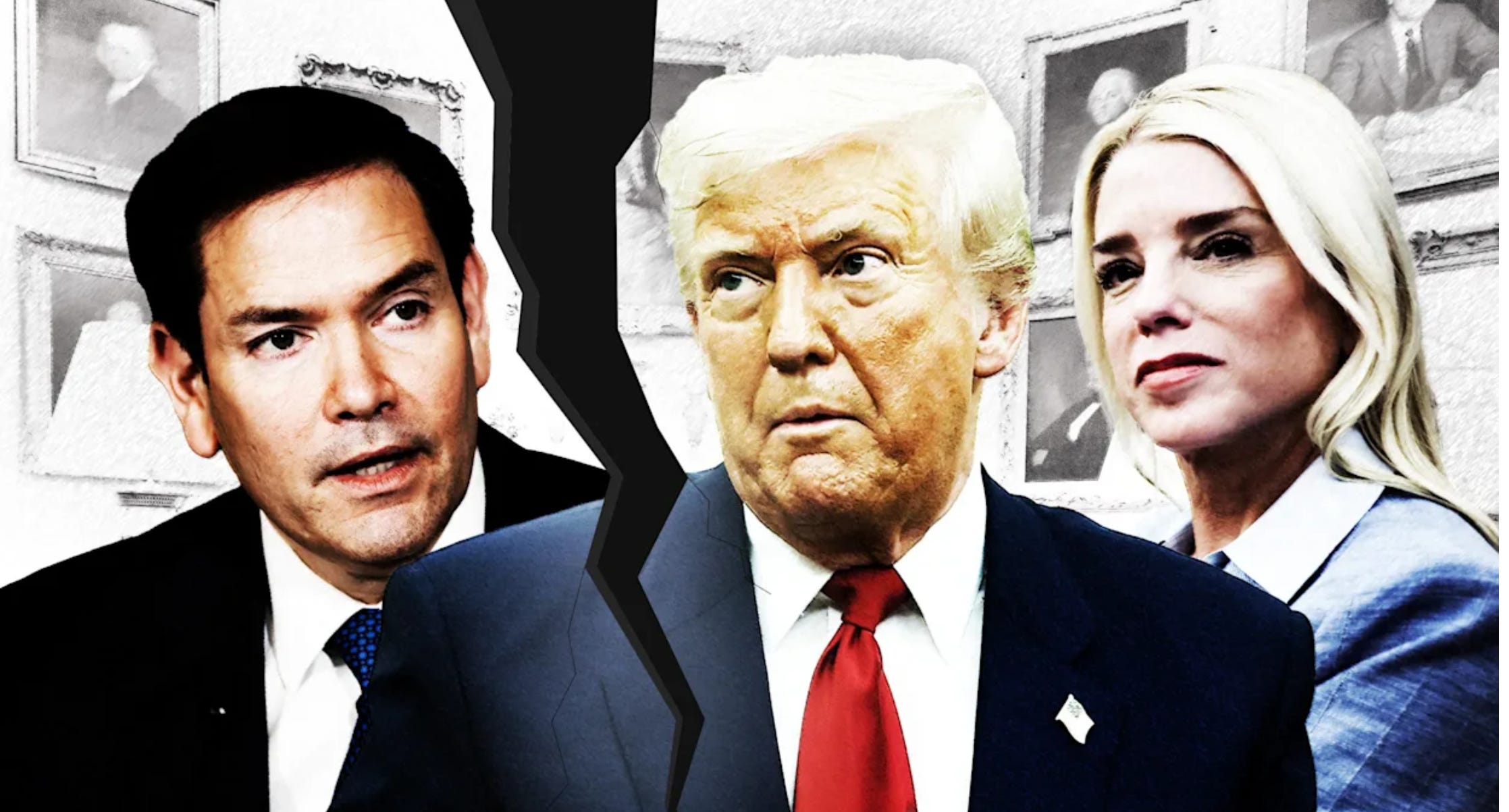
Three stories demonstrate how the Trump regime’s Central and South American policies are in shambles. Together, they highlight the chaos, illegality and sheer horror of the Trump regime’s policies there.
First, recent attacks in coastal and international waters by the U.S. military have reportedly killed civilians who were fishermen, not drug smugglers. In the latest assault, however, there were two survivors, raising the possibility that for the first time we may hear a response to the justifications proffered by U.S. forces.
Second, the Washington Post reported yesterday that Secretary of State Marco Rubio had secretly agreed to hand over MS-13 informants who were supposed to be under U.S. protection to El Salvador. The goal of this betrayal? The right to use President Bukele’s notorious CECOT prison to send deported migrants.
Third, the case against Kilmar Abrego García is now floundering. A judge found sufficient basis to believe García was vindictively prosecuted. Yesterday, 60 Minutes interviewed whistleblower and former Justice Department lawyer Erez Reuveni, who resigned after being ordered to lie to the court that García was an MS-13 gang member.
Each of these stories demands a closer look. Together they add up to a stack of lies, abuses and bodies piling up quickly.
A “lifelong fisherman”
Yesterday Colombian President Gustavo Petro publicly accused the U.S. of murdering Alejandro Carranza, whom Petro called a “lifelong fisherman.” Carranza’s vessel was adrift, Petro noted, and had its distress signal on when the U.S. military fired upon it.
Petro tweeted that “US government officials have committed murder and violated our sovereignty in our territorial waters. Fisherman Alejandro Carranza had no ties to drug traffickers and his daily activity was fishing.” He added, “We await explanations from the US government.”
Per reporting by Le Monde, “Carranza was reportedly killed in a September strike by US forces on his boat while he was fishing the Caribbean, according to video testimony of his family members shared by the president [on Twitter].”
It isn’t immediately clear why Petro chose this weekend to level accusations against the U.S. for something that happened a month ago. The leftist Colombian president’s relationship with the U.S. has become increasingly fraught as he continues to condemn U.S. policy in the Caribbean as well as in Gaza.
The public condemnation may also have to do with an attack over the weekend on another civilian craft, which the U.S. military described as a semi-submersible vessel carrying a load of fentanyl. (This region of the world does not produce much fentanyl at all; the primary illegal export from Colombia is of course cocaine.) Attacking and killing people on board any civilian vessel is an international crime. And even if those on board were involved in illegal activity, there is nothing permitting the U.S. military to use lethal force. Indeed, the fact that the U.S. military could launch a rescue mission for the survivors and take them on board indicates that they could just as easily interdict suspected vessels without committing murder.
To date, there have been no survivors of these attacks to dispute the U.S. version of events. But in this case, there were two, one of whom is a Colombian national, and both are being repatriated to their home countries, despite Donald Trump labeling them “terrorists.”
And that raises another serious question: If these were international drug smugglers, the U.S. would be within its rights to hold and prosecute them, though it is the normal practice of the Coast Guard to repatriate detained suspects for prosecution in their home countries. But if this administration was already willing to execute these men without charges or a trial, it seems counter-intuitive to release them—unless the government is afraid of what might happen should they be held, say, in military detention in Guantanamo.
After all, a federal court review of a habeas corpus petition on behalf of the men could call into question the entire U.S. policy in the Caribbean and the bogus justification for firing upon civilian vessels. With no bodies to summon before the judge—because everyone is either dead or in this rare case sent back home—there’s no case to bring.
The semi-submersible attack follows recent accounts that the U.S killed two men from a fishing village in Trinidad and Tobago. As The Guardian reported,
Relatives of two men from Trinidad believed to have been killed in a US military strike on a boat in the Caribbean have accused Donald Trump of “killing poor people” without due process and are demanding justice.
As further backdrop, Alvin Holsey, head of the U.S. Southern Command overseeing the Caribbean operation, recently announced he will be stepping down from his post, reportedly over the military’s attacks on civilian vessels.
The legality of the entire operation is under intense scrutiny, so the White House is trying to paper over its extrajudicial killings. As CNN reported,
The Trump administration has produced a classified legal opinion that justifies lethal strikes against a secret and expansive list of cartels and suspected drug traffickers, CNN has reported.
The opinion is significant, legal experts previously told CNN, because it appears to justify giving the president power to designate drug traffickers as enemy combatants and have them summarily killed without legal review. Historically, those involved in drug trafficking were considered criminals with due process rights, with the Coast Guard interdicting drug-trafficking vessels and arresting smugglers.
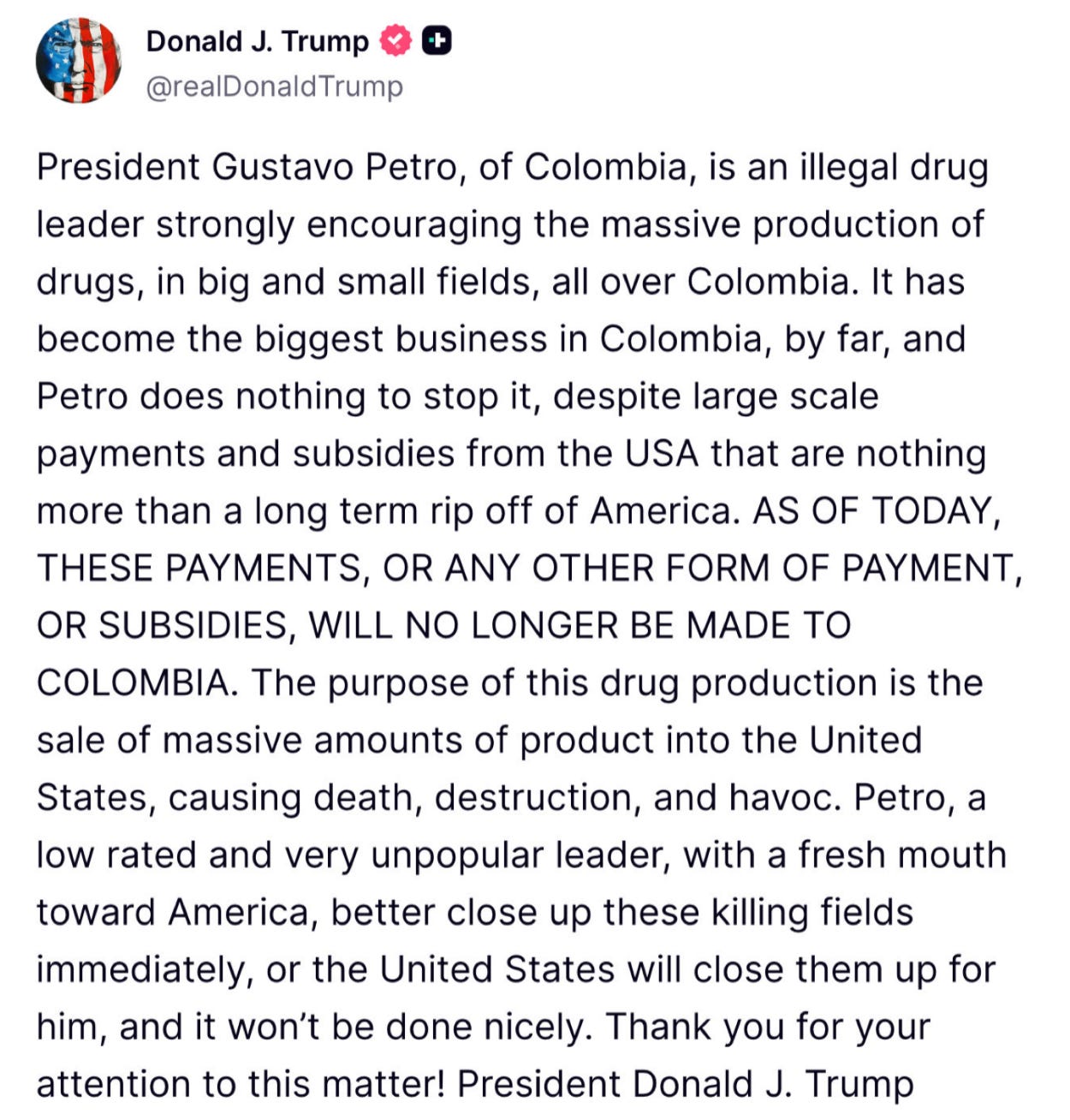
Trump took the most recent accusations of murder by President Petro poorly, as expected. Without denying the claim that Carranza was actually an innocent fisherman and not a drug smuggler, Trump cut off aid to Colombia and labeled Petro an “illegal drug leader.” This essentially puts Petro in the same bucket as President Maduro of Venezuela and on notice that he could also be attacked directly in the name of stopping drug trafficking.
“A deep betrayal”
A bombshell report yesterday by John Hudson, Jeremy Roebuck and Samantha Schmidt of the Washington Post put the entirety of the White House’s “MS-13” gang policy into stark relief. The deal that Secretary of State Rubio struck with President Bukele of El Salvador, unearthed by the reporting team, demonstrates just how far the Trump regime was willing to go to conduct and project its sadistic display of forced rendition. They write,
In the days before the Trump administration deported hundreds of Venezuelan immigrants to a notorious prison in El Salvador, the president of that country demanded something for himself: the return of nine MS-13 gang leaders in U.S. custody.
Secretary of State Marco Rubio, in a March 13 phone call with Salvadoran President Nayib Bukele, promised the request would be fulfilled, according to officials familiar with the conversation. But there was one obstacle: Some of the MS-13 members Bukele wanted were “informants” under the protection of the U.S. government, Rubio told him.
To deport them to El Salvador, Attorney General Pam Bondi would need to terminate the Justice Department’s arrangements with those men, Rubio said. He assured Bukele that Bondi would complete that process and Washington would hand over the MS-13 leaders
As Hudson noted, this betrayal undercut years of law enforcement work to arrest higher ranking MS-13 members. The informants had also reportedly divulged incriminating information about officials inside Bukele’s regime, which could explain his strong interest in them.
Officials who spoke to the reporters noted that nixing the informant agreements threatens to damage the Justice Department’s credibility (if it has any left at all), which routinely relies on such informants to build cases against higher-ups within criminal enterprises. One of the informants, César López Larios, was sent back to El Salvador two days after the March call.
“The deal is a deep betrayal of U.S. law enforcement, whose agents risked their lives to apprehend the gang members,” stated one U.S. federal contractor who investigated and helped dismantle the MS-13 gang.
It bears noting that Rubio ripped up these agreements so that the Department of Homeland Security could rush to deport a few hundred migrants it had rounded up. Many of these people, such as Kilmar Abrego García and make-up artist Andres Hernandez, were not MS-13 gang members at all, but were nevertheless subjected to terrorizing, brutal treatment while in CECOT.
As Tim Miller of The Bulwark observed, “The program was such a disaster that the admin stopped it” and “so now we gave away these informants for nothing.”
“That is a lie”
A federal judge in Memphis overseeing the criminal case of Kilmar Abrego García called the government’s position into serious doubt, issuing a rare finding that the plaintiff had demonstrated a sufficient evidentiary basis to show that he was the victim of selective and vindictive prosecution.
Judge Waverly Crenshaw issued his opinion on October 3, finding specifically that, as to the defendant, whom he refers to as Abrego,
The timing of Abrego’s indictment suggests a realistic likelihood that senior DOJ and DHS officials may have induced Acting U.S. Attorney McGuire (albeit unknowingly) to criminally charge Abrego in retaliation for his Maryland lawsuit.
Judge Crenshaw found that the defendant
has also presented evidence that the years-long delay in bringing Abrego’s human smuggling charges based on a traffic stop is atypical in this Circuit. The data presented shows that when compared to all of the criminal cases in the Sixth Circuit involving a traffic stop from August 19, 2010 to August 19, 2025, only Abrego’s charges were filed significantly—903 days—after the date of the traffic stop.
He concluded,
This supports his contention that there may be an improper motive for his prosecution.
The judge is permitting García to proceed with discovery into the basis for his prosecution, and it is now up to the government to rebut the presumption with “objective, on-the-record explanations” as to what happened. And that may present some serious problems.
As 60 Minutes explored in a very timely segment last night, DOJ whistleblower Erez Reuveni adds important context to this question. Consistent with his earlier complaint, Reuveni told a national audience that his superior at the DOJ ordered him to argue that Kilmar Abrego García was a gang member and a terrorist.
“That is not factually correct. It is not legally correct. That is—that is a lie, and I cannot sign my name to that brief,” Reuveni said. For that, he was fired from his job.
You can watch the whole segment here:
Reuveni stood on principle and shone a harsh light on the DOJ’s practices, with a warning for what could come next for the rest of us:
[W]hat was important was not whether or not Abrego Garcia was a member of MS-13 or a terrorist, but whether or not he received due process.
“What’s to stop them if they decide they don’t like you anymore, to say you’re a criminal, you’re a member of MS-13, you’re a terrorist,” Reuveni said. “What’s to stop them from sending in some DOJ attorney at the direction of DOJ leadership to delay, to filibuster, and if necessary, to lie?”
From the outset, it has been clear to observers—at least those who aren’t trying to kiss up to Donald Trump and Stephen Miller—that the regime was unwilling to undo the “administrative error” it had publicly acknowledged in this case after sending García to CECOT. Then it forced itself into an impossible position by falsely labeling him a terrorist and gang member and swearing he would never touch U.S. soil again.
Now it is humiliated once again, this time by its own acts of retributive prosecution, all ordered from the top, all designed to send a political message rather than achieve justice or actually keep Americans safe.
But this tactic is short-sighted. It only draws further attention to the ugliness of the DOJ’s prosecutions of other perceived political enemies of Trump, including James Comey and Letitia James, and how Trump’s sycophantic enablers have warped the Justice Department into a tool of vengeance and persecution for the Oval Office to wield.
As with its murderous policy in the Caribbean and its betrayal of confidential informants, the strategy around Abrego García is quickly unraveling. In each instance, principled officials are coming forward with receipts, and some are resigning and calling out the blatant lies and illegalities. That is building a record not only for appellate courts to find more compelling and unassailable, but for history to note when those who perpetrated heinous crimes against innocent victims are finally held to account.
These policies also serve as a dangerously eroded foundation for further military action in the region. Coupled with the utter lack of any strategic or long-term thinking, these horrific and often deadly practices serve as a uniquely troubling backdrop as the Trump White House grows eager to launch full-scale military assaults to attempt regime change in our hemisphere.
So much for the anti-war, America First, peacetime presidency.
It's as though he doesn’t give a damn about the rule of law, American security, human rights, or history. Oh, wait....
Jay - thank you!!! for this thorough, explicit and horrifying picture of what is really happening. Your extensive work in putting these daily pieces together so others see the full picture is astounding and much appreciated!