
King of the Sandbox
Trump made a big deal of his “takeover” of D.C. yesterday. But what does it actually reveal?

Programming note: Yesterday I mistakenly noted that I would be writing for The Big Picture today about the plans by Trump and the GOP to steal the 2026 election. That piece will now come out on Thursday. If you’re not subscribed to that substack, you can sign up for free (or as a valued paid supporter) here.
So, am I freaking out over Trump’s “takeover” of D.C.?
While his announcement is a troubling development, it’s also rather pathetic. To me, the move signals weakness instead of strength, desperation instead of confidence.
Trump wants us all to freak out, but I’m not here to oblige. Take a breath, keep an open mind, and I’ll explain what I mean.
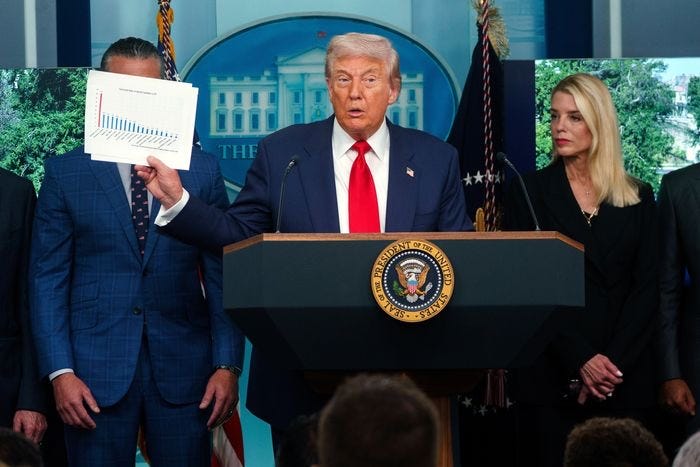
Yesterday, Trump called a press conference to rail against crime and homelessness in the nation’s capital. He declared he was seizing control of the police and sending in federal troops.
That sounds bad and scary. And so very Trumpian. Many correctly saw this as another escalation in Trump’s autocratic quest. Others also correctly saw this as another attempt to distract from the Epstein files.
It’s both of those things, but it’s also, politically speaking, a pretty weak maneuver. If this were a chess game, this is Trump moving the king around as some kind of threat. As I’ll explain below, it’s an allowable move, but not very significant in the larger picture. And Democrats likely can check him soon and force a retreat.
To understand why, we need to explore three main points.
Trump is probably acting within his powers
Unlike his orders sending troops into Los Angeles—an action likely in violation of the Posse Comitatus Act triggering a civil complaint by Gov. Newsom of California—Trump’s declaration yesterday likely does lie within his presidential powers.
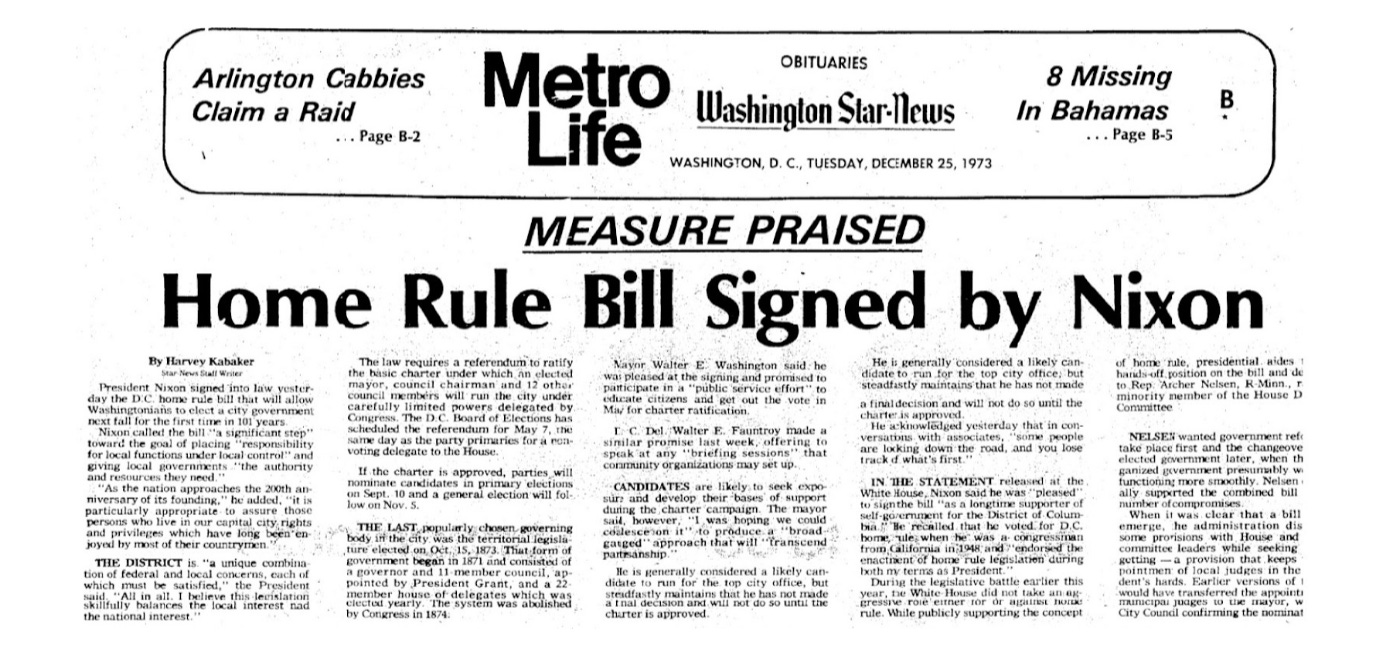
Specifically, the governance of D.C. is set forth in what’s called the Home Rule Act of 1973. That law permits the president to take control of the D.C. police if an emergency requires their use for federal purposes.
Now, admittedly, Trump’s “emergency” around crime is entirely bogus. We all understand that, just as his claims of an “invasion” by Tren de Aragua under the Alien Enemies Act and the “emergency” of a decades-long trade deficit justifying tariff hikes are entirely fictional.
But the authors of the Home Rule Act didn’t figure on a president acting wholly in bad faith, so they left the question of who gets to make the call of an “emergency” unclear. And that means whether the capital is experiencing a true emergency is likely up to Trump himself.
That said, his commandeering of the Metropolitan Police Department (MPD) is only permitted under the Home Rule Act insofar as Trump uses the police for “federal purposes.” That means, as Prof. Steve Vladeck of Georgetown University noted, “the President can borrow the MPD for his own priorities; but he can’t control how they discharge their other duties.”
In short, his decree does not lead to a total takeover of the MPD, however Trump wants to portray it. He can demand that they perform some work for federal purposes, but the rest of their jobs remain the same.
D.C. Attorney General Brian Schwalb isn’t accepting Trump’s decrees at face value. He pushed back in a statement:
The Administration’s actions are unprecedented, unnecessary, and unlawful. There is no crime emergency in the District of Columbia. Violent crime in DC reached historic 30-year lows last year, and is down another 26% so far this year. We are considering all of our options and will do what is necessary to protect the rights and safety of District residents.
Then there’s the matter of the D.C. National Guard, which Trump has also deployed. As a matter of federal law and policy, Trump does directly control this force and, per long standing Department of Justice policy, doesn’t have to federalize them before ordering them into action. On Monday, Trump ordered 800 of them to assist federal officers with their new crime-reduction mission.
While this is clearly an escalation and show of force, it isn’t an illegal use of his power, just a rather pointless one—much like his touted military parade that made him rather paradoxically look weaker than before.
The move also highlights how Trump actually had this power back on January 6, 2021 and declined to use it to quell the insurrection, when the additional troops really could have made a difference. It was never about then-Speaker Nancy Pelosi not authorizing back-up. Trump didn’t have to seek anyone else’s approval to order the D.C. National Guard into action yesterday. If anyone ever claims Trump had no power to call in the troops on January 6, point to Monday’s order as irrefutable evidence to the contrary.
Trump’s decree has an expiration date
Under the Home Rule Act, Trump’s control of the D.C. metropolitan police can only last 30 days, provided he notifies Congress of the extension before the expiry of an initial 48-hour emergency period. He has already provided this notice, but after a month Congress has to approve any further extension.
This provides a rare opportunity for Democrats to show their voters that they are standing up to Trump and curtailing his power. Thanks, Mr. President! Specifically, as Prof. Joyce Vance observed during her live chat last night with Prof. Vladeck, Senate Democrats could filibuster any bill to approve an extension and choke off Trump’s power grab after one month.
There’s an ambiguity Trump may try to exploit, however. At the end of the 30-day period, Trump may seek to extend his control by declaring another kind of emergency so that the state of emergency never really ends. A new declaration, the White House lawyers could argue, starts the 30-day period anew.
But that argument is highly vulnerable to legal challenge because it thwarts the spirit of the 30-day limitation and reads an absurdity into the Home Rule Act. Courts hate absurd readings of the law and should disregard interpretations that make the actual text of the law pointless. After all, why put in a 30-day limitation if the president can just get around it by endless different emergency declarations?
The federal judges who would hear the case are in the D.C. district, meaning many live and all work in the city. They know from personal experience that Trump’s claims about crime in the city are patently false, and it wouldn’t take much for them to rule that he only gets one 30-day emergency declaration to work with.
This limitation led Prof. Vladeck to conclude that the “takeover” is not much of one at all:
The upshot of all of this is that the President does have two important authorities when it comes to “local” law enforcement in the District of Columbia: He can use the (small) D.C. National Guard in circumstances in which he probably couldn’t use any other military personnel; and he can require the use of MPD “for federal purposes” for up to 30 days. That’s not nothing, but it also isn’t anything close to some kind of federal takeover of the nation’s capital.
A nothing burger?
Let’s not lose sight of the fact that Trump put Pam Bondi in charge of the commandeered MPD. Bondi has no real experience in policing and no clue how to actually reduce crime in the city. So expect a lot of performative nonsense. Perhaps we’ll get another “MacArthur Park” display of force that scares a bunch of kids and makes the military even more humiliated at being forced to act like local cops.
The fact is, violent crime in D.C. is at 30-year lows, as the Justice Department itself touted in January. And it wasn’t just the Biden Administration saying it. Just three months ago, Trump himself bragged about how crime had fallen in Washington, D.C. by 25 percent.

The National Guard isn’t trained as a police force, and D.C. isn’t some crime-ridden hellscape no matter how Trump wants to portray it. As Quinta Jurecic of The Atlantic described, the federal troops and officers may have little to do:
Footage from WUS9, a local news station, showed a pack of Drug Enforcement Administration agents lumbering awkwardly along the Mall in bulletproof vests as joggers streaked past. (For those unfamiliar with D.C., the Mall—a green expanse frequented by tourists and ice-cream trucks—is not exactly a hotbed of crime, especially on a sunny summer morning.) Near my quiet neighborhood in D.C.’s Northwest quadrant, federal officers have been patrolling a tiny park whose chief menace, in my experience, has been the occasional abandoned chicken bone scarfed down by my dog. Over the weekend, I watched a Secret Service car drive slowly in circles around my block. At first I assumed that the agents had gotten lost.
That’s the problem with ordering troops to tackle a non-existent issue. The federal troops in D.C. could wind up much like they did in California—sitting around doing nothing. As Jurecic noted, the White House quietly ordered most of the troops in Los Angeles withdrawn just weeks after being deployed, but only after demoralizing many of them. Some described the whole thing as a “fake mission.”
So what’s the purpose of any of this?
There is one worrisome aspect of this that we need to strongly consider. As attorney Marc Elias warns, Trump wants us to grow accustomed to the idea of troops in our cities and to normalize the use of the military as law enforcement. To this end he is operating a test run to see how far he can push things.
But notably, Trump failed to achieve the sense of a permanent military police presence in Los Angeles. Indeed, government witnesses spent much of the first day of the bench trial in California federal court arguing that the military was not engaged in police activity. As CBS News reported from the trial,
William Harrington, deputy chief of staff for the Los Angeles military deployment's task force, testified that he understood the federalized National Guard troops could not engage in civil enforcement activities, and everybody knew the Posse Comitatus Act applied.
This is quite a tell. Trump knows he has a clear way around the Posse Comitatus Act, and that’s by invoking the Insurrection Act. That law is an exception to the limits on using troops as police. It permits the president to deploy federal troops by essentially declaring an insurrection is in progress—perhaps in blue cities where troops are needed to put down “rebellions” against the government.
But so far, Trump has declined to attempt to invoke this power of last resort. He instinctively knows that if he tries it and he gets shot down by the courts, then he has no cards left to play. So he’s trying various other ways to show he is the strongman he imagines himself to be. These now include using his more or less undisputed powers under the Home Rule Act and over the D.C. National Guard to engage in grotesque displays of force.
But these moves are a long way from ordering troops, against the wishes of blue state governors, into cities such as New York, Chicago, Oakland and Baltimore. Trump fears the legal challenges this would inevitably bring, all originating in fairly liberal circuits. He also understands that his standing among independent voters would sink even further the more he acts like a despot. And he worries that the military will not appreciate constantly being used as a political tool.
One final point. The two cities Trump targeted already with federal troops—Los Angeles and Washington D.C.—both have Black female mayors. That is no coincidence. And the other three he mentioned by name during his presser—New York, Baltimore and Oakland—also have Black mayors. Trump’s fake claims of high crime rates simply cannot be separated from his naked racism.
Crime is down in all of these cities. In some cases way, way down. In Baltimore in particular, homicides are at a 50-year low, according to its young and charismatic mayor, Brandon Scott.

Sending in troops to solve non-existent crime problems will likely go the way of DOGE: a lot of chaos and pain at the outset, then a cold realization that the problems are not at all solved. The entire thing, just as we saw in Los Angeles, will be a waste of time and money, and, as always, at the expense of the most vulnerable communities.
Trump wants to look like a strongman, but when you get to the heart of it, he’s still just kicking sand around in the only city where he’s allowed to act that way.
And that reads as pathetically weak.
I love this piece! Everything else I’ve seen and heard seems to be panicking about Trump’s move. Thanks Jay for being the masterful chess player you are and calling him out for this rookie (though horribly racist) move.
“Trump didn’t have to seek anyone else’s approval to order the D.C. National Guard into action yesterday. If anyone ever claims Trump had no power to call in the troops on January 6, point to Monday’s order as irrefutable evidence to the contrary.”
It’d be nice if some of our wealthy political observers noted this and maybe even (shudder) asked him about it.
As for DC, note that the police chief is also a Black woman, who will now be overseen by a white man, which I’m sure is of no significance at all.
Anyway I’m so glad we didn’t elect a woman president. They’re so emotional that they’d be running around declaring an emergency