
MTG v. DJT
The NYT piece about Marjorie Taylor Greene’s split with Trump buries the lede—twice.

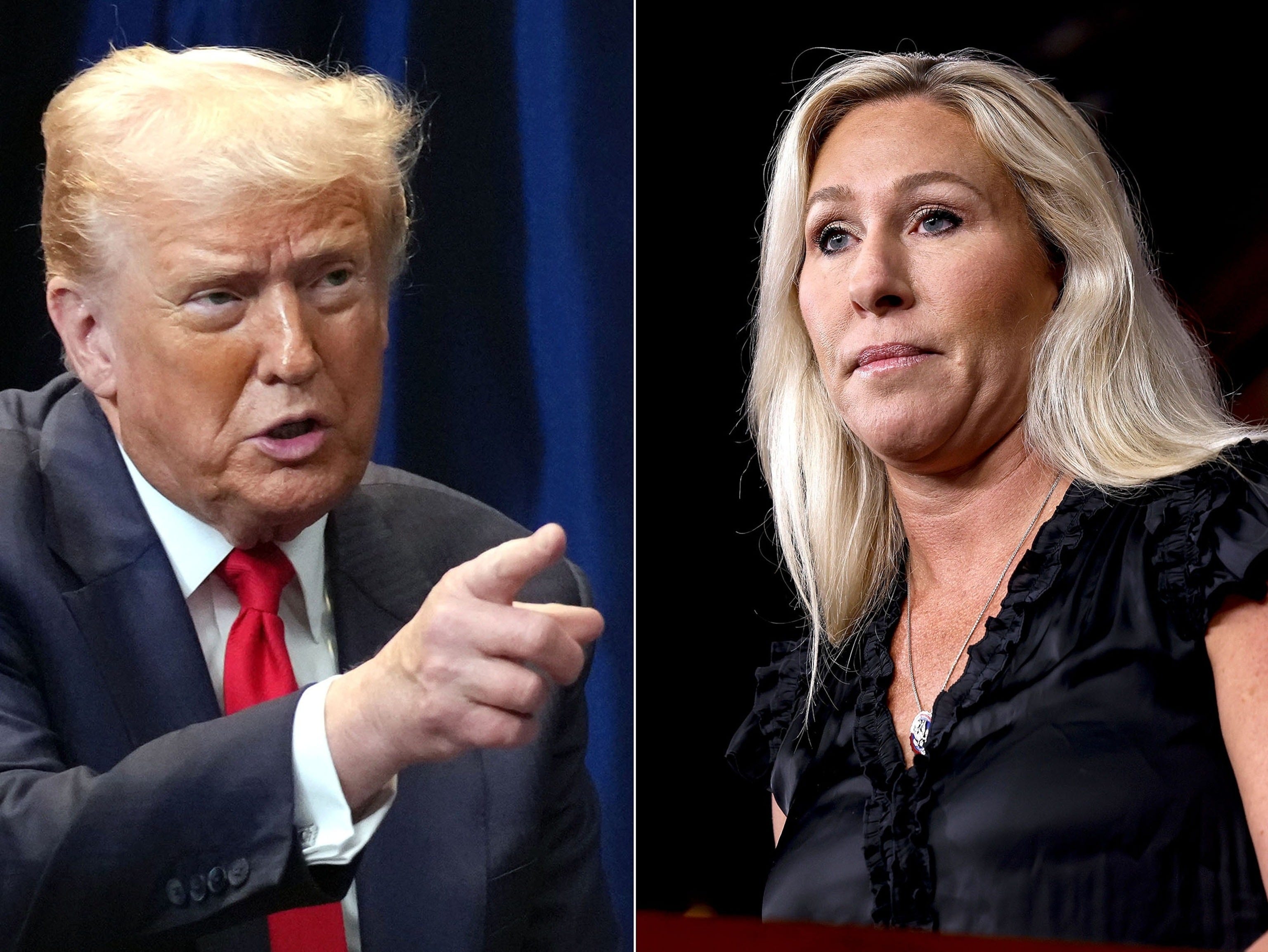
Yesterday, the New York Times published a detailed account examining Georgia Republican Marjorie Taylor Greene’s rift with her one-time idol, Donald Trump. It’s a fascinating and frankly disturbing read, but I wanted to draw attention to two items that should figure heavily into our assessment of Trump and the Epstein files.
The first shows how far Trump was willing to go to prevent the files’ release. And the second describes what Trump told—well, shouted to—Greene that the release would do.
It’s a holiday week, so I’ll keep this short. But we shouldn’t let these slide.
A death threat upon her son
The rupture between Greene and Trump came to a very public head when the president posted that she was, in his eyes, a “Traitor.” This immediately put a target on her—placing her in company with judges, prosecutors and ordinary civil servants who cross him or his plans.
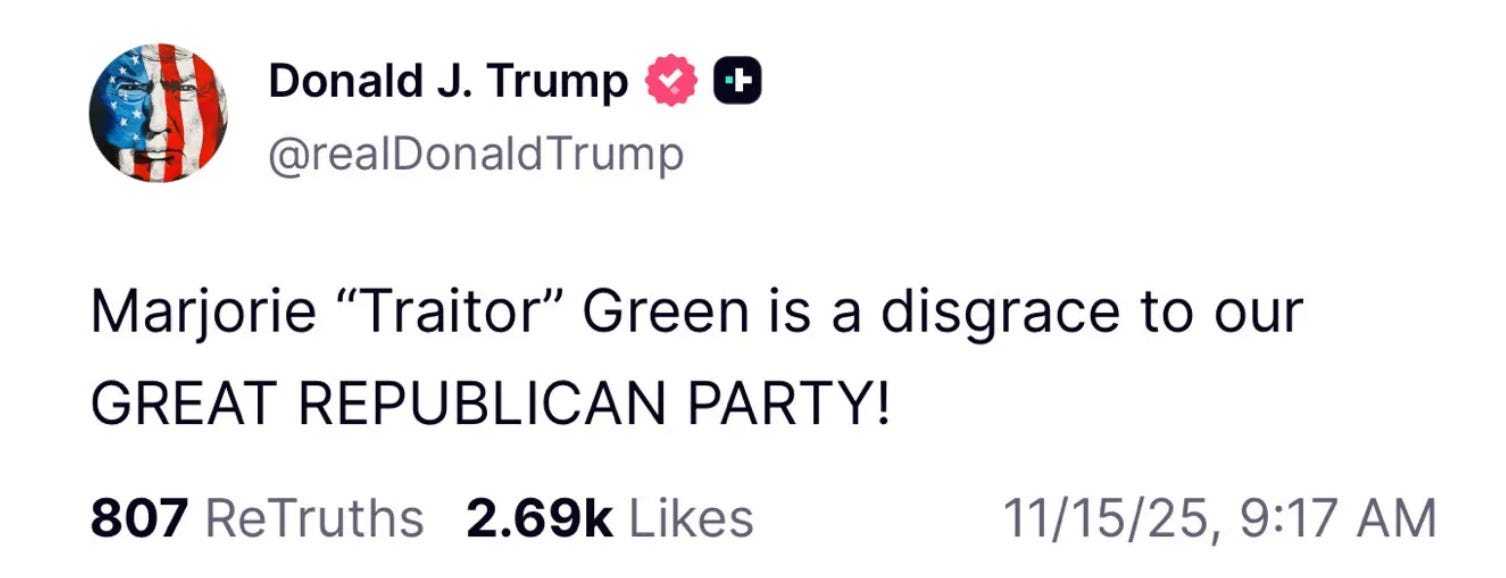
The timing was no coincidence. It overlapped with the ultimate success of the discharge petition to bring the Epstein Files Transparency Act to the House floor just three days earlier, once Mike Johnson was forced to finally swear in Rep. Adelita Grijalva (D-AZ) who provided the 218th vote. Greene was one of four GOP House members to sign the petition after refusing to budge for months. Trump was still smarting from that defeat when he lashed out at Greene.
It wasn’t long before the threats began. Per the New York Times, in addition to warnings upon her life and pipe bomb threats near her house, one was directed at her son, Derek:
Greene’s last exchange with the president was by text message on Nov. 16. That day, she received an anonymous email in her personal Gmail account that threatened her college-aged son: “Derek will have his life snuffed out soon. Better watch his back.” The email’s subject heading used the nickname Trump had given her the day before: “Marjorie Traitor Greene.”
Greene promptly texted that information to the president. According to a source familiar with the exchange, his long reply made no mention of her son. Instead, Trump insulted her in personal terms. When she replied that children should remain off limits from their disagreements, Trump responded that she had only herself to blame.
There are two possibilities here, both deeply disturbing.
The first is that the president himself ordered the threat sent to Greene. After all, someone knew enough about her that they had her son’s name and, importantly, her personal email address.
The second and, in my mind, more likely possibility is that Trump once again deployed stochastic terror, confident someone would act on it for him. Then, rather than disavow and investigate the threat upon Greene’s son, he blamed her for putting her own son’s life in danger and outright refused to keep the safety of her children out of their disputes. Any responsible leader would have publicly condemned the threat and told his followers to stop.
Trump didn’t do this because, like a mob boss, he wanted the pressure campaign to continue and to drive her out of Congress. His response amounted to, “Nice family you got there, would be a shame if something happened to them.” Greene announced her resignation five days later.
Threats upon family members of anyone who doesn’t toe the MAGA line are distressingly common on the right. But instances when the president himself drives the stake of fear deeper are less common, and we should take note when it happens.
So, what had Trump hoped to achieve by putting a target on Greene and her family, besides forcing Greene out? The actual House floor vote on the Epstein Files Transparency Act would take place just a few days later on November 18. Trump could have been trying to send as strong a signal as possible that his party should not support the bill, but it didn’t work. He had been outmaneuvered, and momentum for the bill was building.
On the eve of the vote, Trump switched gears and suddenly announced he was all for transparency, causing a sea change among the cowardly GOP. “House Republicans should vote to release the Epstein files,” he wrote on Truth Social, adding “it’s time to move on from this Democrat Hoax.”
The Act passed by a vote of 427 to 1, and then by unanimous consent in the Senate.
It was then that Trump switched tactics and his DOJ began releasing illegally redacted Epstein files, which now number over a million new files that were miraculously discovered.
Trump’s “friends” are in the files
Donald Trump is not good at cover-ups. And he shows it again here. Back when Trump and Greene were still speaking, he told her directly what the Epstein files contained. Per the Times,
Greene held a news conference at which she threatened to identify some of the men who had abused the women. (Greene says that she didn’t know those names herself but that she could have gotten them from the victims.) Trump called Greene to voice his displeasure. Greene was in her Capitol Hill office, and according to a staff member, everyone in the suite of rooms could hear him yelling at her as she listened to him on speakerphone. Greene says she expressed her perplexity over his intransigence. According to Greene, Trump replied, “My friends will get hurt.”
This revelation is a step further for Greene. During her 60 Minutes interview earlier this month, she revealed that Trump said the release of the Epstein files was going to hurt people. She didn’t reveal that these “people” were Trump’s “friends” until the New York Times piece published yesterday.
With this newly revealed admission by Trump, uttered within earshot of others in Greene’s office, he is one step closer to the precipice. While most rational observers already believe that Trump is using the Epstein files cover-up to protect himself, he couldn’t exactly say that to Greene. So he blurted out another truth, in the heat of their argument: He knows—and is friends with—people in those files.
This stands to reason. Trump partied with Epstein for years, and the powerful men who raped and assaulted the girls Epstein trafficked would have been at those same parties, in those same circles. Of course, those same friends, some of whom could be among the ten Epstein co-conspirators the FBI referred to within internal communications, could also tell authorities what they know and saw with respect to Trump himself. “My friends will get hurt” implies that Trump’s friends could be named, charged and pressured to reveal what they know.
The files released to date continue, in defiance of the law, to redact the names of those co-conspirators and perpetrators, and not just the victims. Among these redactions are likely the identities of some of the “friends” Trump referenced while shouting at Greene to back off from naming names.
But these names are coming out. Indeed, some of them are already publicly known from prior disclosures or DOJ incompetence (or sabotage?) during the redaction process.
Yet it’s not enough to simply announce who they are. At the very least, the ten co-conspirators must testify before Congress, especially once the Democrats retake control of the House. As part of their testimony, they should explain how they know and are friends with Donald Trump, and what they know about what he did with Epstein.
Trump has no friends, just people who enable him and know where the truth is hiding in the Epstein files.
“The Trump-Epstein Files”