
No Means No, Donald
In case after case, Trump has refused to accept the judgment of the legal system.

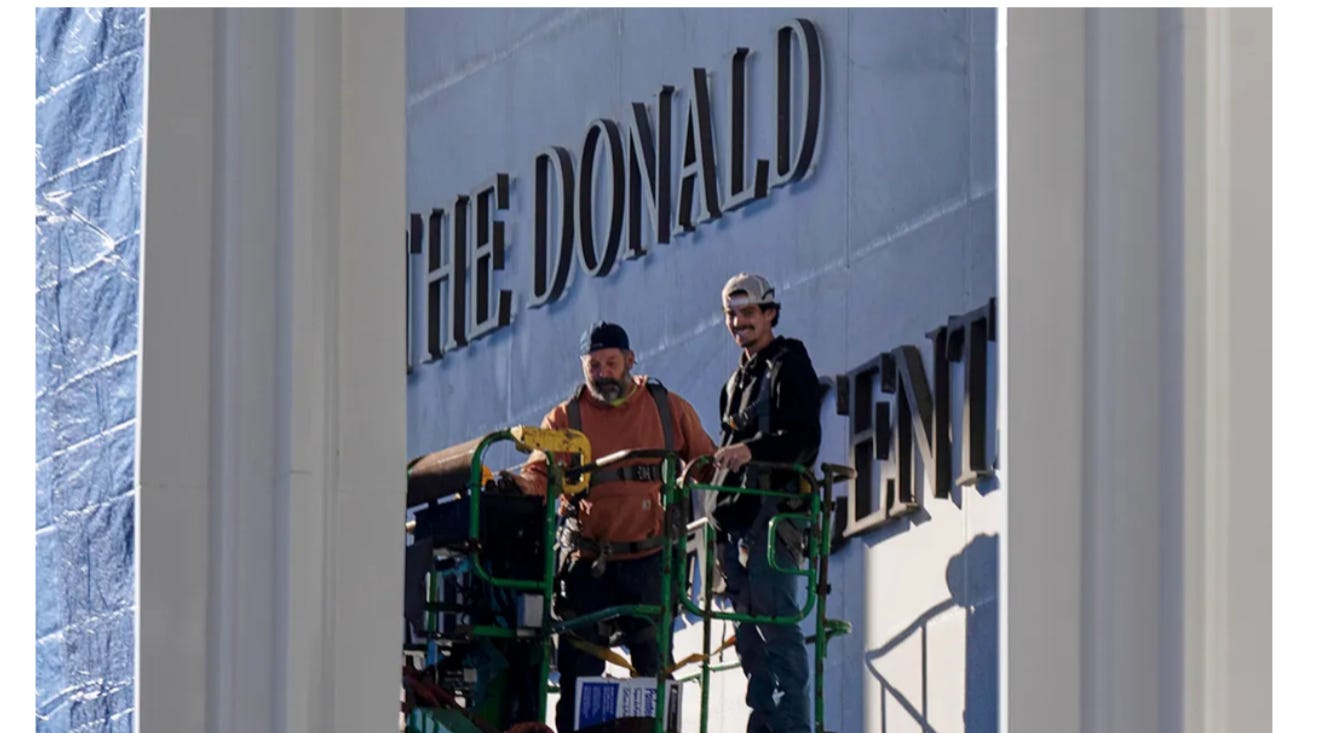
The Kennedy Center’s board voted Thursday to carve Donald Trump’s name into the building, even though a court just told the board it couldn’t rename it. The planned inscription will read “Restored and Renovated by President Donald J. Trump,” set beneath the Center’s official name. The board directed staff to get it done by “all legal means.” The board also voted, again, to shutter the main building for two years of renovations, though a smaller annex will stay open for limited programming. Trump reportedly phoned into part of the virtual meeting himself.
It’s a marble-and-brass part of a much larger pattern. Trump loses in court, but rather than accept the result, he looks for a gap he can squeeze through to reach the same outcome. The Kennedy Center example is relatively easy to follow, and it illustrates the same game now playing out with his “Liberation Day” tariffs, his fight over the E. Jean Carroll judgment awards, his obsession with the Reflecting Pool, and even his latest attempt to destroy birthright citizenship.
“Beyond Comprehension”
Trump filled the Kennedy Center’s board with loyalists not long after taking office, and by December 2025, that board had voted to rename the institution “The Donald J. Trump and The John F. Kennedy Memorial Center for the Performing Arts”—yes, multiple uses of “The.” Letters went up on the facade within a day, over objections from Kennedy family members including JFK’s niece Maria Shriver, who called it “beyond comprehension.” Rep. Joyce Beatty, an Ohio Democrat who sits on the board as an ex officio trustee, sued, arguing the board had no authority to do this and that she’d been muted and stripped of her vote for objecting.
In May, U.S. District Judge Christopher Cooper agreed with her on both counts. Congress had named the Kennedy Center, he ruled, and therefore only Congress could rename it. The renaming was unlawful and unenforceable. He also blocked the board’s plan to close the building for two years, calling that decision “ill-informed and seemingly preordained.” Trump responded by attacking Cooper personally and suggesting he should be impeached. His name came off the facade in June after an appeals court declined to intervene, though the signage remained hidden behind tarps because, well, Trump is a huge baby.
The government is still appealing Cooper’s ruling. But Thursday’s vote didn’t wait for that appeal to be resolved; it just sought a way around the ruling. Rather than rename the Center outright, the board is now inscribing a credit line. It’s not a prohibited “name change,” the board argues; it’s an acknowledgment of a renovation.
Whether that distinction holds up is now something a federal judge will have to decide. But the board’s own resolution directing staff to act by “all legal means” makes clear the goal is the same one the court already rejected.
A “backup plan”
Trump claimed that emergency powers permitted him to impose sweeping “Liberation Day” tariffs on nearly every U.S. trading partner. But the Supreme Court told him no.
In February, the justices ruled 6-3 that Trump had no authority under emergency powers law to impose the tariffs. Trump called the ruling a “disgrace” and told aides he had a “backup plan,” CNN’s Kaitlan Collins reported from inside the meeting.
That backup plan turned out to be a moving target. Within days, Trump imposed a new 10 percent tariff on nearly all countries under Section 122, a provision capped by statute at 150 days, which expired in July. By July, the White House had layered on a second set of tariffs under Section 301 of the Trade Act, targeting dozens more trading partners. The same legal group that beat him at the Supreme Court has already sued again over them.
Then in July, with Section 122 about to lapse, Trump unearthed authority that had sat unused for its entire 96-year history: Section 338 of the 1930 Smoot-Hawley Tariff Act. He used it to invoke a new 50 percent tariff on select Canadian goods. Trade lawyers call its use untested and expect an immediate court challenge if it’s pushed further.
The end result is that the tariffs the Court struck down in February are gone in name only. Trump’s underlying goal of exercising tariff powers Congress did not intend to give him has survived, migrating from one legal theory to the next as each one is challenged or runs out the clock.
A “Fake Case”
Trump continues to deny ever assaulting or defaming E. Jean Carroll despite two civil jury verdicts to the contrary. He has fought both for years. But in what should have been the end of that case, the Supreme Court also told him no.
In June, the justices declined to hear his appeal of the $5 million verdict. It was the last stop in years of litigation, and by his own lawyer’s account, “the end of the line.” Carroll has since received the $5 million award, plus interest. Trump is separately asking the Supreme Court to overturn an $83.3 million defamation judgment. With accrued interest on that judgment, his total liability to Carroll has climbed above $100 million.
The man still hasn’t accepted reality. Trump called it a “Fake Case” and vowed to keep fighting what he termed a “Witch Hunt,” and his lawyers immediately moved to delay releasing the funds that a court had already ordered paid, asking the Supreme Court to reconsider its own refusal to hear the case. But that kind of request rarely succeeds. The High Court has granted only one such request since 2018, and it typically only does so when something has genuinely changed since the original denial. Carroll’s attorney, Roberta Kaplan, told the court that “each of those efforts has been denied in full” and asked that the stalling finally stop. The effort failed, and the judgment, with accrued interest, was released to Carroll in July.
Unfolding the umbrella
Trump insisted for months, without evidence, that vandals had damaged the newly renovated Lincoln Memorial Reflecting Pool. His obsession led federal prosecutors to indict ex-Olympic canoeist David Hearn on a felony charge over it. But then his own prosecutors told him no.
In late July, U.S. Attorney Jeanine Pirro’s office moved to drop the case, telling the court that Interior Department records showed the damage came from a botched contractor installation, not vandalism. Prosecutors dropped related charges against three other defendants days later.
Trump didn’t accept that outcome either. He publicly said Pirro had “choked” and “folded like an umbrella,” and the White House has since pushed the Justice Department to find a way to charge Hearn again, possibly with a misdemeanor, so it wouldn’t need to go back to a grand jury.
If that sounds familiar, blame a Subway sandwich. Last year, prosecutors under Pirro tried the same downgrade against Sean Dunn, aka the “sandwich guy,” who threw a hoagie at a federal officer after a grand jury refused to indict him on a felony. A jury acquitted Dunn anyway on the misdemeanor. Hearn’s co-counsel, Norm Eisen, declared that reviving his case “would mark a shocking first: Bringing back from the dead a case that the DOJ lost by its own admission that it lacked the evidence to convict.”
“Ending it a different way”
Trump claimed he could end automatic citizenship for children of undocumented immigrants or temporary visa holders born on U.S. soil. The Supreme Court told him no.
In June, the justices ruled 6-3 to strike down Trump’s January 2025 executive order, with only five justices holding that the Constitution actually guarantees birthright citizenship. Chief Justice Roberts wrote the majority opinion; Justice Kavanaugh supplied a sixth vote against the order but only on statutory grounds, explicitly declining to say the Constitution required the result.
Then five weeks later, Trump tried again. In early August, he signed two new executive orders narrower in scope than the one the Court struck down. One carved out categories like children of foreign-government employees and “alien enemies,” and the other targeted “birth tourism” visas. While signing them, Trump said of the ruling, “I thought we were going to win it at the Supreme Court. Unfortunately, we had a bad decision, very unfair decision. Our country suffers because of it and we’re ending it a different way.” The ACLU’s Cody Wofsy pushed back, declaring that any order that tries to rewrite birthright citizenship “will meet the same fate as the last one.”
Still not cooked
There’s a reason this pattern with Trump keeps repeating, especially when the Court leaves Trump any kind of opening rather than a flat no.
Take the case of Lisa Cook. In June, the Supreme Court blocked Trump’s attempt to fire the Federal Reserve governor, not by ruling outright that he lacked cause to fire her, but that she was entitled to notice and a chance to respond first. Chief Justice Roberts explained why the Fed gets this kind of protection at all: letting Trump fire Cook at will “would in effect transform the Federal Reserve’s for-cause protection into at-will employment — an interpretive leap out of step with the statute Congress enacted and our Nation’s tradition of central banking protected from political interference.” (Why this doesn’t apply to other positions established by Congress and granted for-cause protection is a stark logical contradiction that continues to threaten the very independence of federal agencies.)
Ignoring this warning, in August, the White House sent Cook a letter reviving the same unproven mortgage fraud allegations, giving her three weeks to respond. The allegations predate her appointment to the Fed Board, so it is hard to see how they could constitute cause for removal. And they describe behavior Trump himself has reportedly engaged in with respect to mortgage loan applications. This time, the White House provided the notice and opportunity to respond that Cook argued were missing before, even if the underlying cause for termination remains highly suspect.
Harvard Law School professor Richard Lazarus observed that this move by Trump doesn’t “repudiate” the Court’s opinion, but it “certainly confronts it by challenging its limits” because the underlying justification for firing Cook remains just as unproven as it was the first time.
Trump has issued the same challenge to the limits of our judicial system with the Kennedy Center, his tariffs, the Carroll case and the Reflecting Pool prosecutions. Georgetown Law professor David Super noted that historically “most presidents treated Supreme Court rulings as dispositive of the issues involved rather than as technical documents to be evaded.” But not this president.
Trump learned this approach from his formative mentor in New York, attorney Roy Cohn. The take-no-prisoners aide to Sen. Joseph McCarthy is widely credited with—or rather blamed for—counseling a young Trump to always attack, consistently deny everything and never, under any circumstance, admit defeat.
Cohn lived by that code to his bitter and painful end. Weeks before he died in 1986, while still hiding his sexuality and a terminal AIDS diagnosis, Cohn was disbarred by a New York appeals court for unethical conduct, including misusing a client’s escrowed funds and lying on a bar application.
He never once conceded he’d done anything wrong.
To call him a whiney baby would insult babies everywhere. He is simply the neediest, weakest, stupidest, worst person in my lifetime. He is completely without any positive qualities.
He's a convicted rapist. Rapists don't understand "no means no," nor do they wish to.