
Pattern of Failure
Operational failures with deadly consequences are deepening a credibility gap and eroding political support for the war in Iran, the president and the GOP.

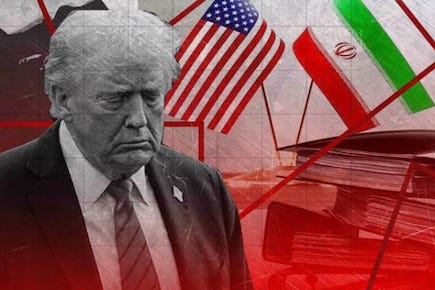
Headlines about the war in Iran piled up last night, making it difficult to fully digest what was happening, other than a general sense that the war isn’t going well. Two American soldiers are dead in Jordan, with a third killed in Iraq. Oil is spiking toward $90 a barrel again. The Houthis are threatening a new blockade. Even Fox anchors sounded confused about how Iran’s military, which Trump insists has been obliterated, is still killing American soldiers.
Taken individually, each story reads as a separate piece of bad news. Zooming out, they form a pattern of failure this White House has now repeated three times since February: an operational setback on the ground, followed by a credibility gap between what officials claim and what the public can see for itself, then a further erosion of political support for the White House and its war.
Operational failures pile up
At least 17 U.S. service members have been killed since fighting began Feb. 28, per Reuters. Two of those deaths were confirmed Monday: the soldiers killed at Muwaffaq Salti Air Base were 1st Lt. Tyler James Feehan, 25, of Ewa Beach, Hawaii and Pvt. Isabella Gonzales, 19, of Carrollton, Texas.
A third serviceman, Sgt. Michael Emmanuel Swinton, 30, of Fayetteville, North Carolina, died separately in northern Iraq on July 18 during the controlled detonation of unexploded ordnance from a downed Iranian drone, and a fourth service member was wounded in the same incident.
The deaths are the most visible cost, but they’re not the only one straining the war effort. A Pentagon official told the Washington Post that U.S. forces lack sufficient THAAD interceptors to safely sustain the air campaign against Iran, and the Center for Strategic and International Studies estimates Patriot, THAAD and Tomahawk stockpiles could take three years or more to rebuild at current production rates. Congress now has an $87.6 billion supplemental request in front of it. That’s more than triple Defense Secretary Pete Hegseth’s own $29 billion estimate of the war’s cost just a month earlier.
The problem is compounded by the fact that the war is spreading, including to a front the White House doesn’t control directly. Yemen’s Houthis declared a maritime embargo against Saudi Arabia this week, threatening to close off a Red Sea shipping route Saudi Arabia has relied on since the Strait of Hormuz shut down. The Houthis are more than a Yemeni faction; they’re one of Iran’s most reliable proxies. The Islamic Revolutionary Guard Corps has armed, trained and advised the group for over a decade. Iran has funneled drones, anti-ship missiles and precision-strike ballistic missiles through them, according to the Council on Foreign Relations. The embargo announcement essentially means Tehran has opened a second maritime front by proxy, without itself striking a single tanker in Hormuz.
The world’s eyes had been on Hormuz, but now they may be on a single pipeline far west of it. With the Strait of Hormuz effectively shut for months, Saudi Arabia has been routing crude overland through the East-West Pipeline, built in the 1980s for precisely this scenario. It runs to the Red Sea port of Yanbu, moving several million barrels a day that would otherwise have to transit Hormuz. That workaround has kept a full-blown global supply shock at bay. A Houthi blockade at the Bab el-Mandeb Strait, the Red Sea chokepoint that oil has to pass through to reach Asian and European buyers, would cut off that relief valve entirely.
Iran also struck U.S.-aligned Kurdish forces in Erbil, Iraq, the same week, with Iraqi air defenses shooting down the drones involved. Jordan stated that it also shot down 10 Iranian missiles on Saturday.
The credibility gap widens
If the operational picture is straining, the story the White House tells about it is fracturing on multiple fronts, including over injuries to American service members that the Pentagon never publicly disclosed.
According to the New York Times, in the week before Friday’s attack that killed two soldiers, Iran carried out three additional strikes against U.S. forces in Jordan that injured dozens of service members and damaged several helicopters. That made three strikes by Iran that the Pentagon never disclosed to the public. They came to light only after U.S. officials described them to the Times on condition of anonymity.
U.S. Central Command’s own public statements about retaliatory airstrikes never mentioned the earlier hits on Jordan. Chief Pentagon spokesman Sean Parnell has pushed back on the idea that this amounts to concealment, calling such claims “fabrications meant to further distress the American people,” and noting the Pentagon’s casualty database is updated regularly. But that database only shows aggregate figures. It doesn’t break out the mass-casualty incidents in Jordan the Times identified, and the number of casualties since July 7 has climbed to nearly 100, according to Parnell’s own account.
Four Iranian strikes on U.S. forces in a single week, three of them kept quiet, are hard to square with the idea that Iran has been militarily neutralized, as Trump often claims. Even Fox hosts had trouble squaring that claim with the reality this weekend. Maria Bartiromo pressed former Trump national security adviser Victoria Coates on air about the contradiction, and Coates acknowledged Iran’s capabilities are “lessened, but not zero.”
Trump’s own words aren’t helping. Asked about the weekend’s deaths, he said the country “feels very badly” about the soldiers killed, then, in nearly the same breath, described Iran as having lost almost everything militarily, with very little left to fight with.
Oil traders don’t appear to believe the “almost nothing left” version either. Brent crude jumped nearly 4% overnight and briefly crossed $90 a barrel after confirmation that at least three U.S. service members had died in the latest fighting, before easing back to $88.87.
Americans, of course, don’t need a White House briefing to notice gas prices. They can watch the numbers rise at the pump in real time. And it’s not hard to see the cause.
Three times since February, Trump has announced that the fighting was ending. Three times, it started back up. The first came March 26, when he paused strikes on Iran’s energy infrastructure for what he called a good-faith gesture toward talks. But the pause barely held through the weekend before the Houthis opened a new front by launching missiles at Israel.
The second came April 7-8, with a Pakistan-brokered two-week truce that Trump extended on April 21. The lull lasted longer, but the ceasefire broke down as talks in Islamabad collapsed and Washington answered with a naval blockade of Iranian ports.
The third came June 17. The parties even ceremoniously signed a 14-point memorandum of understanding that lifted the blockade, reopened the Strait of Hormuz and opened a 60-day window for a permanent deal. The agreement survived just eight days before an Iranian drone struck a ship in the Strait on June 25, and it collapsed for good on July 7 when an Iranian vessel struck three commercial ships transiting Hormuz.
The political damage worsens
That gap between claim and reality is costing the White House political support, not just credibility. A Republican-controlled Congress has voted twice to rein in a Republican president on his ill-rated war, and collapsing poll numbers are bleeding into the midterm map.
Congress has noticed the pattern, and it’s not just the Democrats. The House passed a war powers resolution June 3 by a vote of 215-208, with four Republicans crossing over to join Democrats. Three weeks later, the Senate passed its own version 50-48, with Sens. Bill Cassidy, Lisa Murkowski, Susan Collins and Rand Paul breaking from their party. It was the first time such a resolution had advanced in the Senate after seven earlier attempts failed.
The White House moved fast to contain the damage: Trump berated Senate Republicans at a closed-door lunch the next day and, according to multiple sources, called Cassidy a “lunatic,” while Vice President JD Vance and special envoy Steve Witkoff were dispatched to personally brief the senator that afternoon. By that night, Cassidy and Paul had flipped their votes on a separate, nearly identical resolution, sinking it 47-50-1.
Both outcomes are nonbinding, and operations continued regardless. But a White House that has to deploy its vice president and a special envoy to talk two senators out of a symbolic vote is spending real political capital just to avoid a second rebuke from its own party.
Polling shows why Republican confidence is cracking. An Economist/YouGov poll this month put Trump’s approval at 37%, with 57% of Americans saying the war was the wrong decision. That’s up from 51% in April. Only 18% of Americans believe the U.S. achieved its goals in the conflict, according to a separate Strength In Numbers/Verasight poll, and Democrats now lead the generic congressional ballot by seven points among registered voters, 50% to 43%.
Less than four months from a critical midterm election, a war that was supposed to demonstrate U.S. strength is instead the issue voters cite most often when they say they want change.
The pattern of failure is now the story. More deaths and injuries, depleted weapons stockpiles, tens of billions already spent with huge costs still looming, and an expanding front that no one seems able to contain all feed a widening credibility gap between what the White House says and what Americans can see for themselves. Anger over a disastrous war of choice is showing up in congressional votes and polling, and it could easily carry over to the ballot box in November.
I'm currently envious of countries where it is possible to call snap elections and hold votes of no confidence so people can replace leaders early rather than be stuck waiting for months and years if a politician goes off the deep end.
None of this is funny, but I did have to snicker when MS NOW showed a brief clip of Fox "news" performers looking absolutely baffled at how a country that has been "obliterated" is still able to kill U.S. troops. Their befuddlement looked so genuine, as if everyone on the planet hasn't already figured out that what Agent Orange says MAY not be 100% truthful.