
Taking the Wins
There’s good news to report on many fronts, and we should not only enjoy them but understand what they mean going forward.

Look, I get it. There’s a lot of doom and fear in the news headlines these days. It has worn me down covering it daily, and I’ve had to take breaks from my feeds and tabs just to stay sane. The doom cycle can so reshape our perceptions and outlook that when objectively good news pops up, it’s tempting to discount or even dismiss it.
But we shouldn’t. When there are positive developments, we need to highlight and celebrate them. It is not only important to give credit and thanks where they are due, but also, from a strategic standpoint, to understand why they succeeded so that they can be replicated and scaled going forward.
So on this Friday of yet another long week, let’s take the wins.
ICE announces it is ending its Minneapolis surge
When Tom Homan came in as a replacement for Obergruppenführer Greg Bovino in Minneapolis, he signaled that there would eventually be a pullback of federal forces there.
“We’ll believe that when we see it,” was the understandable response. After all, ICE continued, if not upped, its roving forces and its illegal detentions and arrests. As I’d written earlier, this is typical of forces that are about to retreat. After all, they never want to be seen as surrendering from a position of weakness.
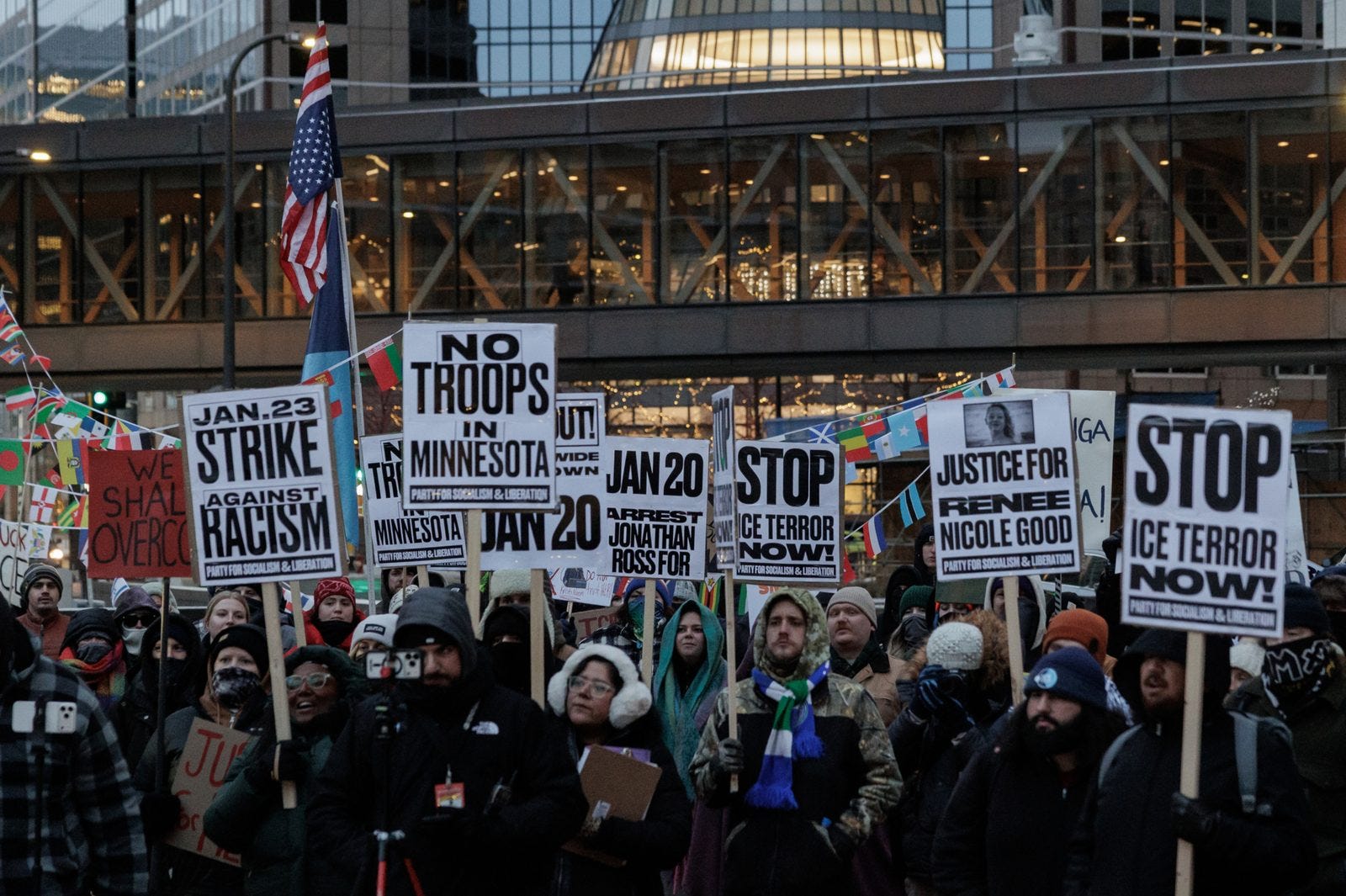
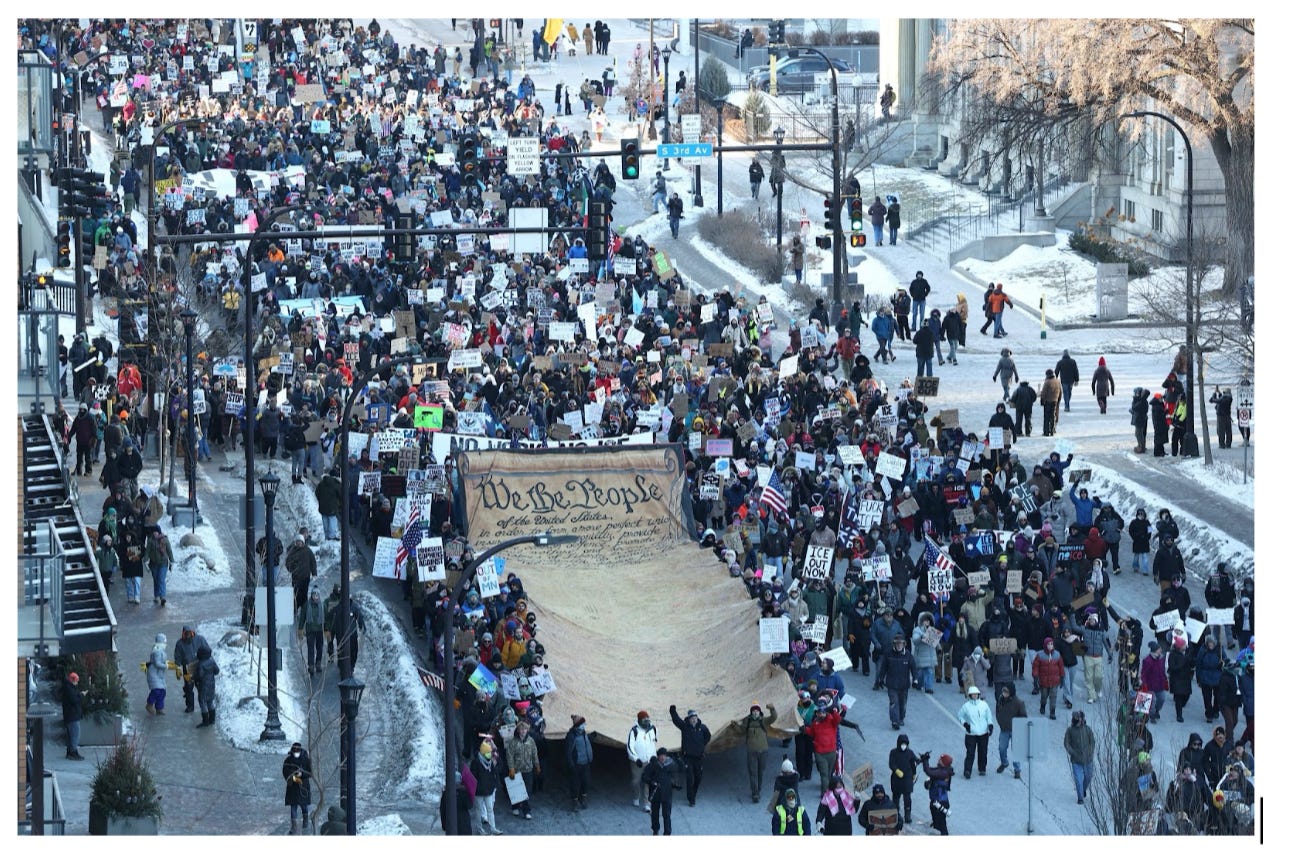
But the fundamental reasons Homan was sent in and Bovino was sent packing remained. The people of Minneapolis had demonstrated a sustained commitment to resisting ICE and CBP actions through tracking, observing, documenting and warning about federal immigration enforcement across the city. They used whistles, communication apps, community organizing and their own cars and bodies to make detentions and arrests harder to conduct. And they turned out by the tens of thousands in subzero weather to make their voices heard.
Yesterday, Homan announced that DHS would be ending its surge in Minneapolis and that forces would be withdrawn over the coming weeks.
The city of Minneapolis fought valiantly and tirelessly for weeks to resist federal forces and protect their neighbors. Some of them lost their lives. That ICE is now pulling back is a major win.
Sure, the drawdown could still stall or reverse. Nothing that this regime says should be taken at face value, and we should monitor the pullout carefully. But ICE’s decision to retreat has been savaged by the right as a humiliating loss. Wrote Mike Davis for Fox, in a piece entitled, “Why surrender is not an option for ICE’s Minnesota mission”:
If Republicans cave to this insurrectionist and seditionist behavior, they will send an unequivocal message to every purple-haired SSRI addict in the country: domestic terrorism works. Caving will incentivize more radical leftist violence across the country. If leftists learn that they can use violence to make ICE withdraw in Minneapolis, they will employ the same strategy across America.
Davis’s definition of “violence” and his aversion to purple-haired protestors notwithstanding, he and others on the far right are apoplectic over the loss and appearance of surrender. And we should take that as a great sign.
The announcement also gives hope and a path for other cities that could face the same. Indeed, Mayor Jacob Frey of Minneapolis met this week with Mayor Zohran Mamdani of New York City to strategize about how to apply the lessons from the Minneapolis ICE surge. Frey told reporters the meeting was about making sure “what happened in Minneapolis does not happen in other cities.”
“Mayors work together,” Frey said. “We’re all operating in the reality business, and the reality is, what just happened with ‘Operation Metro Surge’ is not constitutional, is not okay, and is anti-American.”
Leaders in Minnesota aren’t satisfied with DHS’s retreat from their state either. Senator Amy Klobuchar and Governor Tim Walz both publicly demanded accountability for what took place, including the economic, psychic and blood toll that the surge exacted. There is still no justice for the murdered victims, the investigation remains politically tainted, and many residents illegally detained and transported to concentration camps have yet to be returned home.
The hard work continues. But the battle goes to Minneapolis and its brave people.
Fissures within DHS widen
Earlier, I wrote about how DHS “institutionalists” like Tom Homan are at odds with “optics”-obsessed officials like Kristi Noem, Greg Bovino and Stephen Miller. While all of them share the same vile goal of racist mass deportations, there is a deep division over how to achieve that—one that has big implications for how DHS will operate and interact with the public.
The optics people have been losing because, simply put, the optics in Minneapolis (as well as Chicago, Portland and Los Angeles) have been terrible. As a television and social media personality, Donald Trump fundamentally understands this, which is why Bovino is out and Homan is in.
But it’s not just Homan. Yesterday, Acting ICE Director Todd Lyons and CBP Commissioner Rodney Scott testified before the Senate. There, they proceeded to throw Kristi Noem under the bus through testimony undercutting her false and defamatory claims about Renee Good and Alexi Pretti, whom she had leaped to label “domestic terrorists.”
Ranking Member Gary Peters (D-MI) of the Senate Homeland Security Committee asked both officials directly whether they had provided Noem with any assessment that Pretti was engaged in an effort to inflict mass casualties and “domestic terrorism.”
“Is that why she said that?” Sen. Peters asked. Both men responded “no.”
He then asked whether anyone who reports to either of those men provided that assessment to Noem. Both responded in the negative, to their knowledge.
Sen. Peters asked the logical follow-up. “Why would she tell the public that this was an act of domestic terrorism, right in the heat of the moment? How would she possibly come to that kind of conclusion, to tell the American public that, when they’re watching this video?”
Scott responded, “I can’t speculate on what someone else would say or why.” Lyons responded the same.
Sen. Peters noted that this was now a really big question, and it means they need to have Secretary Noem before them to answer why she made that assessment.
I suspect that the answer to this question, based on what Noem has said, is that Stephen Miller and Donald Trump told her to label them that way. “Everything I’ve done, I’ve done at the direction of the president and Stephen,” Noem recently told reporters.

Democrats hold firm on no DHS funding
Yesterday, Senate Democrats, along with some Republicans but without the help of Sen. Jon Fetterman (D?-PA), blocked DHS funding just before tonight’s deadline. This move is the latest in a string of Democratic successes in using what leverage they still have to pressure ICE to implement basic but key reforms to make it operate like every other law enforcement agency in the U.S.
That began with a carving out of DHS funding from the rest of the “minibus” funding bill that funded the parts of the government that still require appropriations bills. The White House agreed to the carve-out, forcing Speaker Johnson to back down after long insisting that there would be no carve-out, and that Democrats would have to shut down more than half the government to defunded DHS.
DHS got a two week reprieve, but that ends at midnight tonight, and there is no path forward to prevent a shutdown of DHS since Congress has left for the long weekend and the parties remain far apart on any deal.
It’s important to note that the loss of funding will not affect ICE, which already received $75 billion in funding through special appropriation language in the GOP budget bill. And ultimately, it’s possible that moderate Democratic senators who currently oppose the bill eventually peel off and vote for it later, as they have before.
But that isn’t the present reality, and so for now, most of Noem’s department gets no more money. That’s important sand in the gears and it keeps the spotlight on Noem and her department as the one part of the government that remains entirely held up because of the way its agents are acting in the field.
Federal court losses in D.C.
This week, the White House suffered three back-to-back losses in the D.C. courts over its treatment of prisoners, deportees and even a sitting U.S. senator.
Chris Geidner highlighted these losses in his newsletter, so I’ll just summarize what happened.
Inmates who were retaliated against over Biden’s commutations sue and win. Former federal inmates whose death sentences were commuted by President Biden to life without parole challenged the Trump administration’s attempt to transfer them to the high-security federal prison ADX Florence — a move they argued was retaliatory and violated their rights. U.S. District Judge Timothy Kelly (a Trump appointee) ruled that the Justice Department likely used a “sham” process in implementing that transfer plan as part of wrongful retaliation, siding with the inmates and blocking the transfer.
Alien Enemies Act deportees receive a due process remedy. The Trump administration’s use of the Alien Enemies Act to deport Venezuelan nationals resulted in deportations to El Salvador without meaningful legal process. Chief Judge James Boasberg ruled that the regime must provide a proper process for reviewing their habeas challenges, either by allowing them to return to the U.S. for hearings or enabling them to supplement their claims remotely. Boasberg criticized the government’s refusal to propose any remedy and held that the deportees’ constitutional rights had been violated.
Sen. Mark Kelly (D-AZ) wins the first round in his free speech challenge. Sen. Kelly sued the Department of Defense and Secretary Pete Hegseth after the Pentagon took punitive steps over a video Kelly and other lawmakers released reminding military personnel about their oath to refuse unlawful orders. U.S. District Judge Richard Leon found that the Defense Department had violated Kelly’s First Amendment rights. He rejected its argument that Kelly needed to go through military appeals first and ruled that extending certain military speech precedents to this context was inappropriate. Judge Leon issued an injunction protecting Kelly’s speech.
Whenever I post about legal wins, there are always comments that the wins don’t matter because the appellate courts and the Supreme Court could undo them later. I understand the frustration.
But this misses an important point. The fact that these might eventually get reversed ignores that each loss before the federal courts matters. They put the regime on the back foot. Now it has to fight to undo an injunction rather than move forward with nefarious business as usual. And each loss further demoralizes and erodes the credibility of DOJ lawyers, which is already at such a low as to render much of Trump’s punitive and vengeful agenda impractical or even impossible to pull off.
In sum, we should take the wins I discussed here because they are real losses for the other side. They push back on the regime’s fascist project and force it to retreat and regroup. That buys important time as we count down to the midterms and the high possibility that control of at least one chamber of Congress will flip.
It’s not only okay to feel good about each win, it is vital that we do. That energy, and sense of achievement through hard and painful effort, is what will power us to victory in November.
We have to celebrate our wins to keep our sanity. Thank you Jay!
Lawsuit wins don’t matter is, by and large, doomer stuff. There is no magic button or wand that will fix everything that is broken. It is going to take work and time to create a more effective country that serves its citizens.
Great work and write up, Jay!