
The Birthright Precipice
After Tuesday’s Supreme Court rulings, a cherished constitutional right is now hanging by a thread—and the GOP intends to sever it.

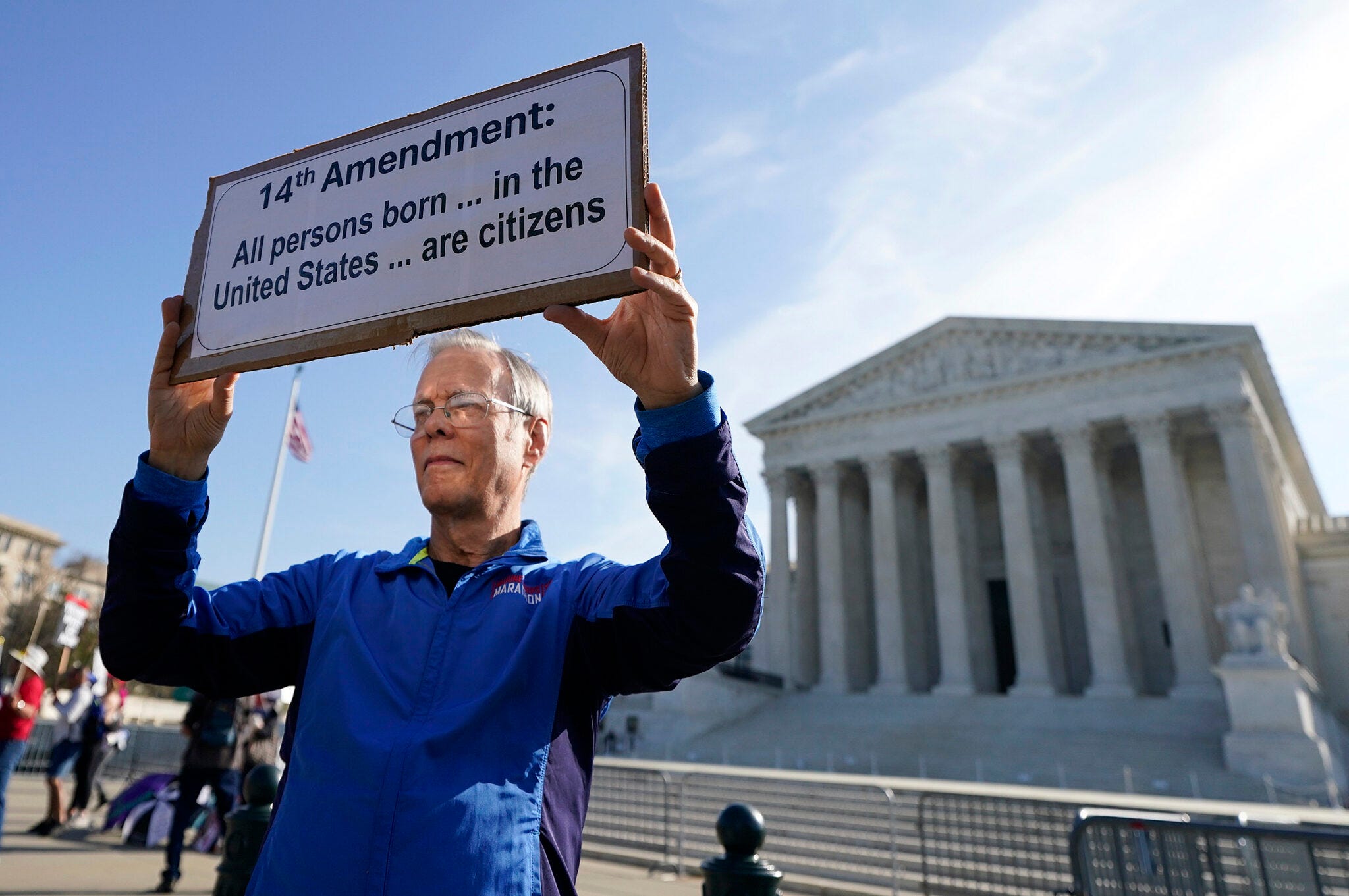
On Tuesday, we breathed a collective sigh of relief. As expected, the Supreme Court struck down Donald Trump’s executive order seeking to end birthright citizenship. The vote was 6-3, with Chief Justice John Roberts writing the majority opinion.
“Citizenship, then and now, was the right to have rights—to freely participate in our political community,” Roberts declared. He added, “The Framers of the Fourteenth Amendment extended that promise to ‘every free-born person in this land.’ We keep that promise today.”
The relief was short-lived. Legal analysts delving into the decision and its array of dissents and concurrences soon realized the country was standing at the edge of something very bad.
It turns out, the 6-3 result was an illusion. It had a second, uglier vote buried within it: 5-4. That’s the actual count on whether the Constitution itself guarantees birthright citizenship. In his concurring opinion, Justice Brett Kavanaugh supplied the sixth vote against Trump’s order, but he pointedly refused to say the Constitution required that outcome. As The New Republic observed, his narrower statute-based reason to rule against Trump left Congress free to legislate and finish what Trump had started.
That means one more right-wing vote, at any point going forward, is the difference between the U.S. as it exists today and a place where much of the Constitution simply stops applying to entire families of American-born children. As Mark Joseph Stern of Slate put it, the outcome is a relief, but the margin “is a scandal.” He added, “This holding should have been 9–0.”
Indeed. There are 128 years of settled law behind Roberts’s ruling. But four justices still spent more than 100 pages constructing legal arguments for a baldly political project. They sought a way to write immigrants’ American-born children out of the Constitution and still call it jurisprudence.
The 14th Amendment says what it says for a reason
The right at issue is just one sentence long. The 14th Amendment states that anyone born in the United States and subject to its jurisdiction is a citizen. That right has existed for centuries in English and then American law. A child born in a country belonged to that country, and it didn’t matter whether the parents were citizens, visitors or something in between. Birth on the soil was enough.
As Roberts noted, Congress wrote the 14th Amendment in 1868 specifically to undo Dred Scott v. Sandford, the 1857 case that infamously held that Black Americans descended from slaves could never be citizens no matter where they were born. After the Civil War, lawmakers wanted the question closed for good. One of the amendment’s authors, Senator Jacob Howard, said at the time that the question was meant to be placed “beyond the legislative power” entirely—permanently out of reach of ordinary politics.
The Supreme Court confirmed that reading in 1898, in United States v. Wong Kim Ark. A man born in San Francisco to Chinese immigrant parents sued for recognition as a citizen, and the Court agreed he was one because he’d been born on American soil. That’s been the settled rule ever since.
Trump’s executive order asked the Supreme Court to reopen the question, precedent and clear constitutional language be damned. His lawyers argued that only children whose parents had a permanent home in the country should count. But that word “permanent,” or in legal terms “domiciled,” appears nowhere in the actual text of the 14th Amendment. Roberts dismissed that argument in a single sentence: “The trouble is that there is scant evidence for this dramatically revisionist view.” The best historical evidence Trump’s lawyers could produce for their theory was (checks notes) a funeral speech given after Lincoln’s assassination. And the man who gave that speech actually believed the opposite: that anyone born on American soil was a citizen, full stop.
The Dissents and Their Rebuttal
Roberts’s ruling is sound, but we need to be wary of the dissents. Legal scholar Ilya Somin, writing for Reason, put his finger on what’s wrong with them. Each dissent invents an entirely new requirement for citizenship. And each requirement, taken seriously, would have failed the very people the 14th Amendment was written to protect.
Take the case of the descendants of enslaved people themselves. Thousands of people were trafficked as slaves into the U.S. illegally after Congress banned the practice in 1808. They didn’t choose to live here. They owed no loyalty to a government that owned them. But judge their American-born children by the dissents’ own logic and those children would not have qualified as citizens either.
That’s exactly backward. Freed Black Americans and their children are the people for whom the 14th Amendment was written.
Stern didn’t mince words. The position taken by Justices Thomas, Alito and Gorsuch was “a view held only by fringe, far-right nativists until very recently.” Yet on Tuesday, it commanded three dissenting votes, and a dangerous invitation from Kavanaugh to Congress. Stern called their reasoning “a road map straight back to Dred Scott.” That’s because this was far more than a disagreement over how to read a sentence. It was an attempt to relitigate, in sterile language about history and precedent, a question this country had settled in blood.
Moreover, each of the three dissenting justices added a different requirement to the amendment’s plain text that simply isn’t there. Thomas argued citizenship should depend on whether a person’s parents had made a permanent home here. Alito argued it should depend on whether a child owed loyalty to America and America alone at birth, ruling out any child who might also inherit a foreign citizenship through a parent. Gorsuch dressed the same idea up in warmer language, describing it as a distinctly American vision that welcomes anyone whose family has truly settled here. That sounds like an invitation, but it operates to exclude the same people the other two dissents exclude.
Smita Ghosh of the Constitutional Accountability Center, which filed an amicus brief in the case, noted that the dissenting justices relied on “shoddy historical evidence” in trying to revisit settled constitutional principles—an approach that would have left “text-and-history reasoning—as well as American citizenship—in jeopardy.”
Justice Ketanji Brown Jackson noted this in her own concurrence, writing separately to push back. The lead dissent argued the 14th Amendment was really only meant for freed slaves and people just like them—people with no other home and no competing loyalty. Jackson called that reading a betrayal of what the amendment actually did, writing that it “elides the entire point of the Second Founding.” Walking through the legislative history of the amendment, she noted that the first draft of the underlying 1866 law covered only “persons of African descent.” So Congress rewrote it the next day to cover everyone, over the objections of lawmakers who had wanted Chinese and Romani children specifically excluded.
Nobody backed those objections, and nobody in that Congress said what the dissenters are claiming today.
Kavanaugh’s truly dangerous concurrence
The three dissents are loud and easy to spot. But Kavanaugh’s contribution is a quiet, dangerous trap.
He agreed Trump’s executive order had to fall. Yet he made sure to say that the Constitution wasn’t the reason. In his view, the order broke an ordinary federal law, not the Fourteenth Amendment itself. “In my view, the Executive Order does not violate the Fourteenth Amendment,” he wrote. “But the Order does contravene a federal statute.”
He then built a case for the next step to get rid of birthright citizenship. He wrote that mass illegal immigration was “a new circumstance” the framers of the 14th Amendment “could not have fully anticipated” in 1868. That is the same argument the three dissents make, laundered through a vote for the winning side. Reach back 158 years, claim to know what people then would have wanted now, then use that to carve an exception into a right the text doesn’t limit.
Then came his instruction: “Congress could—consistent with the Fourteenth Amendment—amend [this law] or otherwise enact new legislation establishing exceptions to birthright citizenship for children born to foreign citizens unlawfully or temporarily in the country. But Congress has not yet done so.”
Even Roberts, writing for the side Kavanaugh voted with, couldn’t let this sleight of hand pass unaddressed. Kavanaugh argued that citizenship shouldn’t extend to children whose parents aren’t citizens. But the 1898 case that everyone in this fight claims to respect—Wong Kim Ark—involved exactly that situation. Kavanaugh was forced to carve out a special, unexplained exception just to keep that old ruling intact. Roberts called this exception “at war with” Kavanaugh’s own supposed principle. It’s also a clear example of a justice reasoning backward from a desired destination.
House Speaker Mike Johnson, asked for his reaction within minutes of the ruling, declared that Congress should “do everything that is possible” to end birthright citizenship, though he admitted he didn’t yet “know what the remedy is.” But Kavanaugh had already sketched the outline of that remedy, and the GOP was on it.
Sens. Lindsey Graham (R-SC), Ted Cruz (R-TX) and Katie Britt (R-AL) have already filed a bill to do precisely what Kavanaugh described. Sen. Eric Schmitt (R-MO) posted after the ruling: “The majority tried to constitutionalize unlimited birthright citizenship. But Justice Kavanaugh MAY have left Congress a door. I’m filing legislation to walk through it.” He added that he would “keep working on a constitutional amendment to restore American citizenship.”
Far-right influencer Jack Posobiec went further, tying Kavanaugh’s opening directly to Trump’s stalled voter-suppression bill: “Kavanaugh is telling Congress they can pass a bill to fix birthright citizenship and it wouldn’t violate the 14th Amendment. Just add this to the SAVE Act and pass it all.”
If Congress takes Kavanaugh up on his invitation, the resulting law could land back on a Supreme Court where Kavanaugh has already told everyone how he’d vote. In other words, he’s already positioning for the rematch.
One vote and one step away from the cliff
The 5-4 ruling means that, should Republicans continue to hold the White House, we are just one liberal justice retirement away from a new birthright case reaching the Court with a fifth vote already lined up. As Stern writes, the radicals “need only nab one more vote to constitutionalize Trump’s vision of America as a caste system in which an entire class of (overwhelmingly nonwhite) people are excluded from the national community.”
As Democracy Docket reported, Gene Hamilton of America First Legal, the group founded by White House aide Stephen Miller, has already proposed turning this into a litmus test for future judges: “Do you agree that Trump v. Barbara was correctly decided by the Supreme Court? Those who answer yes should not be nominated.” And Mike Davis, an attorney who helps vet Trump’s judicial nominees, put the goal even more bluntly: “I just want dumb justices who will fall in line.”
Justice Thomas himself doesn’t sound like a man who thinks this fight is over either. In his dissent, he wrote, “I am not sure that today’s opinion will stand the test of time.” He’s done the basic math. And he believes time, elections and retirements will provide the rest.
The 2028 presidential election will likely determine who appoints the replacement to at least one of the liberal justices. And if justices Thomas, Alito, Gorsuch and Kavanaugh can simply ignore the text of the Constitution and over one hundred years of precedent, as they just did here, there’s no telling what other cherished rights will be next on the chopping block.
Please remember that Native Americans who HAVE ALWAYS BEEN BORN HERE were not allowed to be called or claim citizenship until 1927. This movement by 2025 Heritage Foundation is to totally WHITE American!! It has NOTHING to do with vacation births or any of that 💩. It is in fact and action the continued effort to TOTALLY WHITE AMERICA!
Please remember this when you vote in November.
Message to Scotus: HANDS OFF our Constitution! You are not gods.