
The Courts Strike Back
Three back-to-back federal court rulings on Tuesday provide reason to cheer.

If you’re keeping score, on Tuesday defenders of democracy put major points on the board against the Trump administration. In fact, the White House lost three big rulings in 90 minutes yesterday afternoon. (And there goes my evening, I thought as my feed blew up.)
Federal judges from Washington State to Washington D.C. body checked the Trump administration with preliminary injunctions covering refugee admissions, foreign aid and frozen federal funds. The judges were uniformly incredulous at the brazen overreach by the executive branch. And they excoriated White House attorneys for their evasions, dissembling and failure to comply with prior court orders.
Collectively, these rulings raise considerable roadblocks to the administration’s goal of upending our federal agencies, programs and systems. They demonstrate that the judiciary is growing increasingly wise to the government’s hide-the-ball tactics. And it’s clear now that federal judges have grown impatient with government lawyers and their sorry professions of ignorance, even as to the administration’s own efforts to comply with prior court orders.
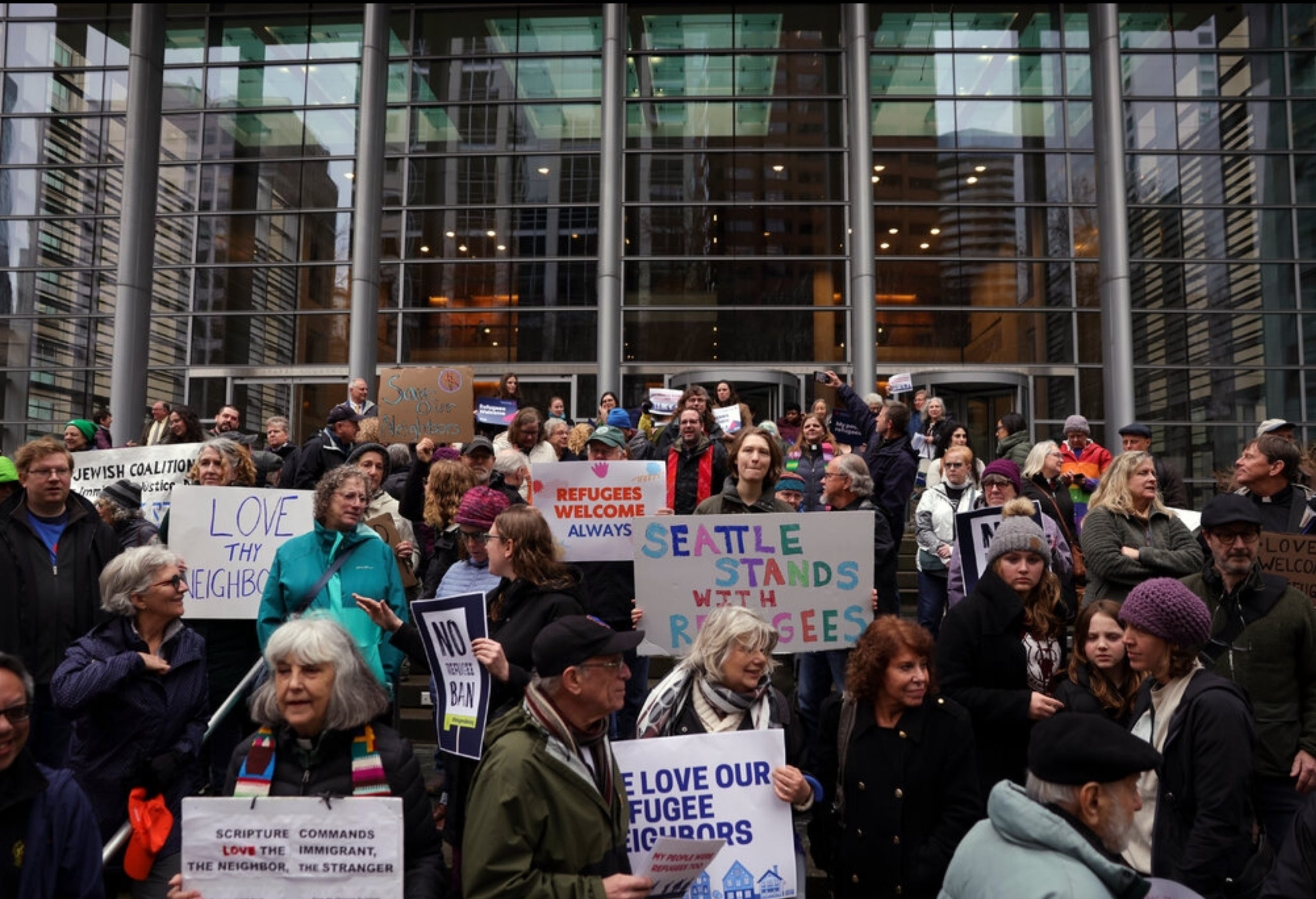
Lifting the ban on refugee admittances
On his first day in office, Trump signed an executive order suspending the nation’s Refugee Admission Program. That affected some 600,000 people who were already in the processing pipeline, according to the government’s own accounting. These were desperate people who had been preparing to come to the U.S. as refugees but are now languishing in legal limbo as a result of Trump’s order.
Congress established the Refugee Admission Program through passage of a law in accordance with international agreements. Trump’s order purportedly suspending it threw that system into chaos and left some of our closest friends and allies—such as Afghans who had worked with the U.S. to fight the Taliban—high and dry.
Individual refugees, their family members and groups with contracts to resettle them in the U.S. sued. The charity organization plaintiffs include the International Refugee Assistance Project, the Jewish refugee resettlement agency HIAS, and Lutheran Community Services Northwest. They have had to lay off staff because funding for processing refugees overseas, as well as support services to help them resettle, has been frozen.
Judge Jamal Whitehead held a hearing on the plaintiffs’ motion for a preliminary injunction in Seattle on Tuesday. The government’s lawyer argued that there was no risk of “irreparable harm” to those waiting on admission because the refugees were mostly now safe in a “third country.” He also argued that the president has broad authority under existing law to deny entry to foreigners whose admission “would be detrimental to the interests of the United States.” He claimed this conferred what amounts to “law making authority” on the president.
I’m sorry, come again? Last I checked, Congress makes the laws, while the White House faithfully executes them.
Judge Whitehead saw through this right away. While acknowledging that the president has “substantial discretion” to suspend refugee admissions, “that authority is not limitless.”
Trump’s Day One executive order suspending the Refugee Admission Program amounted to an “effective nullification of congressional will,” Judge Whitehead said. “I cannot ignore Congress’ detailed framework for refugee admissions and the limits it placed on the president’s ability to suspend the same,” he further ruled. “Our system of separated powers demands no less.”
Moreover, he noted there was a significant risk of irreparable harm to the plaintiffs, a key consideration for whether to issue a preliminary injunction. “I have refugees stranded in dangerous places. I have families who have sold everything they’ve owned in advance of travel, which was canceled. I have spouses and children separated indefinitely from their family members in the U.S., resettlement agencies that have already laid off hundreds of staff. Aren’t these textbook examples of harms that can’t be undone by money damages?” he asked.
Judge Whitehead issued his injunction orally from the bench but will follow up soon with a written one. The government requested that he pause his order while the administration considers an appeal, and the judge responded he would address that request when he issues his written order.
Ordering foreign aid money to flow
After Trump issued a sudden 90-day freeze on all foreign aid and assistance, a group of nonprofits sued in D.C. The government didn’t have a right, the plaintiffs claimed, to freeze funds that were already appropriated by Congress and should have been paid out per agreements with the aid organizations. They sought a temporary restraining order on the freeze.
Federal district court Judge Amir Ali granted that request on February 13, holding that the administration’s actions were “arbitrary and capricious” and that the administration had offered “no explanation” for the blanket freeze on aid. He further noted that the order had “set off a shockwave and upended reliance interests for thousands of agreements with businesses, nonprofits, and organizations around the country….”
Despite that order, Plaintiffs were back in court yesterday to make their case that the government had not complied at all with Judge Ali’s order. In a shocking moment, the government’s lawyer acknowledged that the Trump administration had ignored the restraining order, but argued instead that it should not be required to pay back the money because of “sovereign immunity”—an argument that the government cannot be sued because it is immune.
Judge Ali was not amused. He pressed the government’s lawyer for whether there was any effort to comply at all. The lawyer’s answers likely only worsened Judge Ali’s mood. As ABC New reported,
During an extended exchange with Ali, a DOJ lawyer struggled to answer basic questions about the Trump administration’s compliance with the temporary restraining order, which prevented the administration from freezing funds.
“I’m not sure why I can’t get a straight answer from you on this. Are you aware of an unfreezing of the disbursement of funds for those contracts and agreements that were frozen before February 13?” Ali asked. “Are you aware of steps taken to actually release those funds?”
“I’m not in a position to answer that,” DOJ attorney Indraneel Sur said.
“We're 12 days in and you're here representing the government...and you can't answer me whether any funds that you've kind of acknowledged are covered by the court’s order have been unfrozen?” Judge Ali responded.
Yikes. The government lawyer then responded, “All I can do, really, is say that the preparations are underway for the joint status report on compliance,” Sur said.
In other words, they’ve only got “concepts of a plan” to release the funds, even 12 days after being ordered to.
And Politico noted,
After Sur suggested that officials were holding up or canceling payments under the terms of individual contracts, Ali said he was baffled by the government’s view.
“I guess I’m not understanding where there is any confusion here,” the judge said. “It’s clear as day.”
Judge Ali further observed that Secretary of State Marco Rubio had ordered a pause on $15.9 billion in foreign assistance grants a full five days after Judge Ali issued his restraining order.
“That, again, is the very action that was held to be likely arbitrary and capricious,” Judge Ali said.
It’s small wonder Judge Ali lowered the boom when the two-hour hearing concluded. “Plaintiffs submitted evidence that defendants have not lifted the suspension or freeze of funds as the [restraining order] required. Defendants have not rebutted that evidence, and when asked today, defendants were not able to provide any specific examples of unfreezing funds pursuant to the Court’s [restraining order],” Judge Ali said.
Accordingly, Judge Ali ordered the defendants to release all frozen funds, which total some $2 billion, by Wednesday at midnight. Per Politico, Judge Ali also demanded the government submit “any directive or guidance” issued about his order or about the suspension or termination of aid agreements.
“I want those documents by noon tomorrow,” the judge said.
The government is now claiming that compliance is impossible under such a short timeline because of (checks notes) the risk of fraud. This is a claim that it has never been able to support. Nevertheless, they have pleaded with the court to stay its order so they have more time to comply. We’ll have to see how Judge Ali responds. He is unlikely to view their position charitably after they intentionally ignored his earlier ruling. After all, they had 12 days to comply, and had they done so as ordered, they wouldn’t be in this bind now.
Meanwhile, the government has filed an emergency notice of appeal of Judge Ali’s order to the D.C. Circuit.
You may be wondering, if the government skirted his order before, won’t it just skirt it again? It certainly may try. But Judge Ali would be within his rights to haul Secretary Marco Rubio into his courtroom and even find him in contempt and issue sanctions, including possible civil penalties, a judgment against the government on the case, and even jail time for officials at USAID.
The stakes would rise considerably if he did so, and while such a move may become inevitable the more they try to delay things, it’s likely still the case that no single agency or department head wants to be the one hit first by a federal court’s contempt proceedings.
Getting billions in frozen funds to flow
The most consequential decision, at least for the U.S. economy and our system of co-equal branches of government, came from District Court Judge Loren AliKhan of the D.C. Circuit, who issued an injunction blocking the Office of Management and Budget (OMB) from freezing federal assistance and grants. That order covers billions of dollars that the OMB had frozen before lifting its directive the next day, even while different departments and agencies continued to abide by the initial illegal freeze.
That set up the OMB to argue that it had already complied, but it was somehow the agencies’ fault for continuing to freeze funds.
Judge AliKhan wasn’t having it. Her written order yesterday was an extension of her original temporary restraining order. The most interesting aspect of her 39-page ruling was her methodical dismantling of the government’s arguments and excuses. It’s a roadmap for other judges to follow as the government seeks to wiggle out of orders enjoining its actions.
For example, the OMB argued that it had already withdrawn its memo and therefore there technically was no freeze left to consider, and that any remaining freeze was due to federal agencies acting on their own. Judge AliKhan blasted through this “it’s not our fault” argument by pointing out its inherent implausibility.
Defendants would have the court believe that countless federal agencies, none of which had acted to cut off financial assistance before January 28, suddenly began exercising their own discretion to suspend funding across the board at the exact same time. That would be a remarkable—and unfathomable—coincidence. That this uniform freeze occurred just hours after the memorandum’s issuance would be quite the happenstance, too.
Defendants also tried to argue that the original OMB memo never said which funds or grants to pause, but instead required agencies to make that determination. The judge was not impressed with this passing of the buck:
In a manner of speaking, Defendants are right that the memorandum did not identify specific funds to be paused. Instead, it simply paused them all…. Defendants cannot show that this directive left any room for agency discretion, especially on the nearly nonexistent timetable it provided. Agencies were not given an option on whether to continue honoring their payment obligations; they simply had to stop. And even if the agencies thought they had discretion to act, they were given roughly half a day to evaluate up to $3 trillion in grants, loans, and other programs. That is not discretion.
She further noted, “Defendants either wanted to pause up to $3 trillion in federal spending practically overnight, or they expected each federal agency to review every single one of its grants, loans and funds for compliance in less than twenty-four hours. The breadth of that command is almost unfathomable.”
She used evidence provided by the plaintiffs to destroy the argument that agencies were acting independently and that OMB couldn’t be faulted for that, and besides it’s their own fault this began to happen:
At the TRO hearing, Defendants could not explain all the frozen funding by relying on the executive orders alone…. Defendants insist that this overreach may have been because agencies overzealously implemented the freeze. But that is a problem of Defendants' own creation. Their memo was written, interpreted, and executed as a blanket pause…. Defendants cannot shift the blame onto federal agencies because those agencies followed Defendants’ own orders.
On the merits of plaintiffs’ motion for a preliminary injunction, Judge AliKhan noted that the funding freeze would be “economically catastrophic — and in some circumstances, fatal — to their members.”
She further observed that the Trump administration's actions were "irrational, imprudent, and precipitated a nationwide crisis."
"The pause placed critical programs for children, the elderly, and everyone in between in serious jeopardy," AliKhan wrote. "Because the public's interest in not having trillions of dollars arbitrarily frozen cannot be overstated, Plaintiffs have more than met their burden here."
What next?
The Trump administration will appeal these preliminary injunctions. But the more critical question is whether it will comply and begin allowing refugees to enter the U.S., or release billions in frozen funds ranging from farm aid to billions in critical infrastructure dollars. Courts are notoriously unwieldy and slow when it comes to enforcement, and in this case there’s a highly uncooperative party. As the impatience of federal judges grows, we likely will start to see threats of contempt proceedings and perhaps a cabinet member ordered to appear and show cause for why they are defying a direct court order.
The government will likely continue to claim that quick compliance with these injunctions is difficult to impossible. With respect to frozen funds, it is finding out in real time that it’s not so easy to get big, bureaucratic wheels turning again once things have already ground to a halt, particularly after so many federal workers have been laid off. But it’s also discovering that judges aren’t letting it pass the buck or hide the ball so easily.
A further complication to the release of funds is that many federal computer systems are now overseen by DOGE hackers who reportedly have already overridden direct authorizations from Secretary Rubio and others to pay out funds. As Matt Bai noted in the Washington Post,
Rubio had decreed that certain critical programs — such as aid to Ukraine and Syria and costs related to the PEPFAR program to combat HIV in Africa — would continue to be funded. Several times, USAID managers prepared packages of these payments and got the agency’s interim leaders to sign off on them with support from the White House.
But each time, using their new gatekeeping powers and clearly acting on orders from Musk or one of his lieutenants, [DOGE members] Farritor and Kliger would veto the payments — a process that required them to manually check boxes in the payment system one at a time, the same tedious way you probably pay your bills online.
Some in the government would rather simply defy these judges, or even come after them for daring to stand between the administration and its goals. Elon Musk, for example, is apparently very unhappy with the rulings.
“The only way to restore rule of the people in America is to impeach judges,” Musk tweeted, adding, “No one is above the law, including judges.”
Musk forgot, of course, to include himself and Trump in his group of no ones.
Who is going to enforce the judge's orders though? They are only successes if they are followed.
Why hasn’t an arrest warrant for Elon musk been issued for him and his hacker boys. I get there is only
One way to get trump out and in prison is via impeachment.. which will not happen with the gutless republicans in charge. However , according to the White House itself musk has no official or legal role in government. He and his hacker boys should be arrested and removed immediately.