

A New York Times and Siena College poll has the GOP groaning. It surveyed 1,503 likely voters from Sept. 8-13 and found Democrats leading by nearly nine points on the so-called generic congressional ballot, with Trump’s approval at 38 percent. A spread that size last showed up in 2018, when Democrats flipped 41 House seats and ended eight years of Republican control.
The news was terrible on nearly every issue. The president’s party trails Democrats by 24 points on health care, and Democrats hold sizable advantages on the economy, foreign policy and even immigration, all once GOP strong suits. Republicans’ only edge in the survey came on AI policy, which very few people in either party understand.
The polling reflects a broad erosion of GOP support, even in some traditional strongholds. An implosion there would be catastrophic, so the GOP is now trying to shore up support among base voters on its home turf.
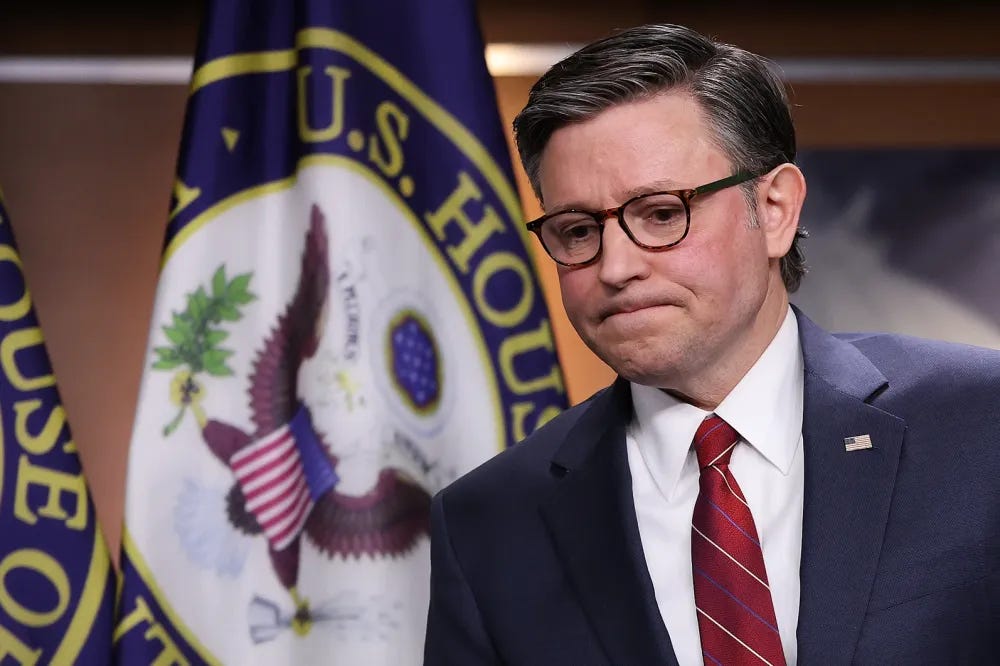
No bueno if you’re John Thune (R-SD) or Mike Johnson (R-LA) and want to stay in charge of your chamber after the midterms.
The map keeps turning light pink
Kansas has not elected a Democrat to the Senate since 1932. That’s before even Sen. Mitch McConnell (R-KY) was born. But the GOP is starting to sweat. Per reporting by the New York Times, the White House clicked its heels and sent Vice President JD Vance to Kansas to campaign for Sen. Roger Marshall (R-KS), who began airing an attack ad against his Democratic challenger, Adam Hamilton, the same week. Republicans worry Hamilton, the senior pastor of the largest United Methodist congregation in the country, is gaining steam. He read Vance’s visit as confirmation of his momentum. “The fact that they sent the vice president, I thought, was a really great sign. I just had to go, ‘Wow, cool.’ They realize this thing is in play.”
The visit came just after Marshall was booed and met with chants of “shame on you” at a Kansas State Fair debate. The booing followed a New York Times investigation that found Marshall had filed more than 700 lawsuits against patients with unpaid medical bills during his career as an obstetrician-gynecologist, including some who were arrested for missing court dates. Cook Political Report and Sabato’s Crystal Ball have downgraded the race from “Safe Republican” to “Likely Republican,” and former Republican Gov. Bill Graves crossed party lines to endorse Hamilton.
Nebraska, another red stronghold, is experiencing a similar moment. As the Times reported, a new Republican super PAC called, rather cheekily, “Cornhusker Majority” has reserved $3.7 million in ads this week. The money will defend Sen. Pete Ricketts (R-NE) against independent Dan Osborn. That sum would have been unthinkable a year ago in a state Trump carried three times by double digits. An internal poll by the Osborn campaign found Ricketts’s favorability underwater by 10 points, worse than Osborn’s. This despite a Mitt Romney-like moment when a hot mic caught him saying some Trump voters’ “lives probably suck,” a take he has since apologized for but that we all pretty much understand is true these days.
Kentucky isn’t safely in the red column either. In the state’s 6th District, which Trump carried by 15 points in 2024, a Trump-aligned super PAC has bought $637,000 in ads against Democrat Zach Dembo, according to the Times. Dembo is a Navy veteran and former federal prosecutor who tied his campaign to the new Canada tariffs, telling Lexington’s WKYT that Trump’s import taxes will “crush whatever progress” the bourbon industry has made toward recovery. Dembo was smart to focus on Kentucky whiskey: exports to Canada fell 42 percent over the latest 10 months of data, and the Republican nominee, Ralph Alvarado, had no statement when a local station asked for one.
Georgia now looks out of reach for the GOP, at least in the Senate race. Republicans increasingly appear to have all but thrown in the towel. At a Senate Republican donor meeting in Dallas last week, per the Times, a slide listed four “quality” Senate recruits: Rep. Ashley Hinson in Iowa, Michael Whatley in North Carolina, Mike Rogers in Michigan and John Sununu in New Hampshire. Rep. Mike Collins, the nominee in Georgia, was in the room—but not on the slide. Awkward. The numbers explain the hesitation. A Fox News poll has Sen. Jon Ossoff up 13 points, and an AARP poll conducted by Fabrizio Ward and Impact Research puts his lead at 9 points, outside the margin of error.
The White House isn’t welcome in its own strongholds
Vance is coming to Council Bluffs, Iowa, today, but Rep. Hinson, Iowa’s Republican Senate nominee, is skipping it. Awkward again. Her campaign cites “previously scheduled events” that it has declined to name.
The dodging of Vance is not an isolated case. In Maine last month, Sen. Susan Collins skipped a Vance rally in Brewer, citing a scheduling conflict.
How many times must Vance be avoided before he gets the hint?
The avoidance extends beyond Vance to Trump himself. NBC News reported on Thursday that a handful of Republicans in competitive races are keeping their distance from the president even as he urges voters to treat him as though he were on the ballot.
Some are openly opposing him on policy in a bid to win back voters. As NBC reported,
The latest example came Thursday in Florida, where GOP Rep. Maria Elvira Salazar — usually a staunch Trump supporter — began airing a direct-to-camera TV ad criticizing his mass deportation agenda.
“Mr. President, some of your immigration enforcement efforts have gone too far,” Salazar said in the ad. “In July, 50 percent of the 50,000 people that were detained had no criminal record. Be careful what your advisers are telling you about immigration policy. The same Hispanics who helped you get to the White House in 2024 feel betrayed today.”
As I wrote after the party’s Dallas “midterm convention” earlier this month, fewer than half of the Republican candidates in this year’s most competitive House and Senate races were listed as convention speakers. At least one vulnerable House member, Iowa’s Zach Nunn, told reporters he was skipping it to stay home in his district. Joshua Blank, research director for the Texas Politics Project, summed it up plainly: “Hugging Donald Trump is really good in the Republican primary. It remains to be seen whether it’s helpful in a competitive general election in 2026.”
Rep. Thomas Massie, who is leaving Congress after losing his primary to a Trump-backed challenger, told reporters at the Capitol this week that 2026 is shaping up like 2006, when Republicans lost both chambers amid an unpopular war. “This was Donald Trump’s election to lose, and he’s doing everything he can to lose it,” Massie said, pointing to the war in Iran and its effect on diesel and gasoline prices.
A slew of bad economic news
As I wrote about this week, the Fed raised interest rates for the first time since 2023, lifting the federal funds rate by a quarter point to a target range of 3.75 to 4 percent in a 12-0 vote. The Fed’s projections point to another hike by December. The timing could hardly be worse for Trump and Republicans, coming seven weeks before midterms already dominated by voter anger over the cost of living. Higher interest rates mean higher payments on credit cards, adjustable-rate mortgages and auto loans—all at a time when affordability is paramount to most midterm voters.
The war driving that decision keeps growing more expensive, too. Apart from the upfront costs, estimated by the Congressional Budget Office at $38 billion through July, more than 40 percent of the growth in personal consumption inflation last quarter can be traced to higher energy costs from disruptions in the Strait of Hormuz.
The situation on the ground—or in this case, in the water—is also deteriorating rapidly. As I detailed separately, a second oil chokepoint is now compounding the first. The Houthis’ seizure of Mokha and Perim Island near the Bab el-Mandeb—also known as the Gate of (MAGA) Tears—has driven Brent crude above $108 a barrel, its highest level since May, and pushed diesel past $6 a gallon for the first time on record. The costs are rippling through the economy well beyond the pump: Amazon, UPS, FedEx and the U.S. Postal Service have all added fuel-related surcharges, and executives at Kroger and Smithfield Foods have warned investors that pressure on grocery prices is intensifying.
Diesel hit yet another record Thursday, nearly $6.40 a gallon, with the national gas average above $4.40. Trump’s response, at a Wednesday night rally in Gastonia, North Carolina, for Senate nominee Michael Whatley, was to double down on the importance of a war no one else but Israeli Prime Minister Benjamin Netanyahu wanted: “It’s a very inexpensive price to pay for what we’ve done,” Trump offered. “Remember that. It’s a little more. Frankly, even if it was a lot more.”
That is not a winning midterm message, if anyone is still wondering.
It’s also a decidedly mixed one. Vance, for example, struck a different note entirely two days earlier on the All-In podcast, asking voters for patience rather than defending the record: “Give us another chance, or give us another couple of years, to continue to work on the amazing things that we’ve been doing for the past two years.” House Minority Leader Hakeem Jeffries responded on social media, “Get Lost. It’s over for MAGA extremism in November.”
Higher fuel costs are now showing up in the data. August’s Consumer Price Index rose 3.4 percent year over year, with gasoline up 27.4 percent. Speaker Mike Johnson did not dispute the numbers: “Gas prices are too high right now; diesel prices are too high. There is a very simple reason for it. It is tied to the Strait of Hormuz.”
Finish that thought, Mr. Speaker. And why is the Strait of Hormuz a problem now?
Republicans are conceding that throwing money at the election hasn’t solved the underlying problem. Republican super PACs have booked more than $140 million in ads since Labor Day, but GOP strategists admit a spending advantage only goes so far when a candidate is trying to outrun the national mood.
Rep. Richard Hudson (R-NC), who chairs House Republicans’ campaign committee, acknowledged that the war was “not helpful” but argued the bigger issue is that voters don’t know what the GOP-led Congress has done. “A lot of voters don’t know the policies we passed,” he said.
To the contrary, I’d offer. If voters better understood the signature policy the GOP did pass into law, they’d probably be even angrier. The Medicaid cuts, for example, which will hit rural areas hardest, conveniently don’t kick in until after the midterms.
The GOP’s own reckoning — and retreat
Republican strategists no longer bother to spin the environment privately. “It points out the obvious that Republicans are in pretty bad shape going into the midterms and that they’re looking at historic losses,” GOP strategist Terry Holt said last month. “The question is whether some of these races can be saved with some miraculous turnout that apparently is going to be very expensive or whether or not the mood in this country can be changed fundamentally.”
Sen. Chuck Schumer (D-NY) struck a confident note from across the aisle. “We have never felt better,” he said, though he cautioned “it’s not an easy map.” Jeffries went further: “Republicans are panicking and are on the brink of losing the House, with the Senate not far behind.” But Democrats aren’t resting on their advantage. They are pressing it, and hard.
The coming reckoning morphed into a retreat this week. Speaker Johnson sent everyone home Wednesday for a seven-week campaign recess, cutting the session short and abandoning a floor vote on Massie’s articles of impeachment against Defense Secretary Pete Hegseth over his conduct of the Iran war. The House will not return until after the Nov. 3 election. The recess also avoids a vote on a second Epstein files discharge petition, which has reached 218 signatures, according to co-sponsor Rep. Ro Khanna.
Johnson dismissed the impeachment push as “a stunt” and insisted the early departure had nothing to do with these measures, but Massie used his own floor time to tear into the decision: “We’re calling off Congress? And we’re in the majority? I’m trying to get justice for the Epstein survivors. I’m trying to stop a war.”
Before the recess, the House passed its third war-powers resolution aimed at ending the Iran war, 220-204, with a record seven Republicans breaking from the president. That’s up from four defections during the previous attempt.
Unsurprisingly, some of the new defectors are defending toss-up House districts, and they know what continued support for this unpopular war could do to their electoral chances.
Republicans always cast their electoral defeats as a "communications problem." They'll pretend to hold an honest post-mortem, and then decide that there is no problem with policies that have fueled the greatest transfer of wealth to the rich in American history, stripped women of their rights, booted people off their health care, kidnapped our neighbors and held them in concentration camps, and brought back communicable diseases. They just need to make a better pitch. SMH.
Well ... perhaps it is time for a small, delicate, "Yay!"? No chicken counting, and TACO could still send in the National Guard or the U. S. Army to sequester polling booths, or challenge every elected member of the House or Senate that isn't Republican, or have them arrested for federal voting crimes, or .... But, again, a small, delicate, "Yay!".