

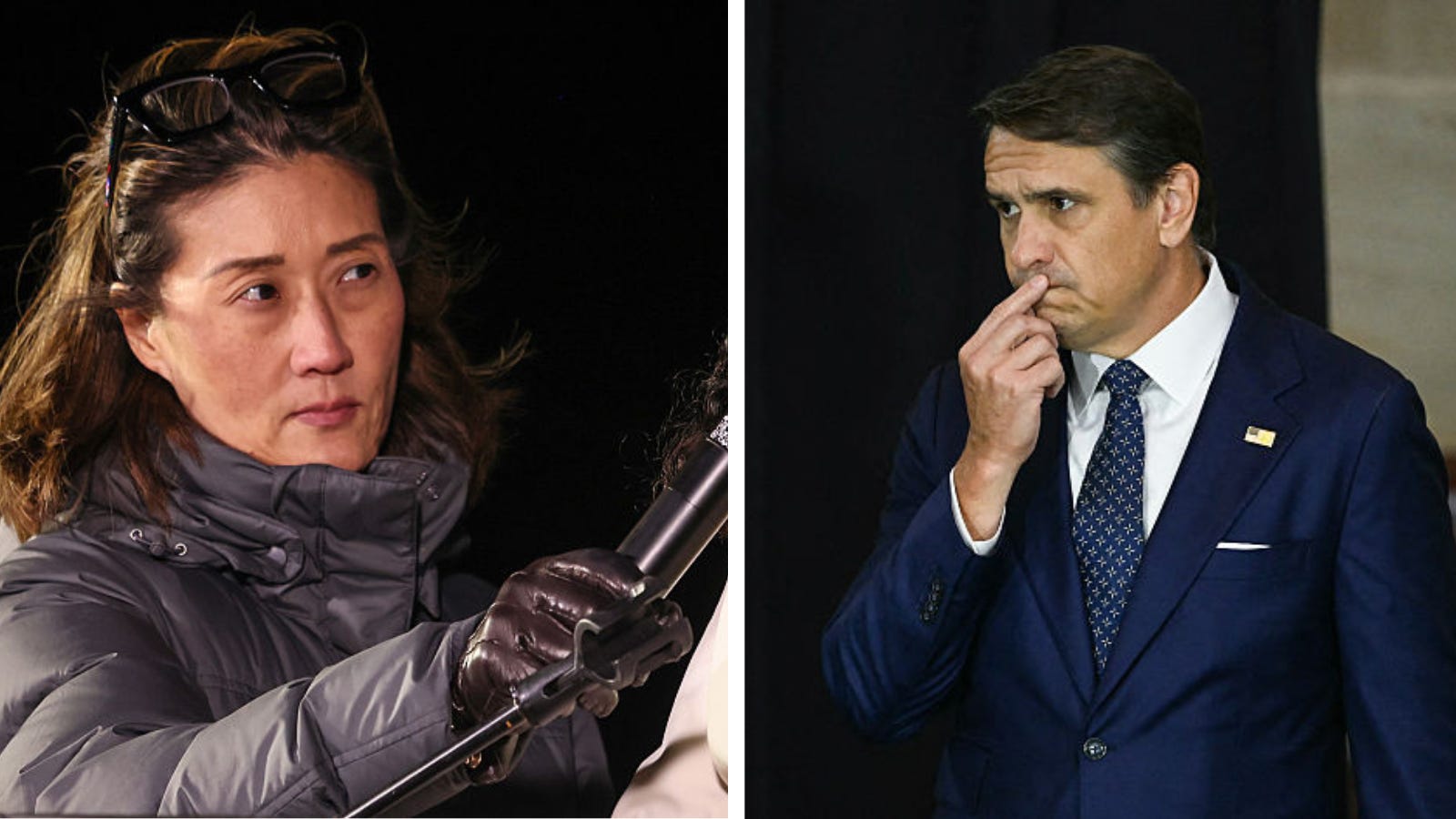
I’ve been chronicling journalist and lawyer Katie Phang’s fight to pry loose the Epstein files from a recalcitrant Justice Department, from her novel legal theory that got her case past the courthouse doors, to Judge Emmet Sullivan’s July order requiring the DOJ to submit unredacted documents for Sullivan’s own perusal in chambers, in what’s known as “in camera” review.
That review has now happened, and Judge Sullivan didn’t like what he found. In an order issued Thursday, he scheduled an Aug. 13 status hearing after conducting his in camera review on July 30. The order doesn’t reveal what Judge Sullivan saw; that review remains private, as I explained in a prior write-up. But the order makes clear that he’s not simply accepting the DOJ’s account of its redactions at face value.
“The Defendant did not provide such documentation,” Sullivan wrote, describing DOJ’s response to his order requiring proof that certain redacted names belong to Epstein victims. The department’s excuse—that attorneys for those individuals had asked to be treated as victims—was insufficient. “The Defendant’s assertions do not comply with the Court’s Order, which requires documentation to support the assertions.”
Sullivan flagged three specific issues DOJ will have to address next week.
The missing victims
The first issue goes to the heart of what Judge Sullivan’s July 25 order was designed to test. That order required Acting Attorney General Todd Blanche to produce documentation supporting his claim that certain redacted names in the Epstein files actually belong to victims.
To no one’s surprise, the department produced no such proof. Instead, the DOJ argued that “certain redacted text contains the identities of victims or potential victims whose counsel have contacted the government and requested that the persons be treated as victims.”
But a lawyer asking that a client be treated as a victim (and not a perpetrator) is not documentation that the client is actually a victim. And note the misleading wording of the claim: “certain redacted text” could refer to only some of the names, not all of them. And “potential victims” could be, well, just about anyone.
The new order requires Blanche to come to the Aug. 13 hearing prepared to explain what actual documentation he will provide.
As I noted before, the DOJ showed what game it is playing when it attached a “victim protection” label to the email address in a communication discussing a torture video. That example was contained in one of the document sets under review by Judge Sullivan. And as lawmakers noted, it turned out to conceal the email address not of a victim but of an Epstein associate, Sultan Ahmed bin Sulayem.
It is reasonable to assume that if the department is concealing perpetrators in one instance, it may be doing so in others. And if the DOJ can’t substantiate its “victim” claims for its broader set of redactions, the bin Sulayem mislabeling sure doesn’t look like an isolated error. Indeed, the more the department hedges and delays, the clearer it becomes that Blanche may be hiding something—namely, that the department may have broadly redacted perpetrators’ rather than victims’ names in order to protect powerful people associated with Epstein.
The missing FBI notes
The second issue is the one that has garnered the most attention: the missing FBI notes tied to Trump himself.
The handwritten records relate to multiple FBI interviews with a woman who says Epstein introduced her to Trump when she was around 13 years old and that Trump sexually assaulted her. Sullivan’s June 25 order directed DOJ to produce the underlying notes behind these interview reports or explain why it shouldn’t have to.
Blanche offered two excuses for his noncompliance. First, he claimed the notes are “substantially similar to” the typed reports already released and therefore duplicative. Second, he argued that handwritten notes are harder to redact without accidentally exposing victim information.
That sudden concern for the victims is dubious, considering how blatantly the department has disclosed victim information across other portions of the Epstein files.
And Judge Sullivan wasn’t having Blanche’s nonsense. “The Defendant does not point to a provision in the Epstein Act that contains an exception for ‘substantially similar’ or duplicative documents,” he wrote. He also pointed out that the DOJ has already acknowledged publishing “substantially similar” draft indictments elsewhere in the case, so its excuse that it shouldn’t produce duplicative material is unpersuasive.
At the upcoming hearing, the DOJ will have to explain why the notes, comprising just 37 pages, can’t simply be redacted by hand or by some other method before their release.
The record around the FBI notes can be a bit confusing, so let’s clarify it. Only the notes from the woman’s first interview, in July 2019, have ever been made public. And surprise, surprise, they don’t mention Trump. The typed FD-302 reports from her other three interviews were released in redacted form, but the handwritten notes behind them were not. The DOJ managed to redact the typed versions without apparent difficulty, belying its claim that the handwritten originals are somehow too risky to touch.
The redaction log deadline
The third issue is the most procedural of the three, but it’s also the one where DOJ’s excuses run thinnest. The Epstein Files Transparency Act requires that “all redactions must be accompanied by a written justification published in the Federal Register and submitted to Congress.” Blanche has said he’ll comply; the parties disagree over whether he already should have.
Judge Sullivan didn’t resolve that dispute in his order. Instead, he directed the DOJ to come to the Aug. 13 hearing prepared to explain its timeline for meeting the requirement. But the requirement itself has been sitting unmet since the statute’s original Dec. 19, 2025 disclosure deadline, which the DOJ blew without any consequence at the time.
Nearly eight months later, DOJ still hasn’t told the public which redactions it’s made or why.
A pattern of noncompliance
The Justice Department also notably missed its own deadline to formally answer Phang’s complaint. Phang’s legal team moved to compel a response, arguing the department is technically in default since it never sought an extension.
Rather than answering, the DOJ sought delay, as it almost always does. Specifically, it asked Sullivan to retroactively stay all deadlines and give the department 60 days after the preliminary injunction proceedings conclude before it has to respond at all. Interestingly, the papers seeking that extension were reportedly filed by U.S. Attorney Jeanine Pirro, who is not the DOJ’s usual counsel in the case.
That disregard for the calendar is consistent with how the DOJ has handled deadlines throughout this litigation. When Sullivan first ordered production by July 2 and Phang asked the court to fine Blanche $1,000 a day for noncompliance, the DOJ called her request “outlandish” and her underlying lawsuit unsubstantiated. Phang’s attorney, Brendan Ballou, put things bluntly after the June 25 ruling: The government “blew off a judge’s order… for the sake of protecting the very powerful and the very rich.”
The department has now missed or resisted nearly every deadline Sullivan has set in this case: the July 2 production deadline, the deadline to answer Phang’s complaint and now, according to Sullivan’s own order, the documentation requirements attached to his July 25 in camera review.
Hanging by a vote
Judge Sullivan’s order landed in what was already political quicksand. The Senate is preparing to hold its first floor vote on Blanche’s confirmation to be the permanent rather than the acting attorney general, with a final confirmation vote expected over the weekend. Sen. Susan Collins (R-ME) and the often unreliable Sen. John Fetterman (D?-PA) had already announced they would vote no.
The picture shifted this morning. Sen. Lisa Murkowski (R-AK) announced that she was a no, while Sen. Bill Cassidy (R-LA), the last Republican holdout, announced that he will vote yes, just as he did at the last minute with RFK, Jr. Even with Sen. Mitch McConnell (R-KY) still absent from the chamber, Cassidy’s support appears to give Blanche the votes he needs for confirmation.
Notably, their votes will be cast one day after a judge, in writing, ruled that Blanche failed to document his own department’s redaction claims or adequately explain why it withheld FBI notes tied to the president who nominated him, while the department has yet to even answer the lawsuit that produced these findings in the first place.
That’s hardly a model for the nation’s chief law enforcement officer. But it is emblematic of everything evasive, politicized and dysfunctional about the DOJ under Blanche.
Thank you for your excellent analysis and reporting.
Simple question: what prevents DOJ from simply destroying the evidence? And I don’t mean what legally prevents. I mean physically, as has happened historically every time a regime begins to crack. Duplicate copies? Big deal! The fact that deletion evidence will exist? Big deal! How do we know the list of redacted evidence is actually a complete list?