
The “Trust Me, Bro” DOJ
Attorney General Todd Blanche isn’t even trying to claim independence from the White House. He just wants us to take his word that he won’t act illegally or unethically.

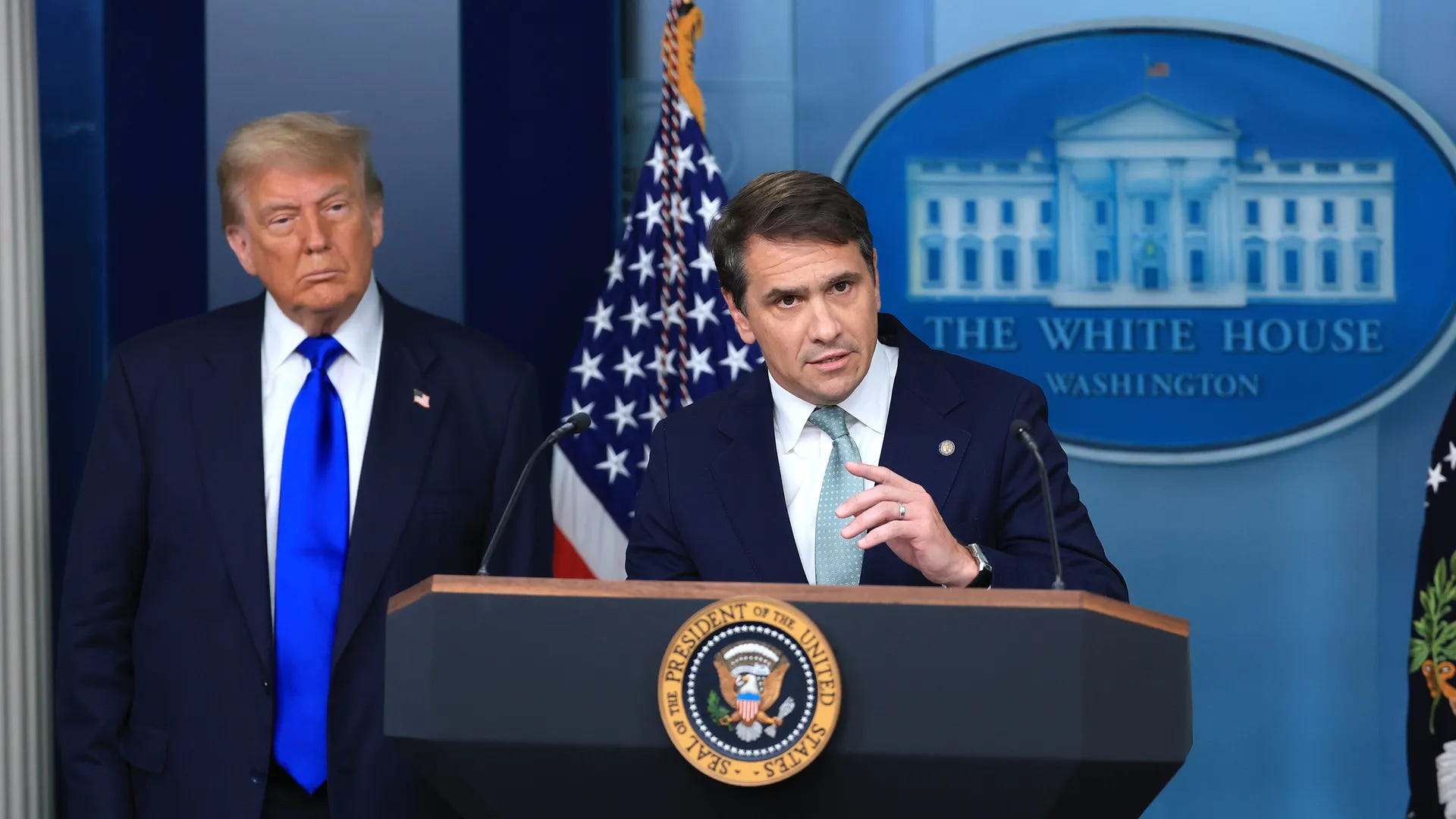
As he sat before the Senate Judiciary Committee last month, Todd Blanche announced a drastic shift in Justice Department practice that had been a guiding principle since the Watergate era. Asked whether the Justice Department would act independently of the White House, Blanche said it would not. He argued that Article II of the Constitution puts federal law enforcement solely under the president’s authority, repeating statements he had made while acting attorney general. In short, whatever the president wanted, the president would get.
In place of that traditional independence, Blanche offered senators something far narrower. Pressed by Sen. Chris Coons (D-DE) on whether he would carry out an order he believed was illegal or unethical, Blanche effectively answered, “Just trust me, bro.”
“That will never happen,” Blanche insisted, “But yes, if it were to happen, I’m not going to violate my oath to the Constitution.” Asked separately by Sen. Amy Klobuchar (D-MN) whether he would commit to following federal election law, including law that keeps armed agents away from polling places, Blanche said, “I will commit to following the law, Senator, of course.”
That was the deal, take it or leave it. Blanche would make no pledge of institutional independence, but in exchange he gave his word he would stay inside the law. The Senate accepted that fool’s bargain, confirming Blanche by a threadbare margin of 50-49.
Blanche was sworn in as attorney general on Aug. 10. Then it was time for Lucy to lift the football on the feckless Senate enablers: Blanche’s pledge not to break the law didn’t last a week.
Fifty years of a different answer
Blanche’s shift on independence, moving to a “unitary executive” understanding of the White House’s control of the DOJ, broke from a standard both parties had maintained for half a century.
As I wrote recently in The Big Picture, after Richard Nixon resigned in 1974, President Gerald Ford installed Edward Levi, a University of Chicago law scholar with no political ambitions of his own, to rebuild the Justice Department’s credibility. At his 1975 swearing-in, Levi told the department, “our law is not an instrument of partisan purpose.” He spent the next two years building three guardrails: a policy limiting contact between the White House and the department on pending investigations; an Office of Professional Responsibility to police the department’s own attorneys; and the groundwork for what became the Principles of Federal Prosecution, later implemented by Attorney General Benjamin Civiletti, holding that charging decisions follow the evidence rather than the target’s politics.
Until Trump 2.0 and Blanche at the DOJ, every administration since Ford maintained some version of those guardrails. Many of us remember the GOP clutching many a pearl in 2016 when Bill Clinton—no longer president but married to candidate Hillary Clinton, who was the subject of an active FBI investigation over, yes, her private use of an email server—boarded Attorney General Loretta Lynch’s plane on an airport tarmac in Phoenix for an unplanned conversation. Both described the meeting as purely social, but Lynch faced sharp bipartisan criticism anyway, and shortly afterward said she would accept whatever charging recommendation career prosecutors made rather than decide herself.
Even Blanche’s recently departed predecessor, Pam Bondi, held to the old DOJ independence standards, at least in her public promises. At her January 2025 confirmation hearing, Bondi told a Senate committee, “Every case will be prosecuted based on the facts and the law that is applied in good faith—period. Politics have got to be taken out of the system.” Pressed by Sen. Peter Welch (D-VT) on whether Trump’s perceived political opponents would face investigation, Bondi swore straight-faced, “No one will be prosecuted, investigated because they are a political opponent.” And when Sen. Coons asked her the same hypothetical he would later put to Blanche, namely what she would do if the White House ordered her to drop a case grounded in the facts and the law, Bondi emphatically rejected the entire premise. “If I thought that would happen, I would not be sitting here today. That will not happen—will not happen.”
Bondi’s tenure, of course, diverged sharply from that promise as her DOJ brought case after case against Trump’s perceived political enemies. Eight months later, Sen. Dick Durbin (D-IL) told her directly that DOJ’s conduct under her watch “would make even President Nixon recoil.” But the promise itself was never in doubt at her confirmation hearing. Bondi had pledged full independence, on the record, and was later measured against it.
By a starker, more shocking contrast, Blanche didn’t even offer lip service to DOJ independence. The department existed to follow the White House’s directives.
Todd Blanche’s fallback promise
Don’t worry, though! Blanche promised that, even though he would do as the president asked, the president would never ask him to do anything illegal.
But what if Trump actually did give an illegal order? Coons had asked Blanche the same question at the hearing and gotten the same answer: “That will never happen,” Blanche said, before adding a fallback: “But yes, if it were to happen, I’m not going to violate my oath to the Constitution.”
The bone thrown by Blanche troubled Sen. Klobuchar, who probed the limits of that position in the context of election law. She asked, “Since the Civil War … federal law has made it clear that the president does not have the authority to deploy armed federal officials to election sites. Will you commit to following clear federal law and not deploy federal agents to polling locations?” Blanche answered, “I will commit to following the law, Senator, of course.” Klobuchar pressed further, asking whether that commitment covered not deploying agents to polling places specifically. “I will absolutely follow the law, no matter whatever it includes, so, yes,” Blanche said.
The two Republican committee holdouts, Sens. John Cornyn (R-TX) and Thom Tillis (R-NC), demanded he commit in writing to certain things. In exchange for their votes, Blanche provided a signed order “rescinding” Trump’s proposed $1.8 billion “anti-weaponization fund,” and a document narrowing the scope of the IRS audit-immunity settlement Trump himself had received. Cornyn and Tillis hailed the result as a “legally enforceable document,” despite doubts from legal observers.
Cornyn had previously withheld his support because he wasn’t convinced that the administration had made a truly binding commitment. After Blanche provided the written assurances, Cornyn voted to advance the nomination and ultimately to confirm him.
Trust me, staff
On Aug. 13, three days after being sworn in, Blanche addressed Justice Department lawyers for the first time as their confirmed leader. “I promise you that I will lead this department with integrity,” he told them. He said he would focus the department on its “core mission,” which he described as upholding “the rule of law fairly and impartially, to keep this great country safe and to protect the rights of every citizen in this country.”
This was the same man who, nine months earlier, had urged lawyers at a Federalist Society conference to join what he called a “war” against federal judges. He condemned judges as “rogue” and “activist.” Blanche declared, “It is a war, and it is something we will not win unless we keep on fighting.”
So much for impartiality. Judges blocking the administration’s agenda, he told the crowd, “have a robe on, but they are more political, or as political, as the most liberal governor or DA.” Weeks after his Federalist Society remarks, his office directed federal prosecutors to compile examples of judges who were, in its view, creating obstacles in cases involving assaults on law enforcement and immigration enforcement. A group of 50 former federal judges, appointed by presidents of both parties, responded that rhetoric like Blanche’s “endangers individual judges and court staff” and “undermines the public’s trust in the judiciary as an impartial and co-equal branch of government.”
The rally on Long Island
Six days after his confirmation, Blanche’s promise to uphold election law despite the department’s lack of independence was already in tatters.
On Aug. 14, Blanche stood behind a podium at the Nassau County Police Academy on Long Island. He appeared along with Trump and FBI Director Kash Patel. The stated purpose was a briefing on falling violent crime numbers, but Trump used the event to endorse Bruce Blakeman, the Republican Nassau County executive running against Democratic Gov. Kathy Hochul. Behind the speakers was a wall of uniformed, on-duty police officers, whose brown shirts evoked for many the terror of 1930s Germany.
Nazi echoes aside, their appearance broke, in the words of contemporaneous PBS coverage, “longstanding norms in which the nation’s law enforcement generally tried to steer clear of participating in overtly political events.”
Blanche’s appearance also raised questions under the Hatch Act. Passed in 1939, it governs how federal officials may conduct themselves around elections, and it bars most executive branch employees from campaigning for candidates while on the job. At the Nassau County Police Academy, Blanche appeared in his official capacity alongside Trump at an event where the president endorsed a candidate for governor of New York.
Legal commentator Joyce Vance noted the potential Hatch Act violation, underscoring that even Senate-confirmed appointees may not use their official authority or influence to affect an election.
At the podium, Blanche also vowed, “If anybody touches a federal law enforcement officer in any way inappropriate, we will prosecute them to the fullest extent of the law.” But earluer, when pressed by Sen. Alex Padilla (D-CA) on whether he would rule out compensating pardoned Jan. 6 defendants who assaulted police through the department’s proposed $1.776 billion “anti-weaponization fund,” Blanche would not commit either way. “We always vigorously defend our cases,” he said.
And when asked in an interview how the pardons of 172 people who pleaded guilty to assaulting police squared with his promise to prosecute anyone who touches a federal officer, Blanche said on Meet the Press, “There’s nothing inconsistent about that.” Blanche’s position already reveals a different set of rules for law enforcement who execute Trump’s agenda versus officers injured while protecting our democracy from him.
Meet the Press
Blanche gave that first sit-down interview with Meet the Press as confirmed attorney general just two days after attending and speaking at the Trump rally. During his sit down with Kristen Welker, Blanche reiterated the shocking departure from independence that he’d conveyed to the Senate.
Welker asked him directly whether he could pledge that the Justice Department would always act independently of the White House. “No, I’m not going to pledge that,” Blanche said. “And no attorney general should ever pledge that.”
Welker also asked about U.S. Attorney Jeanine Pirro, whom Trump had publicly criticized after her office dropped a felony vandalism case against former Olympic canoeist David Hearn. Pirro’s motion to dismiss came after documents surfaced showing that the damage to the Lincoln Memorial Reflecting Pool, which Hearn was accused of vandalizing, had actually resulted from botched contractor work tied to the administration’s own rushed $14.7 million renovation of the site.
Blanche aligned himself fully with the president: “I absolutely support U.S. Attorney Pirro, as does President Trump,” Blanche responded.
But that response is incoherent given what is underway. The Wall Street Journal reported that the White House is separately in discussions with the Justice Department about bringing new charges, such as a misdemeanor, against the same man Pirro’s office had just moved to clear.
Finally, Welker asked about the Justice Department’s campaign to obtain unredacted voter rolls from states, which has suffered more than 20 defeats in federal court, including rulings from judges Trump himself appointed. The election law around this question is clearly not on Blanche’s side, but apparently that doesn’t deter him because the White House wants him to keep going.
Asked whether the department might now take the fight to the Supreme Court despite that record of consecutive losses, Blanche said, “Absolutely, it’s a possibility.”
And WTF is happening with The Epstein Files. Crickets.....
I just pray that when a Democrat becomes president that they hold all these worthless people accountable—
What we don’t need is another Merrick Garland.