

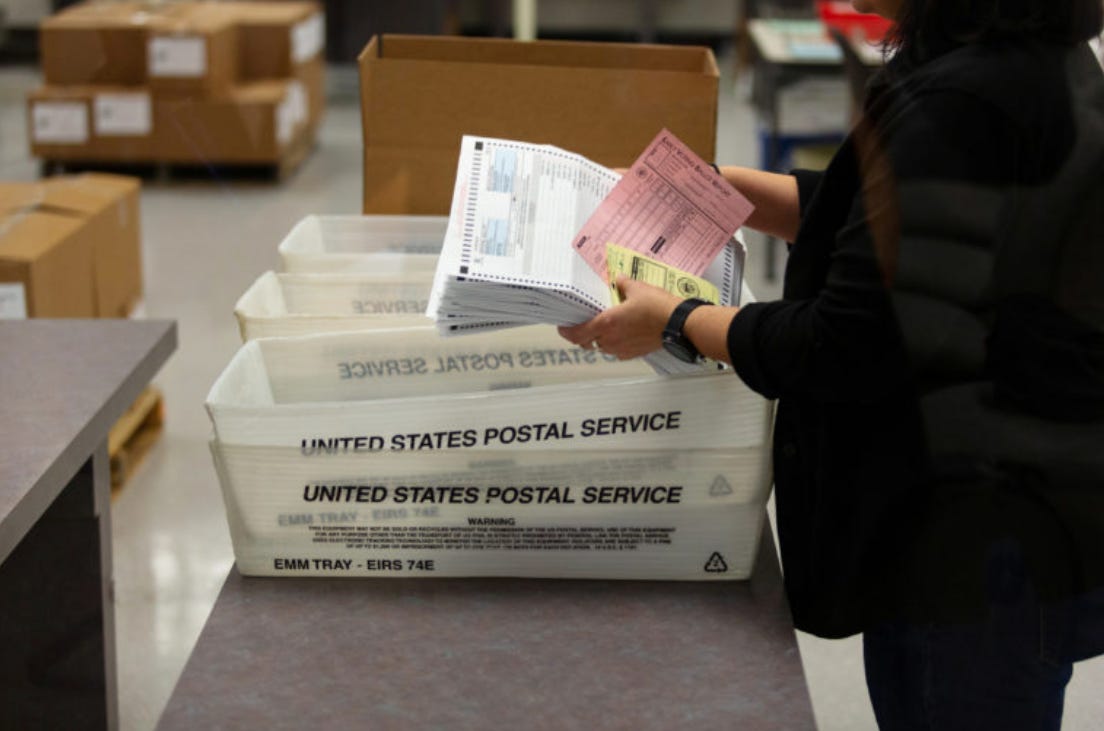
First came the February raid on Fulton County, Georgia, where the FBI seized millions of paper ballots and voter roll data from county election offices, with Tulsi Gabbard mysteriously lurking nearby. At the time, election experts and county election officials issued a stark warning: This was a bald attempt to subvert the democratic process and relitigate long-debunked election conspiracy claims.
Now it’s another major jurisdiction in another swing state—Maricopa County in Arizona. Yesterday, the GOP leader of the Arizona Senate, Warren Petersen, announced that on Saturday he had turned over records to the FBI relating to the 2020 presidential election. He gave no prior notice to the public of the official demand for records, which he received on Friday. Instead, he claimed, after the fact, that he was simply complying with a federal grand jury subpoena relating to a Republican-ordered audit of the vote count.
No one doubts that these events in Fulton and Maricopa counties are connected. But what do they indicate about what’s really going on, beyond the general storyline that “they’re messing with the midterms”?
The real reason, once you unpack what’s happened, is quite concerning. A code red, I’d argue. Before we get to that, let’s talk about what just occurred in Arizona.
No warrant needed
The federal grand jury subpoena served on Petersen covered “several categories” of documents, though what exactly he turned over to the feds remains unclear. Notably, unlike in Fulton County, the White House saw a compliant and cooperative ally in Petersen, and he put up zero resistance to the subpoena. Indeed, he didn’t even alert the press or the rest of the government before unilaterally complying with it.
Democratic state Attorney General Kris Mayes was outraged, noting that multiple audits, investigations and legal challenges resulted in no evidence of widespread election fraud that could have changed the outcome of that contest. Petersen knows this, Mayes charged, and yet “he remains an unrepentant election denier.”
The use of a federal grand jury to subpoena documents cleverly gets around a chief problem that the Justice Department faced in Fulton County: whether the search warrant actually established sufficient probable cause. That question has already led to a high profile court challenge by Fulton County officials, who are seeking to recover the materials seized by the FBI.
As ABC News reported back in February, those officials had filed a motion in court arguing that
the FBI agent behind the search warrant application “intentionally or recklessly omitted material facts” about purported discrepancies in the 2020 election in Georgia, after the Justice Department last week released the sworn affidavit that was the basis for the search warrant.
“Despite years of investigations of the 2020 election, the Affidavit does not identify facts that establish probable cause that anyone committed a crime,” Tuesday’s filing from Fulton County said.
And two weeks ago, attorneys for Fulton County upped the stakes by arguing that the FBI had misled the judge in order to obtain the warrant used to seize the 2020 ballots. The supporting affidavit had simply rehashed long-debunked election conspiracy claims, making it vulnerable to challenge.
A federal grand jury subpoena to a sympathetic politician like Petersen, however, is a cynical way to avoid this level of judicial scrutiny. A grand jury has significant leeway to conduct “discovery” as part of any “criminal investigation,” meaning it can be leveraged by bad faith federal prosecutors to do their work without having to answer to any judge, or to present and later defend probable cause for a search warrant.
State and county election officials around the country should take note of this new White House strategy, which is a possible end-run around local election officials’ authority. They should immediately take steps to ensure that election records are not simply turned over by Trump’s political allies as part of a bogus grand jury investigation, particularly in states where GOP officials have independent access to election records as part of earlier official audits or investigations.
Twin Trump obsessions
The actions in Fulton and Maricopa counties reveal two things about the Trump election playbook, per election lawyer Marc Elias of Democracy Docket.
First, they show Trump remains obsessed with bringing charges against state election officials who oversaw the counties where he claims, without basis, that widespread election fraud occurred. Such charges can have a deeply chilling effect upon the county election staff, discouraging civil servants from participating in the democratic process and riling up Trump’s extreme MAGA base, with its penchant for threats and violence.
Second, the Fulton raid and the Maricopa subpoena are really about the 2026 midterms and running “practice seizures” of ballots and other materials. Each time they do this, the Justice Department and the FBI learn a bit more about what does and doesn’t work.
This includes things such as resolving evidentiary issues with affidavits and warrants and knowing which judges will and won’t approve them in key counties. It also gives them a preview of the legal challenges Democrats will mount.
The practice runs can also answer basic logistics questions for the White House, including where election materials are located, how to physically seize millions of ballots in a short amount of time, and even how many agents and trucks you would need to haul them away quickly.
As the federal grand jury subpoena just demonstrated, the practice runs can test other mechanisms that could get around pesky things like probable cause and judicial review, even while allowing the FBI to get its hands on the ballots and machines. Quick possession of such items might make it impracticable or even impossible for local and state and county officials to perform critical recounts and audits.
The big steal
Importantly, these twin actions by the feds in Fulton and Maricopa counties aren’t the end of the White House’s planned operations. They are likely just the beginning. Trump has made clear that he wants to move against a total of 15 large Democratic strongholds to sow doubt, cause chaos, and try to steal or nullify the November election. The number he’s thrown out suggests that he and his people have actively discussed something close to 13 other jurisdictions where they want to “nationalize” the election—meaning seize ballots, machine tabulators, and voter roll data from election offices if they can’t obtain them voluntarily.
The likely counties in the list include Wayne County in Michigan, Philadelphia County in Pennsylvania, Milwaukee County in Wisconsin, and Clark County in Nevada—all places in swing states where large Democratic votes totals were challenged in lawsuits after the 2020 election based on unsupported allegations of widespread fraud.
Preparing for the attack and building resilience
There is good news to balance this parade of horrors. Even as the Trump regime learns what works and what doesn’t work in these target counties, state and local election officials are growing wise to the playbook. That means they can prepare well in advance to defend ballots, machines and data from being forcibly seized by or secretly turned over to the federal government.
This includes specific training on how to successfully challenge warrants and subpoenas and buy some critical time in the event of a federal raid. It includes having lawyers ready to seek temporary restraining orders to freeze the status quo and prevent the federal government from getting its hands on critical state election materials.
Our legal system tends to grow more resilient and responsive with each new attack upon our democracy. In particular, judges can and should learn about what’s already taken place in these two jurisdictions. They should view the federal government’s claims of “election fraud” skeptically and refuse to grant the presumption of regularity to federal actions or affidavits, just as they have with ICE’s perjury-ridden court filings.
We the voters can prepare for the inevitable flood of challenges to our registrations and ballots, particularly in GOP-controlled states. This begins by keeping a watchful eye on our own voter status (check yours at this site and do so again in the fall). We can also vote early and in person in overwhelming numbers against the GOP. And we can obtain and share accurate information about where precincts are located, because local GOP officials may have moved them without notice, just as they recently did in Texas.
I’m often asked what else ordinary people can do in this era of democratic backsliding besides donating, letter writing and calls, and making their voices heard online and in the streets. All of those are important, but actual local organizing will likely prove the most impactful use of time. That means helping get out the vote through phone banking and postcard writing, volunteering for campaigns, or even serving as an election worker or monitor where needed.
If the Maricopa subpoena shows us anything, it is that the regime prefers paths of least resistance. Fulton County is currently proving messy and difficult, so the Justice Department sought a far easier route in Maricopa County.
That makes our response to these moves crystal clear, even if challenging. We, and in particular our elected leaders and state and local election officials, must make it hard for the White House everywhere to execute its election takeover plan, so that there are no easy paths for it anywhere.
I live in Maricopa County and had to watch the total ineptitude of the Cyber Ninjas "audit" the election. They had no idea how to go about it, had absolutely no security - a news person wandered around and no one questioned him. It was a total farce. And in the end they found more votes for Biden!
Send in secret group to relocate ballots to a secure location and when they come to try and take them oops I guess they aren’t here?