
Trump’s Big Inflation Problem
High prices are spelling disaster for the GOP in the midterms. Trump’s solution is two-fold, but neither is likely to work.

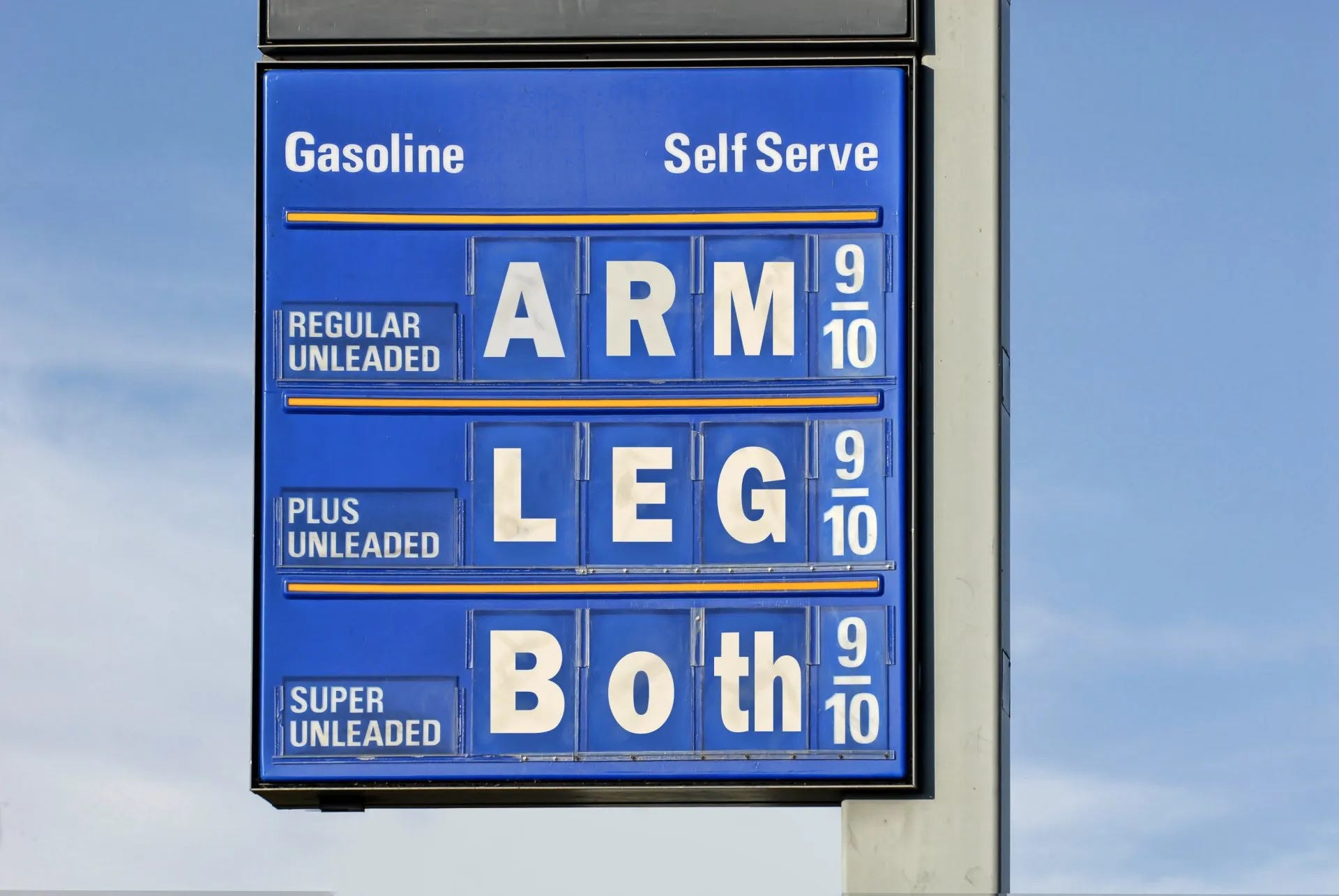
Donald Trump came into office promising to bring gas prices down, riding a bumper sticker slogan—“Drill, baby, drill”—and the go-ahead from voters who blamed Democrats for post-pandemic inflation. Trump committed to bringing electricity prices “5-0, fifty percent” below what consumers were paying. He made that promise explicitly, a month before the election, in a speech in the swing state of Michigan:
He also told the Economic Club of New York in September of 2024 that he would be “getting gasoline below $2 a gallon.”
Sixteen months later, Americans are paying $4.50 a gallon, inflation is at its highest point in nearly three years, and real wages have turned negative.
The Iran war—a war of choice that Trump started—is the proximate cause. Trump’s response? Get over it.
High prices are fast becoming the defining political liability of Trump’s second term. Many of the voters who turned out for him, particularly Latinos and young men, did so on his express promises to attack inflation on “Day One.”
Economists say prices are not headed where the White House claims, even if the war in the Persian Gulf hits pause. Here's why.
The numbers
The Bureau of Labor Statistics, which is never happy to deliver bad news in the age of Trump, reported that the annual inflation rate accelerated to 3.8 percent in April. That’s the highest reading since May 2023, driven by energy costs jumping a whopping 17.9 percent, the steepest annual increase since September 2022. Gasoline alone is up 28.4 percent year over year, and fuel oil is up an astounding 54.3 percent.
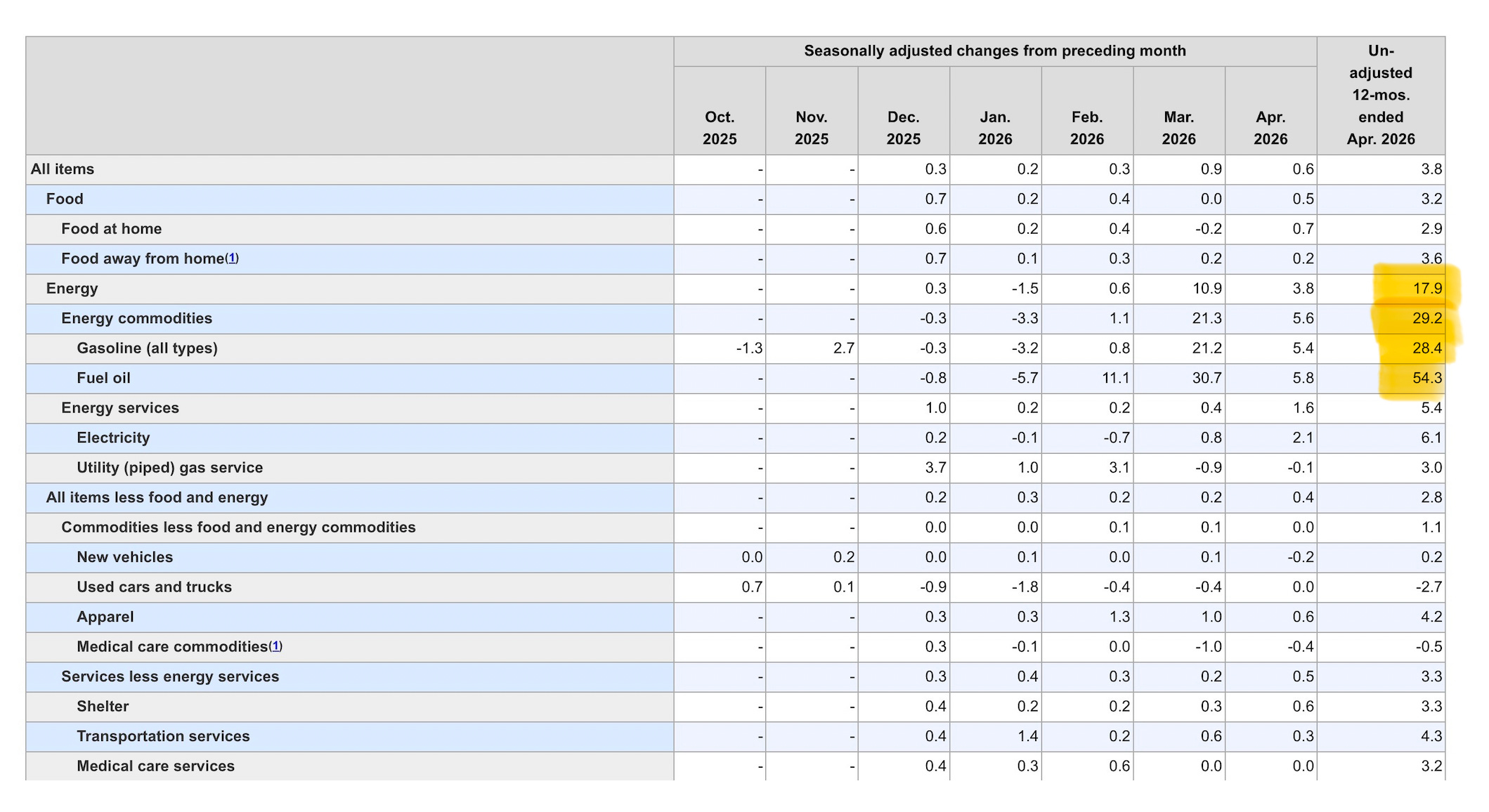
It didn’t have to be this way. Before Trump’s war in Iran began in February, inflation had actually eased to 2.4 percent. It has more than doubled in two months. And for the first time in three years, workers are falling behind; paychecks grew 3.6 percent from April of last year but prices rose 3.8 percent. That means Americans’ wages are no longer outpacing inflation.
At the pump, the picture is bleak. Consumers are paying a national average of $4.50 per gallon as of this week, up from about $3.14 a year ago, a surge of roughly 50 percent since the war began on February 28.
It isn’t only gas. Per the BLS report, “food at home” (generally speaking, grocery prices) rose 0.7 percent in a single month, the biggest monthly gain since August 2022. Beef is up 14.8 percent year over year. Airline fares are up 20.7 percent. Because energy costs are embedded in the price of shipping everything everywhere, the war has raised transportation costs for drivers and businesses alike. Economists are warning that the pass-through will extend to nearly all manufactured goods, which are energy-intensive, as well as to agriculture and construction.
Eighty-one percent of Americans say gas prices are straining their household budget, and the sentiment cuts across party lines. Seventy-nine percent of Republicans say that prices are hurting their families too. If unaddressed, it could spell an electoral wipeout in November.
The White House’s response
Whoever is guiding messaging from the Oval Office isn’t helping. The regime has offered two responses to the inflation problem, and they contradict each other.
The first is that higher prices are simply the cost of preventing a nuclear Iran. When asked Tuesday whether Americans’ financial pain was motivating him to make a deal, Trump replied: “Not even a little bit.” He continued: “The only thing that matters when I’m talking about Iran: They can’t have a nuclear weapon. I don’t think about Americans’ financial situation. I don’t think about anybody.”
This wasn’t Trump misspeaking. He doubled down when asked again by Fox News anchor Bret Baier, calling it a “perfect statement” before adding, “When people hear me say it, everybody agrees, short-term pain. It’s gonna be short-term pain.” (Everyone does not agree.)
Some version of that answer, harsh as it sounds, might be defensible as a national security argument—had Iran been on the verge of producing a nuclear weapon, which our own intelligence agencies said it was not. But a president who won on the economy now telling voters he doesn’t think about their financial situation is a political gift to Democrats.
Even Trump’s own advisers can’t stop him. One Trump adviser acknowledged to Axios that “Iran has more time, and they’re counting on our political calendar to benefit them.” In other words, the political math isn’t entirely lost inside the White House, even as the president expresses cold indifference to it.
The second message is that the price pain is temporary. White House spokesperson Kush Desai put it this way: “President Trump has always been clear about temporary disruptions as a result of Operation Epic Fury, and how energy prices and inflation will quickly drop once the Iranian nuclear threat is neutralized and the Strait of Hormuz is fully reopened.”
But even Trump’s own Energy Secretary doesn’t agree. Chris Wright acknowledged on CNN that a return to sub-$3 gas “could happen later this year” but might not occur until 2027. “Later this year or maybe 2027” is not the same thing as “quickly,” especially with a pivotal election between now and then.
The gap between those two messages—that the pain is worth it and will be over soon—has left the regime’s mouthpieces scrambling as hopes for a quick resolution fade. The White House has floated a suspension of the federal gas tax, which raises an obvious question: why, if the problem will resolve itself? And at most, it would knock just 18 cents off a gallon currently averaging more than $4.50.
Why “wait for peace” isn’t an answer
The expert consensus on the near-term outlook is clear and grim. The White House argument that prices will fall once the conflict ends rests on assumptions that analysts across the political spectrum say don’t hold up. There are three reasons.
The Strait isn’t some on/off switch
The Strait of Hormuz cannot be opened and closed like yet another giant faucet in Trump’s imagination. A ceasefire, even a real one, will not on its own restore tanker traffic.
The logistics of reopening the world’s most critical oil chokepoint will take months. We’ve already seen how this plays out in practice: When Iran briefly announced the Strait was open on April 17, oil prices dropped 11 percent. But commercial traffic still failed to return to pre-war levels because of the uncertainties around what “open” really meant.
To get traffic moving, Trump announced “Project Freedom” to provide naval escorts to commercial tankers. But that, too, failed to calm markets. Saul Kavonic, senior energy analyst at MST Financial, explained why: “Normalising the flow through the Strait of Hormuz will take more than what Project Freedom is offering, whilst the yawning gap in oil supply will take months to resolve.”
How many months are we talking? Brian Bethune, an economics professor at Boston College, put the optimistic scenario at about two months to normalize prices, if the conflict is resolved in the next few weeks. The pessimistic scenario, Bethune said, is “at least double that or even longer—six to nine months to get back to where we were in January or February.”
The World Bank’s baseline forecast, which assumes the worst supply disruptions will ease this month, still projects global oil prices will average $86 per barrel in 2026 before falling to $70 in 2027.
The fertilizer shock hasn’t even hit groceries yet
The Strait of Hormuz isn’t just an oil chokepoint. More than one-third of globally traded fertilizer passes through the strait, and in the first week of the war, the price per short ton of urea fertilizer imports in the U.S. jumped 30 percent. By mid-May, urea prices had nearly doubled since late February, with transit volumes through the Strait down more than 95 percent from pre-conflict levels.
The rtiming is what makes this so dangerous. As Anusha Arif of TD Economics explained, “Fertilizer shortages during the spring 2026 planting season will impact crop yields over the next year and push food prices higher, well into 2027, extending inflationary risk well beyond the near-term.”
The crop is already in the ground. Farmers across the country planted this spring with less fertilizer than they needed, at prices they could barely absorb. The price increases will show up at the grocery store in the fall and into next year, regardless of what happens at the negotiating table this week.
Wolfe Research chief economist Stephanie Roth estimates the disruption could raise “food-at-home” inflation by roughly two percent, adding about 0.15 percentage points to headline inflation on top of roughly 0.40 points from energy. Those grocery price hikes are coming whether or not there’s a deal.
Even if prices drop, voters won’t forget
The third problem is psychological. Mark Zandi, chief economist at Moody’s Analytics, expects inflation to keep accelerating through the summer even if the conflict ends in the next few weeks. That means voters will be living with peak prices through the heart of campaign season. And as we learned under Biden, once those prices are baked into people’s experience, the political damage doesn’t simply reverse when the numbers improve.
One Republican operative, speaking to NOTUS, put it this way: “If other things are low, it kind of doesn’t matter because the gas prices are high. People pump gas once a week or more. They see that expenditure often, just like groceries. Over time that builds this callus where even if they go down, it’s baked in. Yeah it got better, but we already thought it was too high.”
The White House needs prices down before November, but it likely has only until Labor Day. That’s when voters’ judgments on what they’ve been paying will be baked in—and they won’t care what the projections say after that.
Tick tock, Donald. Time’s almost up.
I think the truth is--he doesn't care. The whole scenario of his presidency is a fairy tale that he makes up minute-by-minute in his mind. And that, to him, is reality. The GOP doesn't panic because they have blind religious faith that he is invincible. Problem is, they are totally prepared to make the messiah fairy tale come to pass for him IN ANY WAY NECESSARY. Unfortunately, the rest of us are along for this ride, like it or not.
Many fossil-fuel specialists are saying that global oil reserves have been drawn down at unsustainable rates to meliorate price rises, but this coming June could be the crunch point, and crude oil soars, creating the start of "demand destruction", i.e., a mad scramble to replace hydrocarbon in national economies.
trump's answer: Hey, no worries, we're the leaders in oil production, and we're dealin' today...come on down! What he doesn't say is that US crude will be sold at "market price", and even to American consumers...take note, MAGAts, that means YOU.