
Trump’s War
Despite campaigning as the anti-war candidate, after just five months in office Trump has dragged us into yet another war in the Middle East.

I was going to post a joyful and special Pride edition of my newsletter today, but that sadly will have to wait given the news last night.
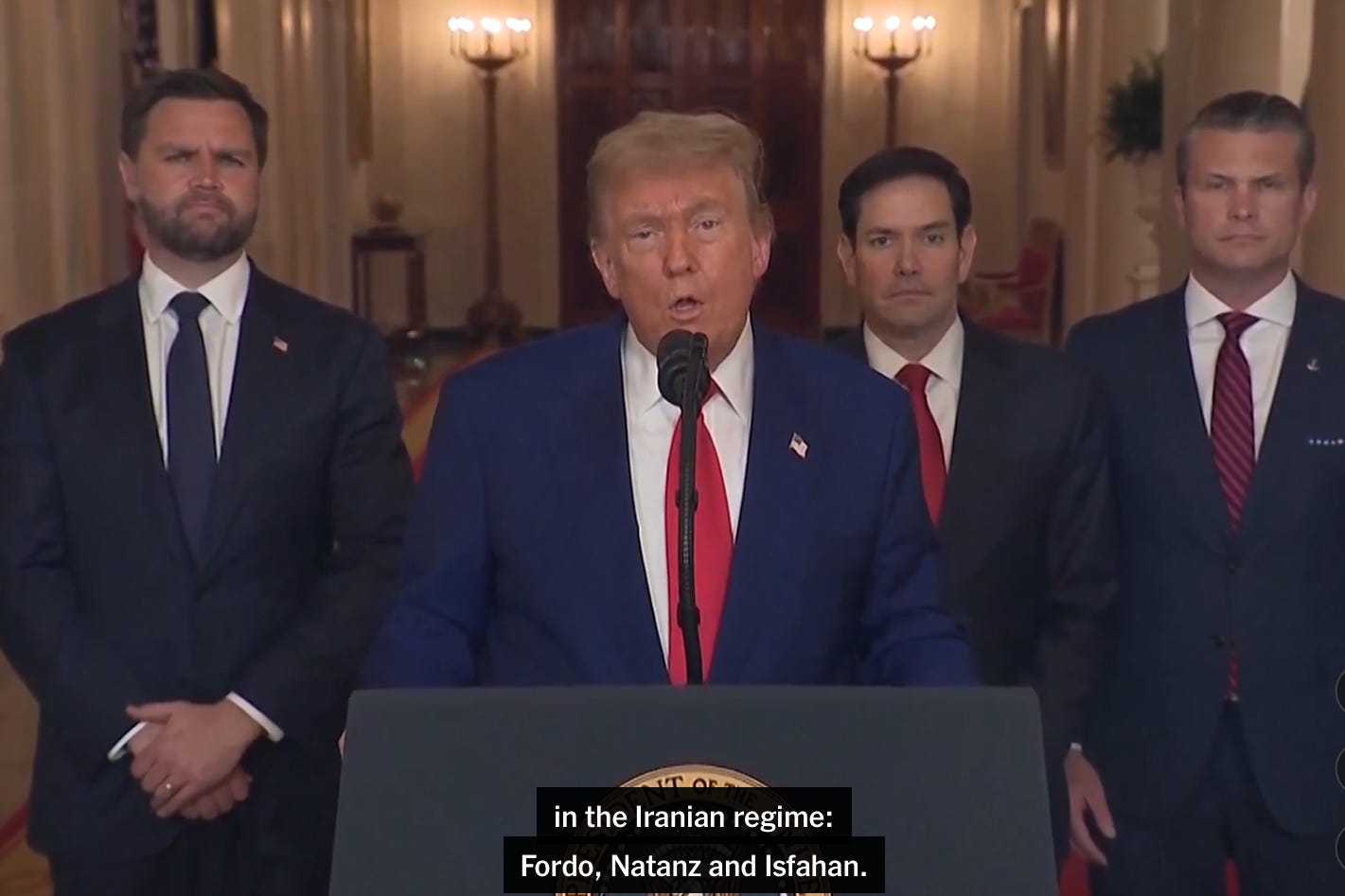
As you have no doubt heard by now, Donald Trump launched an attack upon three nuclear facilities in Iran yesterday, targeting sites at Fordo, Natanz and Isfahan. He deployed U.S. B-2 bombers to drop 30,000 pound “bunker buster” munitions, as well as fired Tomahawk cruise missiles from U.S. vessels.
It’s too soon to know the consequences of the U.S.’s entry into the war. If Iran’s nuclear capabilities survived, it’s unclear whether Trump will order more strikes. If Iran retaliates against U.S. bases in the area, we don’t know if Trump will order yet more bombings.
The idea that we are getting bogged down in yet another war in the Middle East, after having finally and painfully exited two protracted wars in the region earlier this century, is stomach turning. That it came from a president who promised “no more wars” is a deep betrayal to many of his most ardent followers, though they are unlikely to ultimately abandon him over it.
They are, after all, in a cult.
The attack carries significant risk. There are some 50,000 U.S. troops in the region who could come under attack.
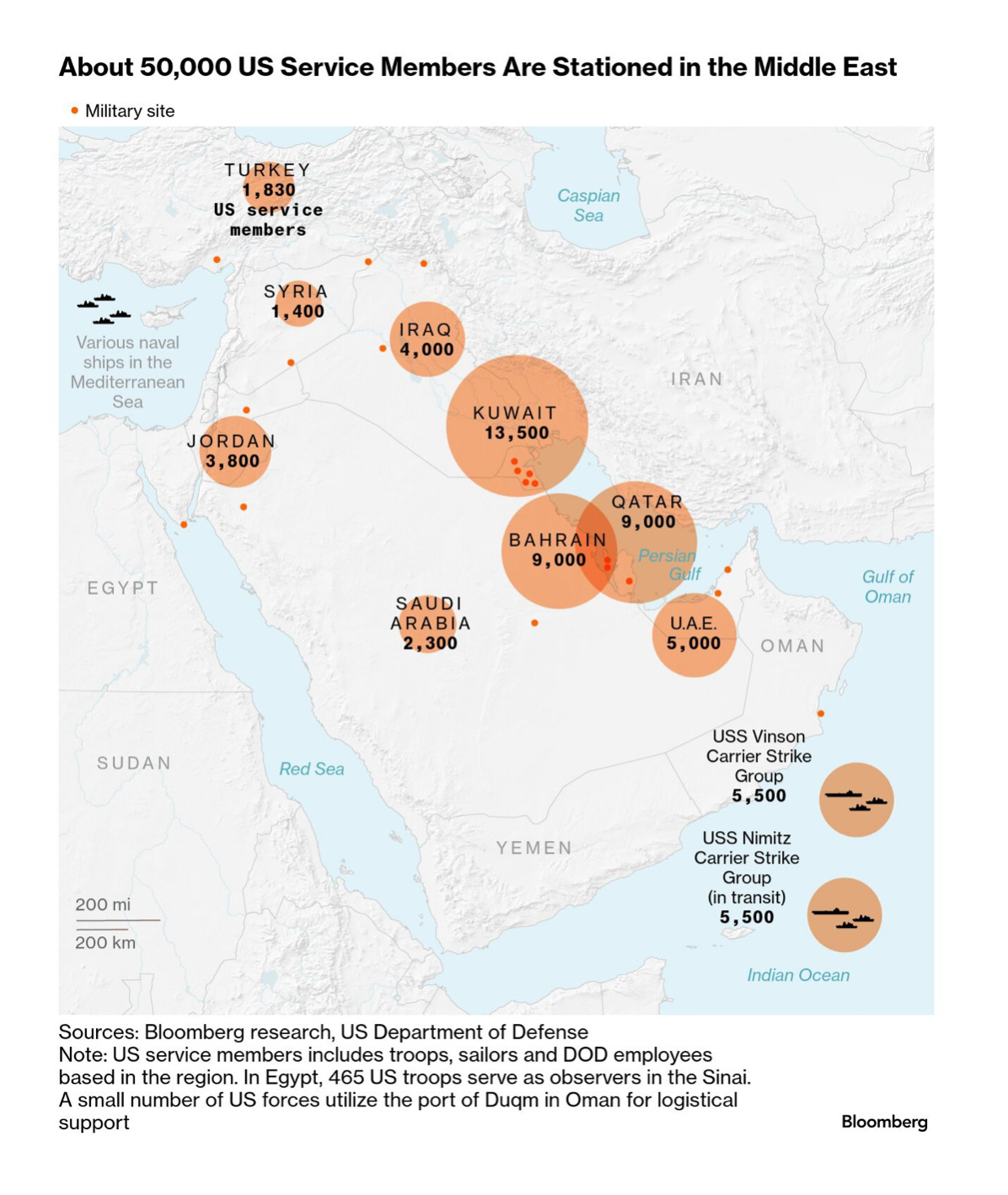
A growing conflict in the region could threaten oil supplies, driving prices and inflation up. Iran might even retaliate against U.S. citizens everywhere, including within our own borders.
How can we begin to wrap our heads around all this? It’s helpful to return to some basic principles about war, which we’ve learned generally apply no matter what the war is about or why we are in it. I’ll take as a starting point five considerations that U.S. historian Timothy Snyder raised last night:
1. Many things reported with confidence in the first hours and days will turn out not to be true.
2. Whatever they say, the people who start wars are often thinking chiefly about domestic politics.
3. The rationale given for a war will change over time, such that actual success or failure in achieving a named objective is less relevant than one might think.
4. Wars are unpredictable.
5. Wars are easy to start and hard to stop.
For today’s discussion, let’s expand upon these and apply them to Trump’s new war against Iran.
Trump‘s confident assurances may well be false
Last night, as Prof. Heather Cox Richardson recorded in her newsletter, Trump told the nation in an address,
“Tonight, I can report to the world that the strikes were a spectacular military success. Iran’s key nuclear enrichment facilities have been completely and totally obliterated.”
Yet this morning, the Pentagon is already sounding a more cautious note. The New York Times is reporting that senior Defense Department officials believe these facilities suffered “severe damage” but that it was too soon to say whether Iran still retains some nuclear ability.
For its part, Iran claims that the sites the U.S. attacked have been empty for months, its stockpiles long since relocated. That would make sense if you were the Iranians and for weeks the sites have been the subject of a possible airstrike.
The truth will take some time to ascertain, but we should be wary of narratives coming out of either side during the fog of war.
The war might be waged for domestic reasons
As I wrote about earlier, Trump’s decision to attack Iran may be a ploy to divert attention from his mishandling of the economy, the unpopularity of his mass deportations efforts and his falling poll numbers. Or, they could be his way of putting himself back into headlines as a strong leader after weeks of vacillations and failures in his tariff policies. Perhaps he believes a war will galvanize the public behind him as he becomes a war-time president like George W. Bush.
Maybe it’s a bit of each, driven by the relentless pundits on Fox News.
And should Iran retaliate against U.S. troops or citizens abroad as it has threatened—or more ominously, should potential Iranian “sleeper cells” awaken within the U.S. and conduct terrorist attacks—Trump could use that as a pretext to declare emergency powers to further curtail civil liberties in the U.S.
But gambling on a foreign war to improve his stature at home could be a losing proposition over time, particularly as costs mount, objectives blur and U.S. casualties increase.
The one thing we know about Trump is that he will act in what he believes is his own best interest in the moment. Our responsibility in opposition to this is to ensure he understands the domestic costs of an all-out, drawn-out war are very high and force him to end it as quickly as possible.
The Trump bait and switch
As a practiced con artist, Trump is quite comfortable with promising one thing but delivering something else entirely. He’s also quite willing to sell the public on an idea under one rationale, but will shift gears entirely if circumstances change.
We saw this first hand with his tariff policies. Trump claimed he wanted to bring manufacturing back to the U.S. and to put a stop to the “terrible deals” that the U.S. had struck with its trading partners. So he hiked tariffs sky high, only to quickly lower them back or put them on hold while he “negotiated” with 90 countries. Such a yo-yo policy on tariffs is the last thing that would convince manufacturers to invest in onshoring manufacturing. And the “deals” we are winding up with simply raise import taxes across the board on U.S. customers in the form of higher prices on goods.
Trump’s stated goal with Iran was to obliterate its nuclear weapons capability. But Iran isn’t likely to lie down and do nothing after this attack. After all, the regime there has to worry about its own credibility and pressure from internal opposition. Just as the war is rallying supporters to Trump’s side here in the U.S., so too could it buttress the popularity of the current government in Iran among its populace.
Watch for his stated goal about destroying Iran’s nuclear capabilities to fall away, especially should Iran attack U.S. interests, troops or civilians in response. We could easily see his goals shift to a more generalized “neutralization” of Iran as a military threat—a much wider and costly end to pursue.
This war is unpredictable
As Ret. Gen. Mark Hertling noted after news of the attack broke,
There is no “one and done” in any conflict.
The opponent always gets a vote, and unless we’ve prepped for all the things Iran may do we’re gonna have some surprises.
Here, it’s useful to put ourselves in the shoes of the nation we just attacked. For weeks, the Iranians have known that the attack could happen as Trump’s rhetoric grew more bellicose and then Israel launched a full-blown war. The leadership in Tehran has understood for some time that the U.S. might get involved, and no doubt it has discussed what the plan would be should that occur.
Iran know it can’t go toe-to-toe with the U.S. directly in a conventional war, especially where the U.S. has air superiority. But that country has learned a lot from the recent unsuccessful campaign the Pentagon launched against one of its proxies, the Houthi fighters in Yemen. Despite a massive bombardment effort, the U.S. was unable to defeat this much smaller force with air power alone. Instead, the U.S. military had to scale down and call off the mission, which ultimately cost billions of dollars and resulted in embarrassing incidents involving pricey navy fighters falling off aircraft carriers and into the ocean.
It’s highly likely that Iran does have something in its back pocket and has not entered this conflict wholly unprepared. It’s also highly likely that the current Pentagon leadership has not prepped for all the things that Iran may do, led as they are by inexperienced and incompetent officials such as Defense Secretary Hegseth.
Will Iran attack U.S. bases? Increase attacks on Israel? Cut off oil shipping out of the Straits of Hormuz? Conduct terrorist attacks? Seek assistance from China, which buys most of its oil from Iran? We will be in reactive mode following whatever Iran does short of standing down immediately, which while possible remains unlikely.
Trump began this war without congressional authorization. Stopping it will prove messy.
We all know that Trump didn’t go to Congress to seek a vote before ordering B2 bombers in the skies and the launch of cruise missiles. He also didn’t brief Democrats in Congress, or any Democrats among the Gang of Eight who are supposed to be privy to intelligence briefings, about his plans.
Democrats may successfully force a vote on whether to ratify the decision to go to war now that hostilities have begun. Most Republicans, and some Democrats such as Sen. Jon Fetterman (D-PA), will vote to approve it. But the vote could come back to haunt the GOP if the war doesn’t conclude quickly.
If Iran hits back in any way, Trump has threatened that more bombings and missile strikes will ensue. At some point it will become hard to say who is hitting whom for what. All that the Iranians will remember is that the U.S. and Israel started the war, and all that they will tell their people is that Iran will finish it.
On the last point, Iran will have history on its side. The U.S. public can’t abide endless wars in the Middle East, with their price tags in the trillions of dollars. Iran also understands that the war could prove highly divisive within the Republican base.
The higher the cost and the longer the war continues, the less support it will have, just as we’ve seen happen with Ukraine. Only this time it won’t take such extensive psy-ops to convince the U.S. electorate to abandon the war effort. Most Americans are already opposed to U.S. involvement in yet another war in the Middle East.
If Trump has any street smarts left, he will want an early exit, but Iran may not give it to him. That would add war to an already growing list of grievances U.S. voters could carry into next year’s midterms, alongside persistent inflation, the loss of the social safety net, the cruelty and disruptions from mass deportations, and possibly even a recession.
That Trump may have bullied his way into a terrible mistake should come as no surprise. It’s easy for him to be caught in the moment, to ignore all his advisors, and to plow ahead on instinct. That he will likely double down on the bullying as a result, both against our sworn enemies abroad and his perceived enemies at home, should also be expected. Opposition to the war, and to the police state he is building at home, will now go hand in hand because both require militarized, declared states of emergency to maintain.
Once the rush of excitement among his base over the massive display of U.S. firepower recedes, and the reality sets in around what yet another war really means for our country, Trump will be more heavily burdened politically than before. The anti-war candidate will be a wartime president, and his MAGA coalition could begin to fracture.
That is not a political silver lining, I should emphasize, but rather the very pathway to end this war and spare the human misery and death that could follow from it.
"Yet this morning, the Pentagon is already sounding a more cautious note. "
Upon further inspection, we have concluded that we should have stuck with inspections.
It's horrifying. Absolutely horrifying what Don Taco is doing to our country - and the world!!!