
USPS Is Trump’s Election Chokepoint Target
A proposed U.S. Postal Service rule, already facing court challenges, could throw the midterms into total chaos. And that’s by design.

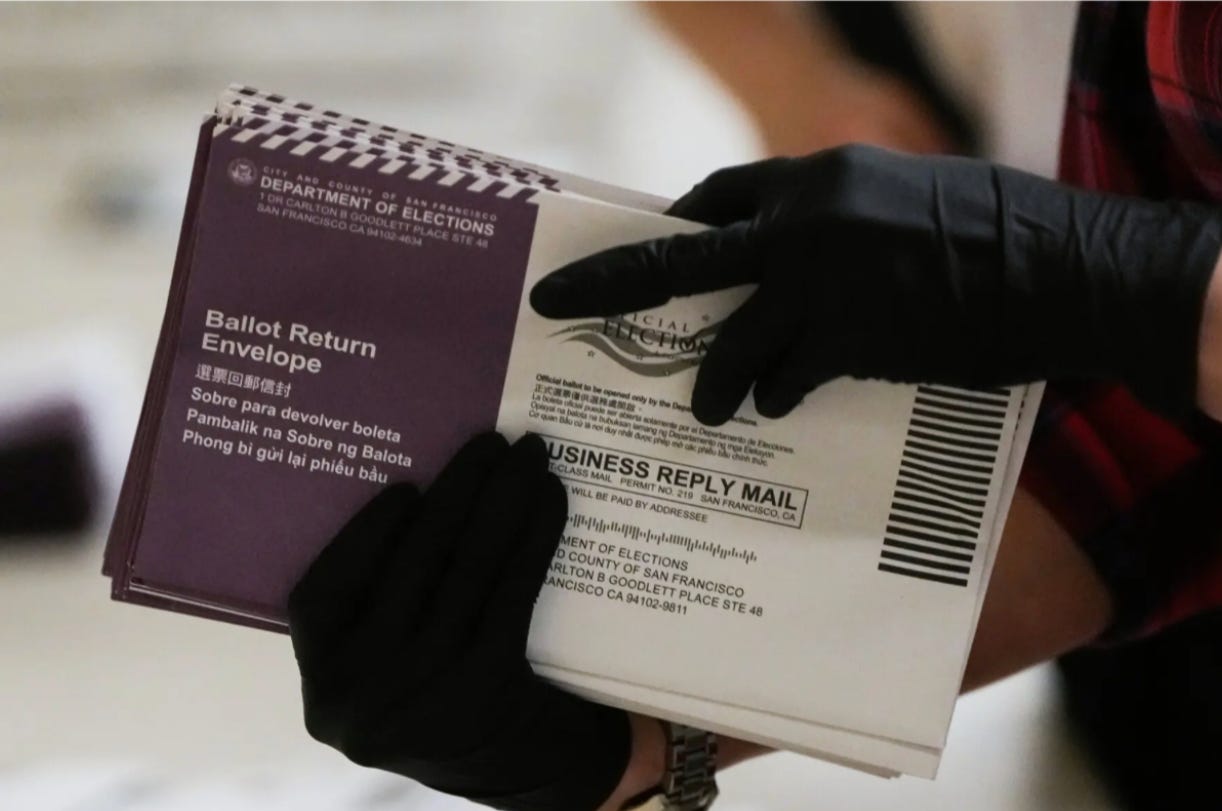
Earlier this year, Rebekah Caruthers, president of the Fair Elections Center, made a clear prediction. She expected federal intimidation at the polls, with ICE agents stationed near voting locations and federal officers deployed to suppress turnout among minority voters. This was a reasonable fear. The Trump White House, after all, had spent the last year signaling exactly that kind of escalation.
She now thinks she was wrong about the weapon of choice: Trump has targeted the U.S. Postal Service as a vulnerable choke point.
“We can’t just look at this new post office rule in a vacuum,” Caruthers said recently. In her view, the defining threat to voting rights this fall isn’t federal thugs at the polls. It’s whether your ballot arrives in the mail at all.
The rule and the order
The weapon Trump has handed the USPS was forged from a proposed rule, published on June 2, implementing an earlier White House executive order. In March, Trump directed the agency to withhold mail ballot delivery from any state that refuses to hand over its voter rolls to the federal government. The rule was then drafted to comply with that directive.
There are two operative parts that concern voting rights activists.
DMM 705.24.4 provides,
“States (including authorized election officials and their mail service providers) will notify the Postal Service of the individuals to whom they are mailing a mail-in or absentee ballot, along with the unique barcode applied to the outbound and return ballot mail envelope for such individuals such that the name and barcode of the voter will be included on a Mail-In and Absentee Participation List.”
DMM 705.24.5 then states,
“The proposed rule also implements a verification procedure for compliance with the proposed standards prior to acceptance by the Postal Service of the outbound ballot mailpiece and the blank return ballots included within such mailings. The verification process by the Postal Service would confirm that a state submitted a list consistent with the conditions laid out in the proposed rule, and that the outbound ballot mail, and thus the blank ballot that could be returned by mail, is destined to individuals on the list, by checking the barcodes.”
If your eyes are glazing over, let me put that into plain English, with an example.
Under the first part, before any mail ballots go out, a state’s election officials must register with USPS and upload a list of every voter slated to receive one. That list must include not just the voter’s name and address but a unique barcode tied to that specific voter’s outbound envelope and the return envelope they would mail back. The list can be updated until the last day the state is legally allowed to send ballots out, but not after. On or about Election Day, USPS would provide the state with the compiled list as the official record of who was enrolled to receive a ballot.
Then, under the second part, before USPS accepts a filled-out ballot into the mail stream (meaning before it takes the envelope from the election office or mail vendor), a USPS employee would check two things: first, that the state actually submitted a compliant list; second, that the voter addressed on this ballot appears on that list, confirmed by matching the barcode on the envelope. If either check fails, USPS does not accept the mailpiece—and the ballot never enters the mail system.
Here’s an example of how it could block a mail-in ballot. Say a voter in Arizona registered to vote by mail and was properly added to the state’s mail voter rolls. Arizona uploads its participation list to the federal portal before ballots are scheduled to go out. But say the voter moved within the county before the upload and only updates her address with the DMV but not separately with the county election office because Arizona law allows DMV updates to carry over automatically.
The address update didn’t sync to the county’s mailing system before the list was uploaded. Her name is on the list, but the barcode on her envelope was generated from the old address record. When the county delivers its ballot mailing to the post office, a USPS employee scans the barcode on her envelope. It doesn’t match what’s on the federal list. USPS rejects the envelope. Her ballot is returned to the county office.
By then it’s days before the election. If the county catches the error, reprints the envelope with the corrected barcode, re-uploads a corrected list and resubmits, and if USPS processes the correction in time, she might still receive a new ballot. If any one of those steps slips, she won’t get one.
That’s just one example among many. In the wrong hands (i.e., someone intent on obstructing as many mail-in ballots as possible), the "federal list” could knock out millions of valid votes, with voters completely unaware of what happened.
In short, the rule would transform USPS from a neutral carrier of election mail into a federal gatekeeper. It would suddenly have the authority to decide, before a single ballot enters the mail stream, which voters are eligible to even receive one.
That is a power the Postal Service has never held. Election administration is the province of the states and, to a degree, Congress. The power does not belong to the executive branch, and certainly not to the agency that delivers our mail. But the order and the rule reveal plenty about Trump’s broader strategy heading into the midterms and the particular vulnerability he has chosen to exploit.
Why the obsession with mail-in votes?
Trump spent years convincing his own base that mail-in voting was a fraud-riddled scam. Enough Republicans believed him that the two parties now vote in fundamentally different ways. In 2024, 37 percent of Democrats voted by mail compared to 24 percent of Republicans—a 13-point spread. Trump built the asymmetry himself, and is now moving to exploit it. He knows that restricting mail-in balloting will suppress more Democratic voters than Republican ones.
That asymmetry explains both the urgency of his executive order and the White House’s willingness to absorb the legal and possible political costs of pursuing it. Mail balloting, at its current scale, represents a self-created structural disadvantage the administration has decided it can no longer afford.
On March 9, standing before a gathering of House Republicans, Trump told his party that passing the SAVE America Act—legislation that would, among other things, restrict mail-in voting with limited exceptions for illness, disability, military service or travel—was essential. “It will guarantee the midterms,” he said. “If you don’t get it, big trouble.”
He added, in the same breath, that he wasn’t doing it for that reason at all. Which, of course, meant he was.
The legislative push for the SAVE Act failed twice. It cleared the House 218–213 in February, then fell short of the 60-vote threshold in the Senate in March. Republicans tried an end-run through a process called reconciliation, where only a simple majority is required, but that effort collapsed too, after four GOP senators—Susan Collins of Maine, Lisa Murkowski of Alaska, Thom Tillis of North Carolina and Mitch McConnell of Kentucky—joined Democrats to kill it earlier this month. Senate Majority Leader John Thune has acknowledged publicly that the votes simply aren’t there.
What Trump can’t accomplish through legislation, he typically pursues by fiat. His executive order arrived between those two legislative defeats, and the USPS rule was published after the legislative options ran out.
Trump hasn’t been subtle about any of this. In a February speech in Georgia, he told the crowd that his voting changes would mean the GOP would “never lose a race.”
Legal challenges
The new USPS rule faces two distinct categories of resistance, and either one could be enough to stop it before November.
Let’s start with why it’s unconstitutional. Under Article I, Section 4 of the U.S. Constitution, the states set the rules for federal elections, subject to Congress’s power to override them. The president isn’t supposed to be involved:
The Times, Places and Manner of holding Elections for Senators and Representatives, shall be prescribed in each State by the Legislature thereof; but the Congress may at any time by Law make or alter such Regulations, except as to the Places of chusing Senators.
Yes, “chusing” was a perfectly respectable spelling variant at the time.
As the Brennan Center noted, Trump’s executive order doesn’t just violate that allocation of authority over federal congressional elections. The same problem extends to USPS itself. Congress, not the executive branch, holds constitutional authority over the Postal Service, which Congress reorganized as an independent federal agency by statute in 1970. That move was meant to insulate the mail service from political interference.
Notably, when Trump attempted to direct the Election Assistance Commission, another independent federal agency, to change federal voter registration forms in his 2025 executive order, a federal court found that “neither the Constitution nor the NVRA grants the President the authority” to do so, and blocked the order. The same reasoning would apply to the USPS, which is also supposed to be an independent federal agency. (This is why we are all very nervous about the Supreme Court’s move to give the president full and unfettered control over independent agencies.)
The NAACP has identified a separate legal problem entirely apart from the constitutional questions. In 2020, amid pandemic-era mail delays that threatened millions of voters, the organization sued USPS. The resulting 2021 settlement required the agency to safeguard the timely delivery of election mail through 2028. The proposed rule, the NAACP argues, violates that agreement on its face; an agency that has committed under court order to deliver election mail cannot simultaneously construct a system for withholding it.
Practical implementation issues
There are significant practical obstacles that compound the legal issues. And in court, they may be just as important.
As discussed earlier, the rule’s core mechanism is a new federal registry—the “Mail-In and Absentee Participation List”—that states must populate before a single ballot goes out. At least 30 days before ballots are mailed under a state’s laws, each state’s chief election official must submit to USPS the names and addresses of every voter eligible to receive a mail ballot, along with unique barcodes tied to each outbound and return envelope. As the example earlier showed, any ballot that does not match the list—or whose envelope fails the new design standards—can be rejected before entering the mail stream.
Building such a system from scratch is no small burden. Even ballot envelope design can be costly and time-consuming. Tammy Patrick, chief programs officer at the Election Center and a former architect of the Postal Service’s own ballot-tracking barcode system, explained that a ballot envelope design is “way more complicated than one would ever believe it to be.” Even minor changes to envelope folding can affect how ballots are tabulated.
There is also a staffing shortage. More than a third of election offices nationwide lack a full-time employee. Some have no dedicated computer. Patrick said compliance will be impossible for many offices. “I haven’t seen much here that is giving me much confidence this can be done by the fall without creating a lot of confusion and potential chaos,” she said.
Former Pennsylvania Secretary of the Commonwealth Kathy Boockvar put the broader picture plainly. “Especially in situations like this, where there is no funding being provided and no time for election officials and voters to absorb the required changes,” she said, “voters will bear the brunt of a poorly planned, last minute attempt to upend electoral processes.”
The timeline makes Boockvar’s assessment hard to dispute. Trump’s executive order directs USPS to finalize the rule no later than July 29, or just over six weeks from today. Under the rule’s own terms, states would then have until August 4, just two business days, to submit their voter lists 90 days before the November 3 election.
Some experts say that the trap is the point. UCLA election law professor Rick Hasen wrote that the executive order “seems aimed to sow chaos in elections and depress turnout.” Any real engagement with it as serious policy, he argued, misreads its purpose.
The Brennan Center’s structural analysis points in the same direction. States that attempt compliance face operational chaos, forced to build untested systems on an impossible timeline. States that refuse face having their mail ballots withheld entirely.
A third path—“partial compliance”—carries its own cost. Some election officials have noted that submitting voter lists to satisfy the rule would hand the federal government essentially complete mail-voter rolls, the same data the Justice Department has been trying unsuccessfully to extract from blue states through litigation. In universal vote-by-mail states like California and Oregon, that list would amount to a near-complete voter database. In other words, the rule creates a suppression mechanism no matter what states do.
These practical obstacles could strengthen the legal case for blocking the rule before it does real damage. To obtain an emergency injunction, plaintiffs must show that harm is real, imminent and not easily undone. A rule forcing thousands of underfunded election offices to build new federal compliance systems in weeks—with no funding, no guidance and no margin for error before millions of ballots go out—makes that showing almost by itself.
Where things stand
Taken together, the legal landscape is well-trodden. Trump’s first executive order on elections, issued in March 2025, targeted proof-of-citizenship requirements and mail ballot grace periods. Multiple federal courts blocked it, and appeals continue.
The pattern is familiar: an aggressive executive action, a wave of litigation, judicial skepticism at the district court level, and a slow appellate process that may outlast the election at stake.
The difference this time is the clock. The November election is far closer, and the rule’s comment period closes July 2. The administration has until July 29 to finalize it. Meanwhile, election offices across the country are already preparing ballot materials for an election that the federal government is now threatening to disrupt.
One final observation: The “tackling fraud” justification for the executive order and the proposed USPS rule has never matched the evidence. Noncitizen voting, which these changes are supposed to address, is vanishingly rare. Every post-2020 audit and investigation has confirmed this. The order and the rule purport to fix a nonexistent problem, but their true purpose is to suppress valid votes by handing the regime unprecedented power over whose mail-in ballots get accepted.
My eyes didn't glaze over, but my blood pressure has shot up to concerning levels. Damn this administration!! 😡😡😡😡😡🤬🤬🤬🤬🤬
You tell Americans they can't do something and you'd better get out of the way. We WILL restore Congress to Democratic control. Whatever it takes. Count on it.