
Waverers and Wildcards
The GOP budget bill could still die in Congress, but that comes down to a handful of votes.

As I write this in the wee hours here in the U.K., the vote-a-rama is crawling along in the Senate in Washington, D.C., where the GOP’s “Big, Beautiful Bill” faces some tough if expected obstacles. If Republicans can get past those, as I expect they will, even if by a single vote, the bill must still go back to the House for approval.
There, things are getting a bit dicier. The problem for Republicans is this: The House passed a version that had fairly strict instructions to stay within spending limits. The Senate ignored those and is steaming toward a version that blows up the deficit by quite a bit more while slashing Medicaid benefits even deeper. This has the effect of earning the ire of both self-described fiscal hawks and Medicaid supporters in the House GOP.
Let’s take a look at where things stand.
Four senators needed
The math in the Senate hasn’t changed since I wrote about the bill yesterday. The GOP has a 53 to 47 majority, and it can win ties because of JD Vance’s tie-breaker vote. That means the GOP can afford to lose three votes and still pass the bill.
There are two announced “no” votes already, however. Those are Sen. Rand Paul (R-KY) who hates the deficit spending and debt implications of the bill, and Sen. Thom Tillis (R-NC), whose state will be hit hard by the Medicaid cuts. Tillis is now free to speak his mind and vote the way he wants because, after Donald Trump threatened him with a primary, he declared he would not seek reelection.
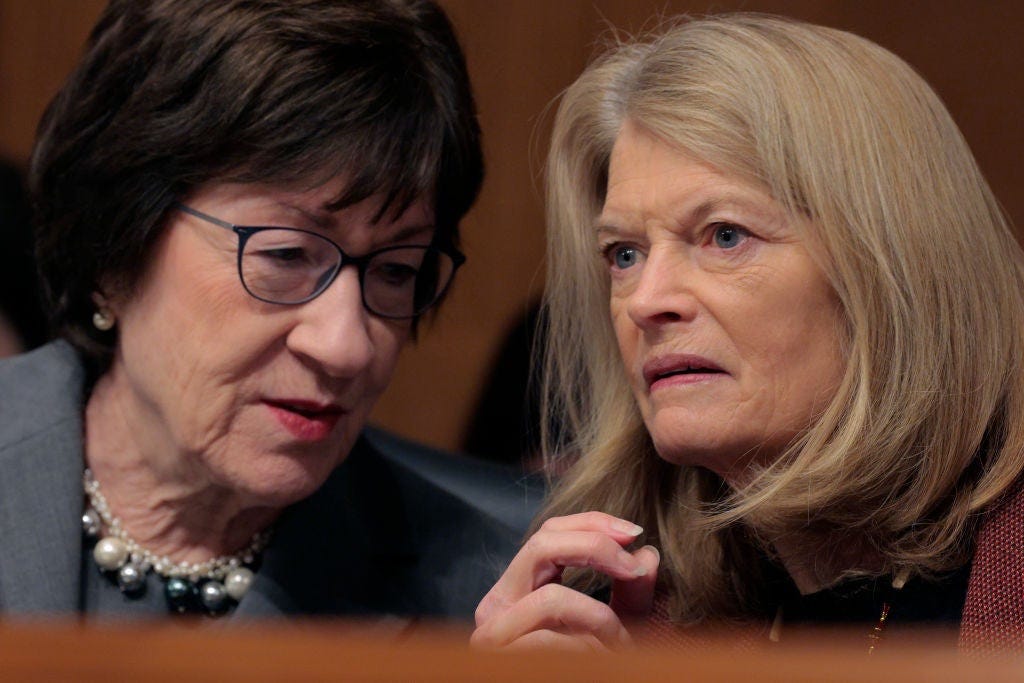
But are there two more votes? The next most likely waverers are Sens. Lisa Murkowski (R-AK) and Susan Collins (R-ME). To be frank, I’m not feeling great about either.
Murkowski demonstrated that her vote could essentially be bought after she overcame her personal misgivings once a bunch of exemptions and goodies were thrown Alaska’s way. Because the parliamentary gods have an ironic sense of humor, all of these promises were later nixed by the Senate Parliamentarian, so Murkowski’s vote to advance the bill gained her exactly nothing, at least so far. The pace of amendment votes slowed in the vote-a-rama because the GOP is reportedly working furiously behind the scenes to cobble the votes they need together. This likely includes new ways to induce Murkowski to vote “yes,” using some other, as-yet-undisclosed bunch of carrots. (When Thune emerged recently from his office and was asked whether Murkowski was a “no,” he said, “Well, we don’t know. We’ll find out.”)
As for Collins, she’s “concerned” as usual and has said that she is “leaning no” and will have to see how the amendments wash out. She even proposed her own amendment, which went down to defeat without much support from either Democrats or Republicans, to increase the size of a rural hospital fund—a move that Sen. Ron Wyden (D-OR) described as putting a “Band-Aid on an amputation.” Personally, when I hear that Collins is “leaning no,” I think of Lucy holding the football. Those amendments she referred to are unlikely to change the fundamentals of the bill: taking from the poorest Americans and giving to the richest. If Collins was okay with that as a starting point, it’s hard to see her suddenly finding common cause with poor people in her state who will lose their Medicaid funding. Collins faces reelection in 2026, but so far there isn’t a strong announced contender from the Democrats.
Still, these two senators are our best shot at sinking the bill, and it may still be worth lighting up their phones.
That leaves a couple of wild cards, including Sens. Josh Hawley (R-MO) and Ron Johnson (R-WI). Both have been vocal about their unhappiness with the bill, Hawley because of how it will hurt Medicaid recipients in his state, Johnson because of the way it will increase deficits and our national debt. But neither of these senators voted against advancing the bill, meaning that if their opposition was that strong, they could have stopped it from even coming to the floor.
Another wild card is of a different sort. An amendment by Sen. Rick Scott (R-FL) would rob Medicaid of even more funds by preventing new enrollees in Medicaid expansion states from receiving federal medical assistance if they are nondisabled and do not have dependent children. According to The Hill, that would slash Medicaid spending by an additional whopping $313 billion, bringing the total cuts to well over $1.2 trillion.
Yikes.
That proposed amendment isn’t expected to pass, thankfully, despite Majority Leader John Thune (R-SD)’s public backing. If it did manage to get into the bill, however, that could harm the bill’s chances of passage once it gets back to the House for approval.
A House, divided
Republicans have another problem. Assuming they can get the Senate version through, likely by a 51-49 margin, they are still not in the clear.
When the House sent the bill over, it came with a specific budget instruction: no new deficit spending. The Senate saw that, shrugged, and added another $651 billion, not to mention the interest costs of that over time, basically doubling it.
The Senate wasn’t even supposed to be able to bring such a bill to the floor, because the Senate Parliamentarian would rule it out of bounds. That’s because one of the rules for reconciliation is that the bills have to match the budget instructions and not stray too far from the budget framework. Per Politico,
Under that framework, if the GOP piles on tax cuts over $4 trillion, they’d need to match them dollar-for-dollar with additional spending cuts beyond the $1.5 trillion in the House-passed bill.
Newsflash: That didn’t happen. To get around the Parliamentarian’s likely adverse ruling, the GOP is instead using a budgetary gimmick to claim that the extension of the Trump Tax Cuts are not a “new” cost but rather part of a “current policy” existing baseline—a ploy that shouldn’t pass any sniff test. They then argued that they could unilaterally set that policy without the Parliamentarian’s input and that the tax extensions therefore cost… nothing at all.
Magic!
Ultimately, the House Republican conference will face the same tensions that the Senate GOP does presently between fiscal hawks who want more cuts versus Medicaid moderates who want fewer. Either side could sink the bill upon its return to the House, or the two opposing forces could each give up their concerns and meet in the middle.
But the road ahead isn’t getting any easier. Last night, the House Freedom Caucus received a warning shot from billionaire Elon Musk, who hates the bill’s attacks upon green energy infrastructure and its high deficit spending. And he’s begun tweeting at them again, after a hiatus from his disputes with Trump.
First he threatened primaries against those who had broken faith with reducing government spending:
Every member of Congress who campaigned on reducing government spending and then immediately voted for the biggest debt increase in history should hang their head in shame!
And they will lose their primary next year if it is the last thing I do on this Earth.
Then he threatened to start a new political party:
If this insane spending bill passes, the America Party will be formed the next day.
Our country needs an alternative to the Democrat-Republican uniparty so that the people actually have a VOICE.
It isn’t clear if Musk’s threats still carry much weight, and Trump fired back warning that the government could end Musk’s government subsidies. (We’ve seen this drama before.)
But Musk does still have more or less unlimited funds to back GOP primary challenges if he chooses. And that may give some Freedom Caucus members pause. After all, presently the only “threat” they are receiving is from Trump. Now they have to worry about Musk, too.
Then there are the GOP “moderates” who have sworn up and down that they won’t allow cuts to Medicaid, only to hide behind “waste, fraud and abuse” language to justify their votes for the cuts. The Senate version of the bill, however, slashes Medicaid across the board by going after things like provider tax reimbursements, making it hard for these representatives to argue that they are only cutting out “undeserving” recipients.
There’s also one pivotal vote that the GOP could lose, now that Rep. Don Bacon (R-NE) has also announced that he will not run again. Bacon told the Wall Street Journal that he is not necessarily a “yes” on the budget bill and will have to wait and see what passes out of the Senate. He’s unhappy that the Senate’s version was worse than the one he helped pass out of the House.
“It’ll come down to: Does the bad outweigh the good, or the good outweigh the bad by the time it’s done?” Bacon asked. He said he had concerns about the Medicaid provisions and the rollback of clean-energy tax credits.
Bacon is probably watching Thom Tillis torch the bill on the Senate floor and gauging the pushback. Like Tillis, Bacon has been freed up by his decision not to run again, and if he seeks some other local office, he could gain credibility in his fairly blue district by standing up to his own party.
In short, the fight over the bill isn’t quite over, and there could be surprises still to come. If the Senate does pass its version later today, opponents could still mobilize to defeat it in the House by flipping just a couple more members, including Bacon.
To contact your senators and reps, call the Congressional switchboard: 202-224-3121.
Since you’re over here in the UK, maybe the title to your piece today should have been “Waverers, Wildcards and Wankers” 😂
During Rick Scott's tenure as CEO of Columbia/HCA about a decade ago, the hospital company was fined $1.7 billion for Medicare fraud.
"Rick Scott is saying Democrats are committing Medicare robbery, when in fact he's the ultimate Medicare thief. He lost the right to accuse Democrats of raiding Medicare when he oversaw the largest Medicare fraud in the nation's history."
Read all about it here.
https://www.politifact.com/factchecks/2014/mar/03/florida-democratic-party/rick-scott-rick-scott-oversaw-largest-medicare-fra/