
We Dodged A Constitutional Bullet
A 5-4 Supreme Court decision on Wednesday leaves our distressed system alive to fight another day.

Few Americans understand how close we just came to a political abyss. It all hinged on a Supreme Court decision that landed on Wednesday morning.
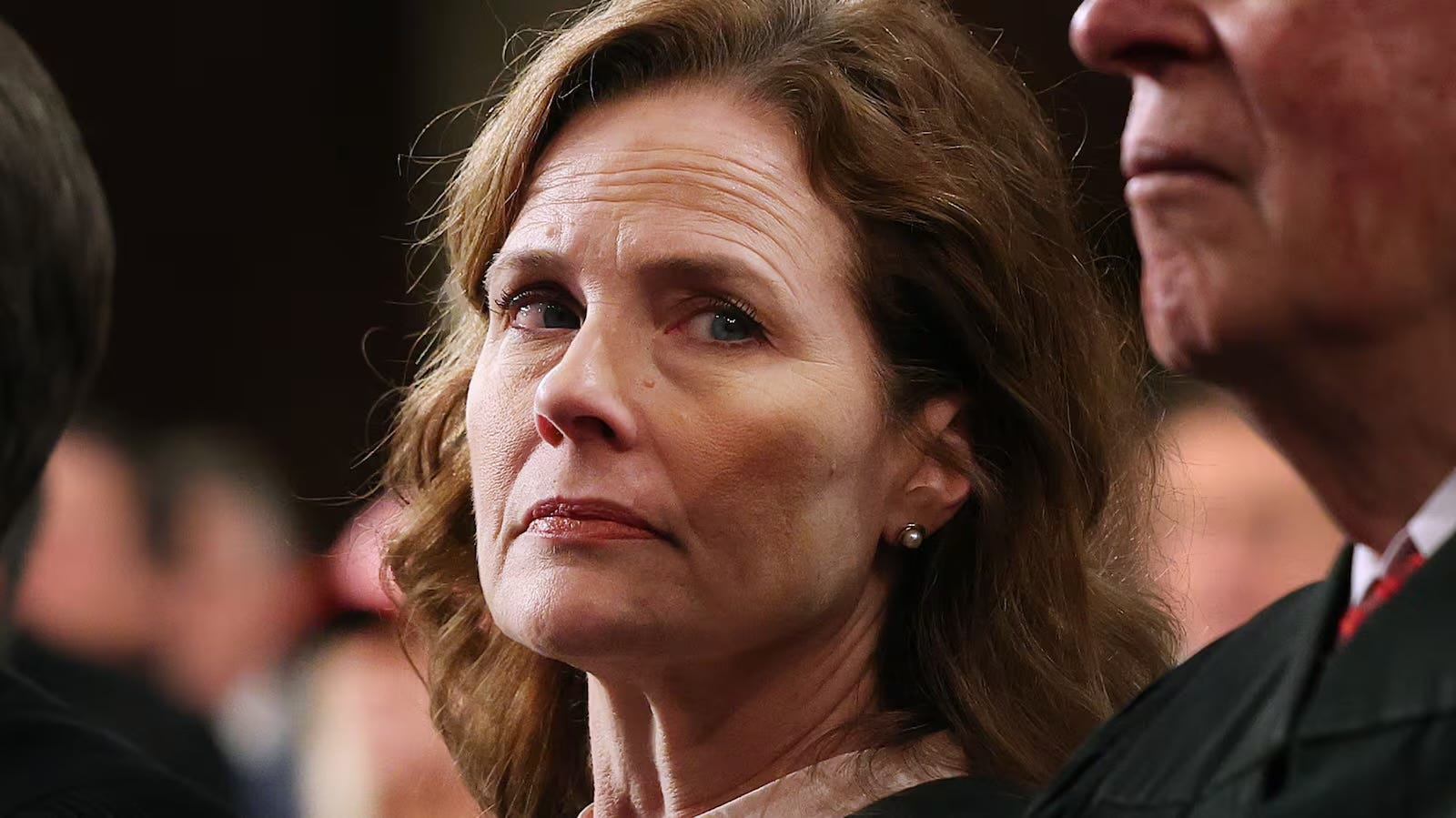
By a vote of 5 to 4, with Chief Justice John Roberts and Justice Amy Coney Barrett siding with the three liberal justices, the Supreme Court held that the White House cannot ignore a federal court’s restraining order compelling release of $2 billion in foreign aid funds already appropriated by Congress.
Why was this decision so important? And why are legal observers all breathing a little easier after Wednesday? It has to do with the crisis of capitulation that we have seen spreading to all corners of our society, from elected representatives, to CEOs, to the press. Would the Supreme Court itself also give in to Trump’s vision of an all-powerful executive, one that must be obeyed and appeased, by choosing the White House over one of its own district courts?
The answer, after Wednesday, is no. At least not yet, by a single vote. And we should take the win.
Let me explain this more fully so you can appreciate how important this was.
The existing crisis
Many, including myself, believe we’re already in a brewing Constitutional crisis because our system of checks and balances isn’t working the way it’s supposed to.
For example, when the executive branch seizes control of money that the legislative branch has already appropriated, Congress is supposed to fight back to protect its power. Instead, the GOP-controlled House and Senate have done nothing to challenge the White House. Rather, Republicans are cheering Trump on as he takes away their power.
It’s a grim and dangerous situation.
This dynamic played out in the case that the Supreme Court weighed in on this Wednesday. It involves an agency that the MAGA right truly reviles: the U.S. Agency for International Development (USAID). This is the body through which most of U.S. foreign aid is delivered. And the White House had it out for USAID from the get-go by freezing its funds, refusing to pay third parties it was already contracted to pay, and firing nearly all of its employees.
This happened without any pushback from the Republican Congress, even though USAID was established by statute and its funding was already approved by legislation. In this sense, the Trump White House’s attempt to gut USAID by freezing its money and firing all of its staff was a direct assault upon the power of Congress. In legal terms, the White House was asserting a right to “impound” funds, including some $2 billion in foreign aid—a power that the Supreme Court previously unanimously found the executive does not have and one that is expressly limited by Congress by way of the Impoundment Control Act.
In a functioning democracy, Congress would be up in arms over the White House’s trammeling of its power of the purse. This is a core power of the legislative branch, and if the executive branch can simply go through line-by-line to say which expenditures it approves and which it forbids, that would render Congress a mere advisory body. The Founders never imagined that Congress would sit back and let this happen.
But in our dysfunctional system today, the GOP-controlled Congress is not only complacent, they are on Trump’s side. They’re perfectly okay with the White House gutting a whole congressionally authorized and funded agency, simply because the Democrats support it while they do not. If the shoe were on the other foot, and a Democratic president were line-item vetoing project expenditures in red states and districts, you can imagine that the GOP would not be pleased and would cry White House overreach.
With Congress sitting on the side lines, that left only the federal courts. Nonprofits directly impacted by the foreign aid freeze sued to force the executive branch to distribute the money that was held back.
A major crisis before the final one?
Many legal scholars have observed that, should Trump openly defy the federal courts, we would find ourselves in a full-blown constitutional crisis. With no congressional action to stop the White House, the federal courts also could be neutralized by the executive branch’s defiance. At that point, the last guardrail of our democracy would be gone.
But there is actually a major threshold question that we would hit long before it came to that: What if the Supreme Court actually sides with the White House, affirming he has power over Congress’s purse? In such an outcome, Trump’s power grab would be complete. The Supreme Court would have given him its final stamp of approval, and our democracy would become an autocracy overnight. After all, whoever completely controls the lifeblood funding of our government controls everything.
In the USAID case, such a ruling would have entered like a deadly poison and likely gone unnoticed by the public. The fact that it didn’t happen—at least not yet—means our system gets to live to fight another day.
Let’s get in the weeds
To understand why exactly that is, we need to geek out a little about the procedural state of the case. I’ll try to make this as non-eyeglazing as possible.
The judge on the case is Judge Amir Ali. (You can imagine what MAGA thinks of him just based on his name and ethnicity.) The plaintiffs filed their case on February 10 claiming the government had no right to freeze all foreign aid, especially on contracts it had already signed where the recipients were expecting payment and would fail without it.
As is typical when time is of the essence, the plaintiffs went before Judge Ali and asked him to put what’s called a “temporary restraining order,” or TRO, on the government. The TRO would “undo” the freeze on the funds.
On February 13, after weighing all the legal factors including the likelihood of irreparable harm, Judge Ali granted the TRO.
But days went by, and the government still hadn’t released the funds. So on February 19 the plaintiffs went back before Judge Ali asking him to enforce the TRO against the government. The judge issued an enforcement order on February 20.
Surprise, surprise, even after this order the government still didn’t release the funds. Now things were looking dark. After all, a TRO is supposed to be obeyed right away precisely because of the chance of irreparable harm. Hundreds of thousands of lives, including sick and starving children, were on the line as days ticked by. Many wondered whether this was the way the White House would defy the courts, giving them the run-around while critical services failed for lack of funding.
Four days later, on February 24, the plaintiffs went back to the judge and asked him to renew the enforcement, this time with teeth. Judge Ali, who was very angry by this point, agreed. On February 25, he issued an order that got down to the nitty-gritty.
The order required the administration to pay all invoices and drawdown requests for any work completed prior to his initial TRO, as well as all reimbursements on grants and assistance agreements. He set a deadline of 11:59 p.m. the next day for compliance.
This time, the government appealed the order. It went to the D.C. Circuit asking it to overturn it (as well as to freeze everything in place) until their appeal was complete. Long story short, the appellate court shot down the government’s request.
But the government had another card to play. It also filed an emergency request with Chief Justice John Roberts that same day, claiming there was no way it could meet the midnight deadline (even though it had had 12 days to obey the original TRO).
To the dismay of many observers, Roberts granted a brief “administrative stay” of Judge Ali’s order. Some saw this as an indication that Roberts was eventually going to rule for the White House and had begun that process by taking the pressure off the government to obey Judge Ali’s order. I had cautioned that we couldn’t read that much into an “administrative stay” because the emergency request came in so late at night that the justices wouldn’t want to gather to decide it before the deadline.
But that still left a big, lurking question with a very long shadow. What if the Court ultimately ruled that the White House had a right to freeze those funds after all, and that Judge Ali had no business trying to stop it? That would mean, in effect, that both Congress and SCOTUS were on the side of the Trump administration when it came to its blatantly illegal and unconstitutional moves.
It would open the door to the White House doing the same with every other case where it had frozen money, knowing the Supreme Court would not act as a backstop.
In essence, there would be no Supreme Court order for Trump to “defy” because it would have actually greenlit his overreaching, his impoundments and his gutting of federal agencies, even those that Congress, and not the White House, had established by law.
You can imagine how worried legal watchers were.
On Monday, then on Tuesday, I kept checking for the ruling on the appeal. Nothing yet. In retrospect, the Chief Justice may have realized that Trump was giving a national address to a joint session of Congress on Tuesday. It’s entirely possible Roberts simply waited until Wednesday morning to release the order—which was just a paragraph long—so that Trump couldn’t take it out on the Court in public and live before a national audience. (It’s also possible that Judge Samuel Alito took his sweet time writing his 8-page, deplorable dissent in order to burn up even more time, who knows.)
Crisis averted, for now
The 5-4 decision by SCOTUS came out on Wednesday. After reciting the procedural history of the case, it said simply,
Given that the deadline in the challenged order has now passed, and in light of the ongoing preliminary injunction proceedings, the District Court should clarify what obligations the Government must fulfill to ensure compliance with the temporary restraining order, with due regard for the feasibility of any compliance timelines.
In nonlawyer talk, it meant this: “Your appeal is denied, but since the midnight deadline Judge Ali gave you has already passed, and you’re about to get into the lengthier court battle, let’s have the judge tell the government what it needs to do to release the funds per the TRO, keeping practicality in mind.”
As Professor Steve Vladeck noted, it’s important to recognize that the Court denied the government’s request, rather than merely ruling that it was now moot. After all, since the midnight deadline had already passed, the Court could have simply said, “You appealed from an order that’s already expired, so there’s nothing for us here to decide.”
But that’s not what happened. The Court said that while the order to release the funds by midnight had expired, the original TRO was still in effect. If you recall, that TRO said the government had to lift its freeze on the funds. The only question now is how much time the court will give the government to comply with it.
Who gets to run out the clock?
It’s not often discussed, but the question of “who controls the clock” very much matters when one side is doing the wrecking and one side is trying to stop it.
When prosecutors were racing to hold Trump accountable for his multiple crimes around January 6 and his absconding with classified documents (and trying to cover it up), Trump’s lawyers played a game of delay. They understood that if they could tie the cases up in court and prevent trials from occurring before the election, then Trump could undo all of his legal risk by winning reelection.
The strategy worked, in part because he had a lot of help from specific bad faith judges and justices, and in part because our legal system isn’t set up for speed and can get bogged down easily.
But now the situation is somewhat reversed. The Trump White House is trying to do as much damage as it can as quickly as it can, while opponents are doing all they can to throw sand in the gears. Plaintiffs know that once there’s a preliminary injunction in place, the “status quo ante” will hold until a permanent injunction issues.
That’s why these initial court salvos wind up mattering so much. When the Supreme Court allows the district courts to do their work, unhindered by emergency appeals that stop orders in their tracks, then those courts can freeze conditions as they were just before the bad activities took place. That frozen circumstance then can last for months or years while the parties battle things out at trial and on appeal.
This will have the greatest impact on cases where the government has sought to freeze and impound money, but it could also keep in place key personnel (for example, inspectors general) who were illegally terminated.
This week, for example, another federal judge held that the government grant and assistance freeze order, initiated by the Office of Management and Budget, was illegal. He ordered the frozen money released. “Here, the executive put itself above Congress,” wrote Judge John McConnell in his decision. “It imposed a categorical mandate on the spending of congressional appropriated and obligated funds without regard to Congress’s authority to control spending.” That ruling, along with a similar one issued in another federal case last week, could spare thousands of projects and desperate recipients the pain and shock of permanently losing funds they had been expecting.
Another federal judge held that a member of the National Labor Relations Board was illegally terminated by Trump and has ordered her reinstated. “The President’s interpretation of the scope of his constitutional power — or, more aptly, his aspiration — is flat wrong,” wrote Judge Beryl A. Howell. “The President does not have the authority to terminate members of the National Labor Relations Board at will, and his attempt to fire plaintiff from her position on the Board was a blatant violation of the law.”
A third judge blocked the firing of the chair of the federal Merit Systems Protection Board. That’s a body which protects government workers from political discrimination.
The Trump administration is appealing all of these decisions. It hopes that the conservative majority will side with the notion that the president should have broad power to hire and fire within the executive branch, even if it now looks less likely that the Court will give him the power to withhold funds as he likes.
The High Court could also decline to hear these cases at this time, allowing the injunctions to remain in place and for the cases to develop more fully in the courts below. That would essentially allow plaintiffs to run out the clock for a change.
Not every case may or even likely will go our way. But with its 5-4 ruling in the USAID case, at least we know we have a fighting chance.
The takeaway
Stepping back, the big takeaway here is that the Supreme Court has now instructed the White House to obey a court ruling ordering release of funds the government had frozen. If Trump were truly a king, no High Court could order his government to do so. And if it did, he wouldn’t have to obey.
Moreover, the Supreme Court (again by a frighteningly thin majority) said to him, “Yes, in fact, a single district court has the power to tell you to do this, and we will stand behind that court’s power with our own.” It signaled there are in fact limits to Trump’s power, and the courts will say what they are.
The day may still come when Trump defies the Supreme Court itself and we must lock arms in the streets. But at least for now, there’s still something left for him to defy.
It’s very important to note that four maga justices voted against the rule of law.
The time to lock arms in the streets is coming, and quickly, and we all need to be prepared to act.