
“Become Ungovernable”
How the DOJ turned a Facebook post into evidence of a federal conspiracy

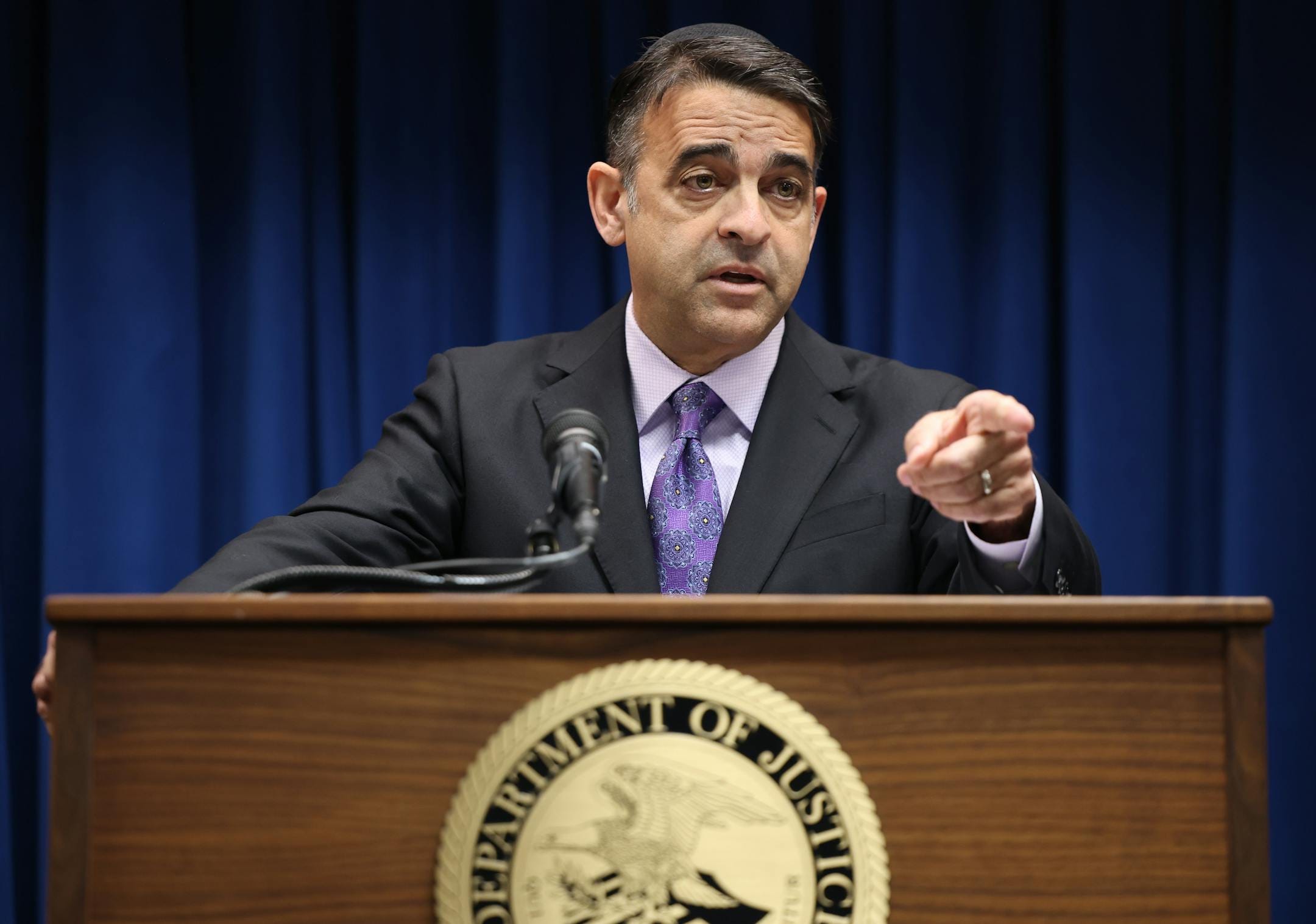
On the morning of June 16, U.S. Attorney Daniel Rosen—a Trump appointee confirmed on a party-line Senate vote—stood before cameras at the federal courthouse in Minneapolis to announce what his office called a sweeping conspiracy to undermine federal law enforcement. His office had obtained an eight-count felony indictment against 15 people connected to anti-ICE organizing in the Twin Cities.
The lead charge was conspiracy to impede or injure a federal officer. Rosen described the defendants as participants in a left-wing coalition called Direct Action Minnesota, which he accused of “surveillance, operational planning, and rapid mobilization against law enforcement actions.”
Behind him, on a monitor, was the evidence he had chosen to lead with: a screenshot of a social media post. “You see here a Facebook post from one of the defendants writing, quote: ‘We need to become ungovernable. We need to resist any way we can to materially stop the Nazi occupation,’” Rosen read aloud.
Twelve of the 15 defendants had already been arrested that morning. Two remained at large. Rosen closed with a warning: “If you are actively conspiring to impede law enforcement … you ought to assume that we’re watching you and that we will get you.”
But the unusual charges have already led to many questions.
The thought police
Rosen had told MPR News reporter Matt Sepic that the people were “charged not for what they said but what they did.” But he led his presentation with a defendant’s thoughts posted publicly online.
A defense attorney in attendance, Bruce Nestor, called the presser a “propaganda show” and zeroed in on this central contradiction. Then he asked what we were all thinking: “What’s wrong with being ungovernable by a fascist government?”
Minnesota Reformer reporter Madison McVan noted that more than a third of the individuals charged during the earlier federal crackdown on Minnesota protesters had already had their cases dismissed or failed in some way. If that’s the case, why was this case different?
“I don’t think any cases have failed in any way,” Rosen replied.
A second reporter immediately bodychecked him with facts. Prosecutors had in fact dropped 18 of the 36 prior cases entirely, with non-prosecution agreements in at least 11 more.
Rosen was also asked directly whether any federal officers had actually been harmed. He declined to say. “Whether or not they actually at the end of the day caused bodily harm,” Rosen argued, “is not the measure of whether or not they committed a serious federal crime.”
Minneapolis in the spotlight again
In Season Two, the federal government has chosen to put Minneapolis back in the news, so it’s helpful to review what happened in Season One.
Operation Metro Surge launched in December 2025, flooding the Twin Cities and surrounding areas with federal immigration agents. At its peak, roughly 4,000 officers from ICE and Customs and Border Protection had been deployed across the state, ultimately making more than 3,700 arrests. Federal agents killed two U.S. citizens in incidents caught on camera—Renée Good on January 7, and Alex Pretti on January 24—bringing the number of people shot across the country between September 2025 and February 2026 to 13, with four fatalities.
Residents of Minneapolis organized in response to the surge and the killings. Community members filmed federal agents during enforcement actions, a practice former DHS Secretary Kristi Noem characterized as a form of violence against officers. Hundreds, and eventually thousands, of Twin Cities residents joined community patrol networks, monitoring ICE movements and bearing witness to arrests.
On January 23, the day before CBP agents killed Pretti, Minneapolis saw a general strike. Schools and businesses shut down as workers marched under the banner of “No Work, No School, No Shopping.” Over 50,000 people marched through downtown in subzero temperatures, with hundreds of businesses closing their doors, in a shutdown endorsed by the Minneapolis Regional Labor Federation, which represents more than 80,000 workers across 175 unions.
One coalition that emerged from this moment was Direct Action Minnesota. The people now facing federal felony charges were organizing during, and in direct response to, all of it.
The charges
The indictment unsealed Tuesday runs 94 pages. The bulk of it is devoted to a single charge applied to all 15 defendants: conspiracy to impede or injure a federal officer under 18 U.S.C. § 372. The statute was first enacted in 1861, and the Justice Department’s own Office of Legal Counsel, in a 1977 memorandum, noted it had historically been charged only alongside substantive offenses like assault, and had rarely stood alone.
It appeared most recently in a handful of January 6 prosecutions. Before that, its most notable use was against a pair of tax protesters who retreated to their New Hampshire home with a cache of weapons in 2007. The Justice Department is now applying it to nonviolent protest organizers in Minnesota.
To establish the conspiracy, the indictment leans heavily on the group’s internal communications and organizational activity. These include
conducting Signal chats in which members expressed frustration with non-violent tactics;
holding planning sessions for blockades around the Bishop Henry Whipple Federal Building in Fort Snelling;
creating a GoFundMe account;
organizing training sessions for new members;
attending worker assemblies held at the United Labor Centre in Minneapolis, cited in the indictment as evidence of criminal coordination;
and holding an “Anarchist Speaking Tour” in Chicago, Ann Arbor, and Seattle in April, where members allegedly shared tactics with other groups.
And of course, that Facebook post.
As Talking Points Memo noted, beyond the base conspiracy charge, some individual defendants face additional counts. Kyle Wagner, who had previously been arrested in February on federal threat and cyberstalking charges, faces counts of solicitation to commit a crime of violence and interstate threats, based on social media posts urging followers to abandon peaceful protest.
Isaac Auman Sant faces an interstate stalking charge for following a federal officer from the Whipple Building across state lines to Hudson, Wisconsin. William Morgan faces the same stalking charge, plus assault on a federal officer and destruction of government property, after he allegedly knocked an agent’s notes from his hand, kicked a government vehicle and placed sandbags under its tires.
Natasha Rakotz faces a single count of assault on a federal officer.
Courts should proceed very skeptically
Tuesday’s indictment didn’t arrive in a vacuum. It was delivered by a Justice Department whose record of prosecuting anti-ICE demonstrators in Minnesota has been spotty, and whose record elsewhere has drawn allegations of gross misconduct.
Of the 36 people federally charged with assaulting or impeding federal agents during Operation Metro Surge, prosecutors have since dropped 18 cases entirely and resolved 11 more through non-prosecution agreements, meaning they were dismissed for reasons including a lack of probable cause and evidence that directly contradicted law enforcement’s own claims. Several others were quietly downgraded from felonies to misdemeanors.
The case of Nasra Ahmed is illustrative. At the height of the surge, federal officers arrested Ahmed, a 23-year-old U.S.-born citizen, posted her booking photo on social media, and named her in a news release alleging that 16 Minnesotans had assaulted immigration agents. Then-Attorney General Pam Bondi called her a “rioter” in a post that drew 3.3 million views. The Department of Homeland Security amplified it, calling the defendants “violent anti-ICE anarchists.” Four months later, the U.S. Attorney’s Office asked to drop the charges. A federal judge lambasted the office for prosecutorial harassment, finding that the government’s conduct had violated a court order, likely violated the Justice Department’s own policies, and undermined the presumption of innocence. The charges were dismissed with prejudice.
Defense attorney Bruce Nestor, who has followed these cases closely, said the pattern is consistent. The prior Metro Surge charges, he said, “were based on lies. They were based on false information, they were based on violation of judicial orders. And now today, 15 more people are going to go through that process, and the same thing will be true of the charges.”
The Minnesota dismissals are part of a broader national pattern. In Chicago, the Justice Department brought a conspiracy prosecution against six people who had demonstrated outside the Broadview ICE detention facility. It was a case that included a progressive congressional candidate, Kat Abughazaleh, and it became a national flashpoint. The case collapsed in May when U.S. District Judge April Perry reviewed grand jury transcripts and found prosecutorial misconduct so severe she described it as unlike anything she had seen in hundreds of such transcripts over her career. The U.S. Attorney dismissed all remaining charges with prejudice and took responsibility before the court. Sanctions against the prosecutors involved may follow.
Chris Parente, a former federal prosecutor who represented one of the Broadview defendants, was unsparing in his condemnation. “This DOJ has completely corrupted the grand jury process. When they decide that they want to get a political indictment through, they will do whatever it takes, even acting in an unethical way.”
Abughazaleh, whose own charges were dismissed after the grand jury misconduct came to light, drew the connection between the Broadview Six and the charges announced on June 16. “As the government raids ‘antifa groups’ in Minneapolis with the SAME charges levied against myself and the rest of the Broadview Six,” she wrote on Bluesky, “we need to be asking how they got this indictment. And as charges (hopefully) get dropped, we must remember the process is the punishment.”
The question of how the Minnesota grand jury was conducted, and what a judge might find if she looked at those transcripts, too, remains unanswered but may come to light.
What This Means
The statute at issue, 18 U.S.C. § 372, was written in 1861 to protect federal officers from organized interference at a moment when the authority of the federal government itself was under armed challenge. The Justice Department is now applying it to people who organized blockades, attended union hall meetings, monitored ICE vehicles on public streets, and posted on Facebook.
Among the indicted are leaders of Minnesota’s labor movement, who received the George Meany–Lane Kirkland Human Rights Award from the AFL-CIO at its national convention in Minneapolis on June 7.
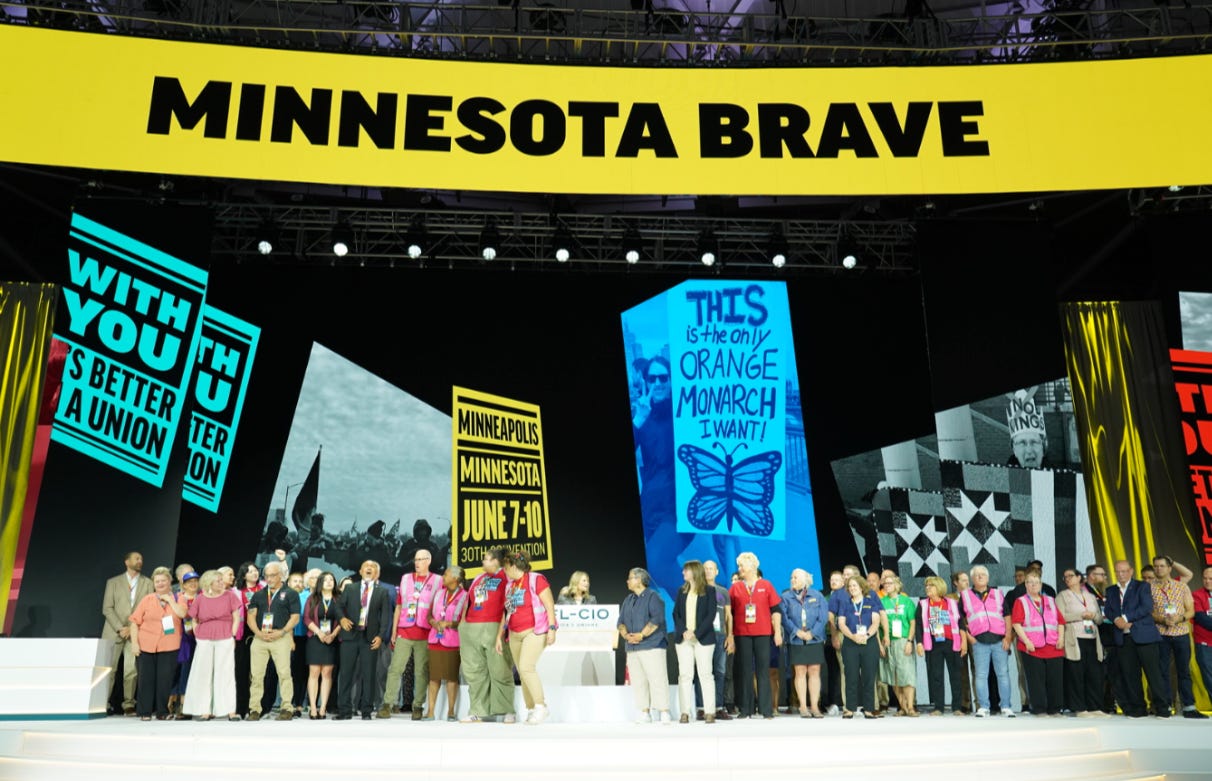
Conduct that would be entirely unremarkable in any other civic context—coordinating volunteers, raising money, holding meetings and traveling to share information—has been reframed as overt acts of a criminal conspiracy, all because the object was to resist federal immigration enforcement.
The Trump administration has been explicit about its intent. An executive order signed by Trump titled “Countering Domestic Terrorism and Organized Political Violence” directed the Justice Department to treat left-wing activism as an organized terrorist conspiracy. It declared that political violence “does not emerge organically” but is instead “a culmination of sophisticated, organized campaigns.”
The label of “conspiracy” is now being attached to any left-leaning group engaged in direct action. The Brennan Center for Justice, analyzing NSPM-7 shortly after its release, concluded that the directive was “ungrounded in fact and law” and that acting on it would threaten “any person or group holding any one of a broad array of disfavored views with investigation and prosecution.” The 15 Minnesotans charged Tuesday are the latest proof of concept, meant to chill organizing against the federal government across the country.
Minnesota’s labor movement built one of the most robust and celebrated civic responses to a federal enforcement action in recent memory. It developed food distribution networks, stood up a rapid response system, and held a general strike that shut down a major American city for a day in negative-30-degree windchill. That is a real threat to the White House’s authoritarian goals and, seen in that light, the charges, while deplorable, are unsurprising.
Whether the charges survive judicial scrutiny is a separate question. Given the record of the prior prosecutions, there is ample reason for skepticism and a clear need for close scrutiny.
Survival in court may not be the White House’s primary objective. The legal process itself, as these defendants and the Broadview Six before them have learned, is the punishment. Arrests, bail conditions, legal fees and public branding as “antifa”—all of it accrues before a single day of trial, and all of it is meant to deter others from attempting the same resistance.
But there is a high cost to the White House, too. By filing these charges and reopening the wound of Minneapolis, the Justice Department is reminding Americans of the brutality and fascism of this regime at a time when Trump’s popularity is at a nadir. And for a party that has long railed against censorship and thought policing, there is the strong stench of hypocrisy.
As historian Heather Cox Richardson noted in her newsletter, the government’s highlighting of the words “Become Ungovernable” in a Facebook post bears an inconvenient backdrop. “Trump attended the Libertarian National Convention in 2024 when its theme was ‘Become Ungovernable,’ and stood in front of the banner bearing that slogan,” Richardson observed, “so the idea that the phrase is part of a criminal conspiracy will be awkward to argue.”
I looked up the image of the cheato in front of a huge banner with the Become ungovernable in a wild font behind him…They are merciless hypocrites.
Meanwhile, the federal government is working hard to make sure there are NO consequences for the federal agents who murdered Renee Good and Alex Pretti. Their killers have not been arrested. The federal government refused to even identify them. They concealed and destroyed and discarded evidence, and worked hard to prevent state law enforcement from having any access to the evidence that remained or being part of the investigation at all. Kristi Noem and many others in the administration and right wing propaganda ecosystem smeared Good and Pretti as “terrorists” while their bleeding bodies still lay on the streets of Minneapolis. ICE and CBP fired tear gas into the people around, including their family, friends, and neighbors, and *prevented* any bystanders, including a medical doctor, from rendering aid as Good lay dying. DOJ and this administration is led by people who are dishonest, lawless, and pure evil. We see them for exactly who they are.