
ICE Collapse: From the Top Down and the Inside Out
Leadership missteps and internal dissent over ICE abound, and this is costing the regime in public approval.


There is both a crisis of public perception and a crisis from within at ICE.
Public opinion on the regime’s ICE policies, already damaged by the Minneapolis murders, took another beating yesterday after a series of unforced errors from the White House and GOP leaders.
Meanwhile, a revealing report by Wired, released today, details internal dissent within DHS ranks, based on comments posted to an online forum of roughly 5,000 self-identified current and former ICE and CBP agents.
Taken together, these developments create significant pressure on the agency, even as Congress debates conditions on DHS funding that would rein in some of ICE’s worst abuses and excesses. Lawmakers are also eyeing recent polling confirming a strong negative shift in support for ICE among the American public.
They keep handing us sound bites
Donald Trump gave an interview on NBC in which, once again, he said some truly astonishing things. One of the most widely viewed and shared clips was his response to the murders in Minneapolis of Renee Good and Alex Pretti.
Trump used the occasion to express perfunctory regret, but he still wound up smearing the victims all over again. He victim-blamed once more, claiming Good and Pretti “were not angels” and that we should “look at the tapes.”
We have, Donald. They were not at fault, they did nothing wrong, and they were still killed by federal agents.
Trump also whined about the optics, saying, “Two people out of tens of thousands, and you get bad publicity.” This confirmed that Trump does not actually care about the lives that were lost in January, but rather only about how the murders and the official response to them played with the public.
JD Vance was no help yesterday either. In an interview with The Daily Mail, a reporter asked Vance—who had amplified false claims that Pretti was an “assassin”—whether he would apologize to Pretti’s family.
“For what?” Vance responded with a characteristic smirk.
Vance then, rather ironically, argued that it is “not smart to prejudge” what happened—even though he had done exactly that with both killings. He further argued it would not be “fair” to Border Patrol agents for him to walk back his claims, without mentioning how unfair this has been to the victims’ reputations and to their grieving families.
Speaker Mike Johnson chimed in with his own head-spinning, unhelpful take on immigration enforcement. “Imagine if we had to go through the process of getting a judicial warrant,” he exclaimed to reporters, “to apprehend people who we know are here illegally.”
Imagine having to follow the law, Speaker Johnson.
Pressure builds from within
Wired’s reporting reveals significant internal dissent over DHS policies and practices. Several examples show agents venting their frustration over a host of topics. Here are just a few:
Frustration with working conditions and last-minute assignments: One user nearing retirement wrote about being overwhelmed by stressful deployments with little notice and the loss of weekends and union protections: “I have 2.3 years left for full special category retirement … but don’t know if I’ll make it. Tired of this agency. Employees being abused badly. Mandated TDYs [temporary duty assignments] with less than 24 hours’ notice … No more weekends off, more work than ever before in 18 years.”
Criticism of leadership: Another complained that leadership had “managed to turn a righteous mission into a complete clown show.”
Concerns about integrity in reporting: One user alleged that agents, including EROs (Enforcement and Removal Operations), were actively falsifying reports: “ERO AND CBP AND BP QUIT LYING IN YOUR 213 NARRATIVES … You’re putting false statements down … Whistleblowers!!!!”
Operational missteps and lack of planning: A user criticized operational planning for deployments: “Absolutely zero forethought, and our management just rolled over to let BP take over. HUGE mistake…”
Field tactics: Another criticized reckless pursuits: “How about the genius who thought it was a great idea to film himself during a vehicle pursuit… when ICE literally has a no-pursuit policy?”
Minneapolis surge: One user complained about a mandatory 30-day detail: “Forced deployments are getting out of hand.” Another cited “no pre-planning… databases, cars, equipment, duties—nada.”
Low morale: A user warned that high-profile arrests near schools were demoralizing: “This will absolutely kill any morale we had, if any… pulling over a car at 7:30 in the morning in front of a school for an administrative arrest.”
While we can’t directly extrapolate from these complaints and claim DHS agents are ready to revolt, the complaints themselves were widespread and specific. This underscores significant dissent and growing dissatisfaction within the ranks of DHS.
Democrats coalesce around reforms and guardrails
Congress has just eight days to reach a bipartisan agreement to fund DHS or face another shutdown of that department. Democrats are aligning around key demands in exchange for their votes on funding. House Minority Leader Hakeem Jeffries’s office released a 10-point framework, coordinated with Senate Minority Leader Chuck Schumer:
Targeted Enforcement – DHS officers cannot enter private property without a judicial warrant; end indiscriminate arrests; improve warrant procedures and standards; require verification that a person is not a U.S. citizen before holding them in immigration detention.
No Masks – Prohibit ICE and immigration enforcement agents from wearing face coverings.
Require ID – Require DHS officers conducting immigration enforcement to display their agency, unique ID number and last name; require them to verbalize their ID number and last name if asked.
Protect Sensitive Locations – Prohibit funds for enforcement near medical facilities, schools, child care facilities, churches, polling places, courts and other sensitive locations.
Stop Racial Profiling – Ban stops, questioning and searches based on presence at certain locations, jobs, spoken language, accent, race or ethnicity.
Uphold Use of Force Standards – Codify reasonable use-of-force policy, expand training and require officer certification; remove officers from the field pending investigations after incidents.
Ensure State and Local Coordination and Oversight – Preserve state and local authority to investigate potential crimes and excessive force; require evidence preservation and sharing; require consent of states and localities for large-scale operations outside targeted enforcement.
Build Safeguards into the System – Require immediate access to attorneys in detention; allow states to sue DHS for violations; prohibit limits on member visits to ICE facilities regardless of funding source.
Body Cameras for Accountability, Not Tracking – Mandate body-worn cameras and establish storage/access rules; prohibit tracking or databases of individuals engaged in First Amendment activities.
No Paramilitary Police – Regulate and standardize uniforms and equipment to align with civil enforcement.Targeted enforcement
Many progressives want additional reasonable conditions, including humane detention standards and strict compliance by the department with court orders. But the sad reality is, most of the above demands are already unlikely to get past the GOP-controlled House or survive a GOP Senate filibuster. Some kind of compromise—or a DHS shutdown that nevertheless still leaves ICE functioning, because it’s maddeningly already funded through 2029—appears inevitable.
Even if they don’t get all or even most of these fundamental reforms in place, they remain popular with voters, including nearly all Democrats and most independents. That means the reforms also remain worth fighting for. And when you boil them down, they are asking little more than for DHS to act like any other law enforcement agency.
Down go Trump’s approval numbers
Polling continues to deteriorate on what was once Trump’s strongest issue: immigration. A new NPR/PBS News Marist Poll shows nearly two-thirds of respondents now saying ICE has gone too far, including 71 percent of independents.
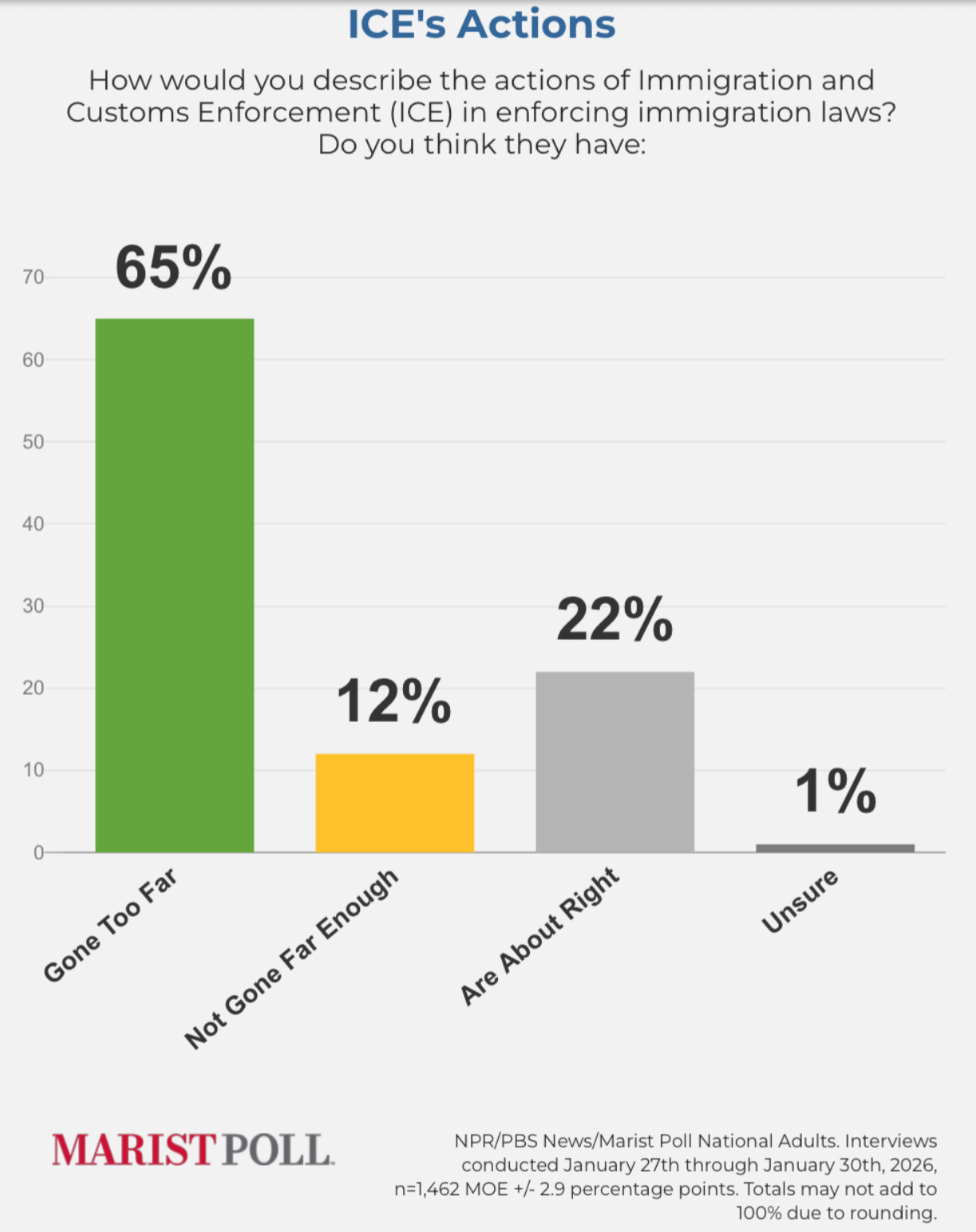
Among Republicans, approval has also weakened, with those expressing strong support dropping and skepticism rising. The number of Republican respondents who believe ICE has gone too far has risen from about 20 percent to 27 points.
More than six in ten respondents believe ICE is reducing public safety, and roughly six in ten disapprove of the agency’s performance. Meanwhile, six in ten Americans view nationwide protests against ICE as legitimate rather than unlawful.
The course ahead
Trump has squandered the public approval that once helped carry him back to the White House in the 2024 election. In its place is an increasingly alarmed electorate, while senior officials continue to deliver outrageous responses and internal DHS morale erodes.
The only action that might “turn the Titanic around,” to borrow JD Vance’s phrase, would be to withdraw ICE from Democratic cities, return CBP to the border, and refocus the entire department on targeted enforcement, as under previous Democratic administrations.
But that would never satisfy the likes of Stephen Miller, who still calls most shots within the White House and views mass deportation as a tool for transformation of our country into a vision of white nationalism.
As a result, the White House—and the American public—is stuck for the foreseeable future with a horrific and brutal mass deportation policy. That will continue to spiral, even while it helps tee up highly consequential electoral losses for the GOP this November.
I don’t remember seeing Stephen Miller’s name on the ballot. The Republicans are cowards.
It's disappointing, to say the least, that the democrats' list of requirements does not require humane conditions in the detention facilities. From what I've heard, none of them - not a single one - meets humane conditions. That's no surprise, given that the contracts for them are given to companies that are interested only in making money, not in doing anything humane once they get the people into their facilities.