
It’s the Oil, Stupid.
It’s not just Trump and his war in Iran. It’s Putin and his war in Ukraine, too.

A month ago, I wrote about Russia losing its war of choice in Ukraine, outmaneuvered on the battlefield by a smaller, faster and more inventive adversary fighting a fundamentally different kind of war. Since then, Ukraine has opened a second, complementary front, playing out at Russian gas stations, on highways choked with burning tanker trucks, and in the worried communiqués among Russian leaders.
Ukraine has opened a massive economic front against Russia, and it is working.
As I write this, the contrast between the two sides could not be starker. Last night, Russia launched 70 missiles and 611 drones at Ukraine, killing five rescuers in Kharkiv in an illegal “double-tap strike” by a second drone as they fought a blaze from an earlier attack. The strike wounded at least 20 people in Kyiv and set the roof of the Dormition Cathedral ablaze. The Kyiv-Pechersk Lavra, the nearly thousand-year-old Monastery of the Caves, is a UNESCO World Heritage site and the spiritual heart of Ukrainian Orthodoxy. The head of the Orthodox Church of Ukraine called the strike “a crime against humanity, against history, and against Christianity.” President Zelenskyy added, it was “one of the biggest Russian crimes against Christian culture to date.”
Ukraine isn’t attacking Russian cultural or civilian sites. Instead, it is targeting Russia’s oil industry, with devastating effectiveness.
Smoke over St. Petersburg
On the morning of June 6, delegates began arriving at the St. Petersburg International Economic Forum, Vladimir Putin’s annual flagship event for projecting financial confidence and courting foreign investment. The setting was his home city, and the forum was, by design, a showcase for business as usual.
The smoke rolling in from the harbor suggested otherwise. Ukrainian drones had struck energy and military sites the night before the forum opened, turning the skyline into a humiliating backdrop.
It was the latest in a series of public humiliations. Just weeks earlier, fearing Ukrainian drone attacks, Putin had scaled back the annual Victory Day parade on Red Square, stripping it of its tanks, missiles and heavy weapons for the first time in nearly two decades. Putin had even reportedly sought help from Donald Trump to broker a temporary ceasefire just to protect the ceremony. Zelenskyy responded by issuing a mock presidential decree formally “permitting” the parade to take place.
At the forum, when Putin was asked directly how Russia intended to guarantee a stable economic future while Ukrainian drones were systematically destroying critical industrial facilities across the country, he offered a confession dressed as reassurance.
“These attacks, of course, do not bring anything good. Moreover, they cause us some harm,” he told the assembled delegates. Two days later, before his own military officers, he tried again: “They are certainly causing us some damage, but we are recovering quickly. They won’t be able to cause us any serious problems.”
The long arm
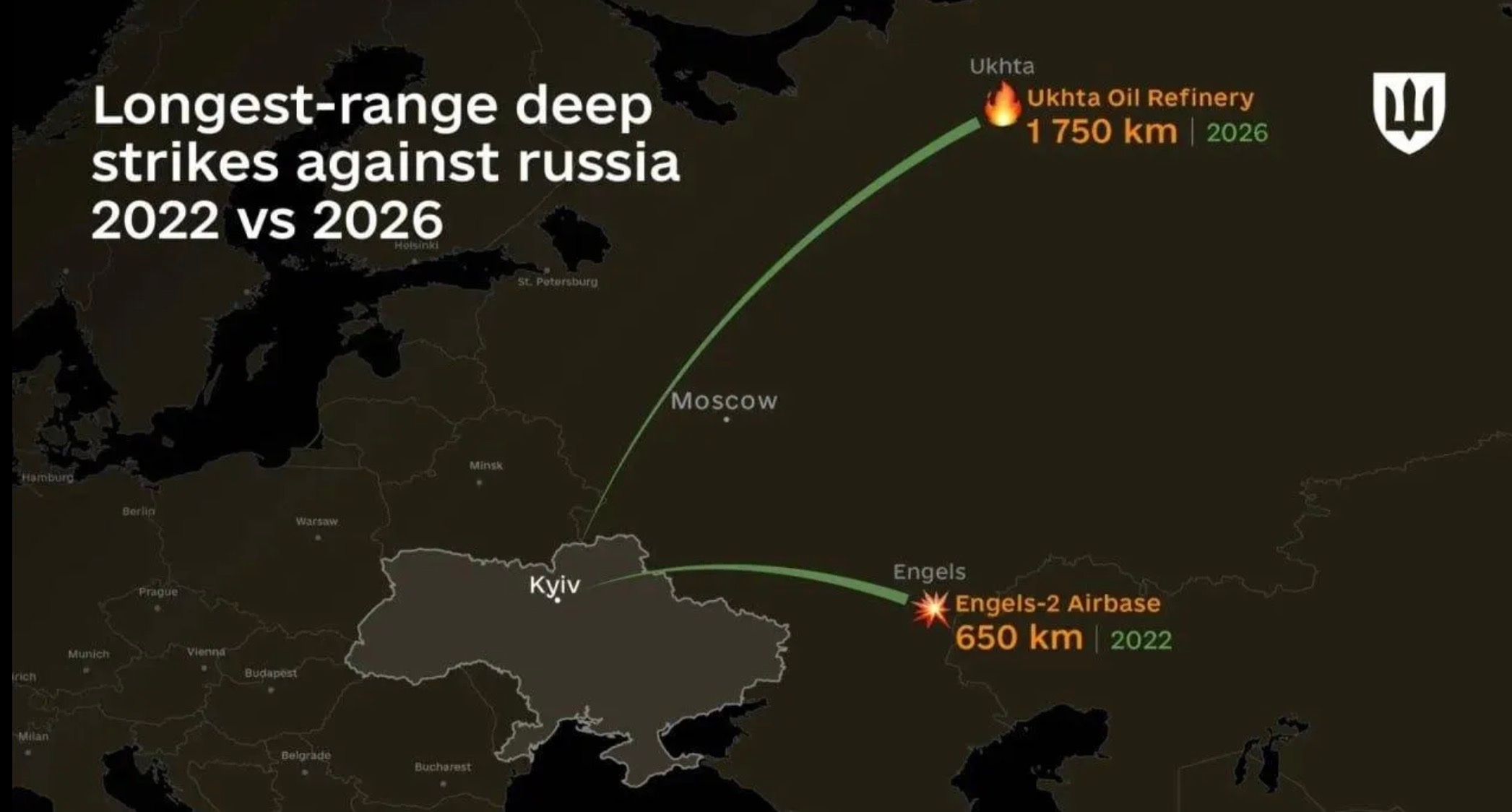
Ukraine’s ability to strike deep inside Russia grew over a period of roughly three years. At the start of Russia’s full-scale invasion in February 2022, Ukraine was limited to strikes within 650 kilometers from its border. That was enough to reach a military airbase, but not nearly enough to threaten the vast industrial interior where Russia refines its oil, manufactures its weapons and believes itself safe.
By early 2026, however, Ukrainian forces had struck the Ukhta Oil Refinery in the Komi Republic — approximately 1,750 kilometers from the Ukrainian border. The range had grown by more than two and a half times in roughly three years.
Ukraine built its own way there, independently of Western governments whose restrictions on long-range missile use remain largely in place. Its domestically-produced drones now hit targets deep inside Russia at a pace that has roughly doubled since late 2025. In March, Ukraine surpassed Russia in the total number of long-range drone strikes launched for the first time since the 2022 invasion.
Zelenskyy described this remarkable achievement with characteristic understatement. “There was a time when dozens of Ukrainian drones striking Russia was a big deal. Now, hundreds of our long-range sanctions every day are no longer a sensation.”
The targets shifted accordingly. Early strikes by Ukraine concentrated on military airbases and ammunition depots. Today, Ukraine is sustaining a systematic assault on the infrastructure through which Russia converts its oil into money and its money into war. The targets include refineries, export terminals, connective pipelines and the tanker trucks carrying fuel to occupied territory.
“Our long-range sanctions continue,” Zelenskyy said in late May. “We are achieving the designated goals inside Russia, primarily targeting Russian oil refining and oil export capabilities.”
Russia’s oil and gas revenues fund roughly a quarter of its federal budget, down from over a third, so Zelenskyy has a word for these strikes: sanctions.
What Russia’s defenses can’t stop
Russia has spent years and enormous resources building layered air defenses. Around Moscow alone, approximately 130 air defense systems were positioned by spring 2026. The problem Ukraine identified and exploited is geometric: Russia’s airspace spans 11 time zones and is almost 30 times larger than Ukraine’s. Even a drastically expanded air defense network cannot protect the country’s many military production sites and sprawling energy infrastructure from aerial attack.
Ukraine’s answer to whatever defenses do exist has been saturation. Send enough drones at once, and some will get through.
On the night of May 15, 2026, a swarm of 99 drones struck the Ryazan Oil Refinery’s critical distillation facilities. The resulting fire was so intense that locals described “black oil rain” falling over the city. Authorities declared a municipal state of emergency and canceled school classes in surrounding districts. Two nights later, dozens of drones penetrated the airspace around Moscow and struck the city’s own refinery despite those 130 air defense positions ringing the capital.
Ukrainian forces have now struck 24 of Russia’s 33 major refineries since the invasion began, destroying up to 300 Russian air defense units in the process.
Running dry
NBC News reported the results of these attacks in Crimea:
Frustrated residents and tourists have been sharing videos of interminable lines at gas stations, while local authorities in Crimea have turned to rationing their limited supplies as they admit they are not able to meet demand.
In more than 20 regions, purchases have been capped. Russia has banned its own gasoline exports through July 31, and imposed a separate ban on jet fuel exports through late November.
Nowhere is the crisis more visible—or more symbolically loaded—than in Crimea. When Russia seized the peninsula from Ukraine in 2014, it promised residents higher salaries, better hospitals, modernized infrastructure, and the security of belonging to a great power. Twelve years later, Ukraine’s drone campaign has triggered the worst fuel crisis on the peninsula since that annexation. And per NBC News,
Tanker trucks have been left burning. And Ukrainian drones also struck the Chonhar Bridge linking the Crimean peninsula to the mainland, forcing authorities to deploy pontoon bridges with far more limited capacity.
The result is something closer to a Mad Max scenario than a posh Russian resort destination. Ayder, a resident of Simferopol, who withheld his last name out of fear of punishment, told Al Jazeera: “Every day I see cars that ran out of fuel and were left on the curb.” After a 20-liter-per-car limit was introduced, he added: “There are long lines and fistfights at gas stations.”
The Kremlin attributed the shortages to “completely unfounded” panic-buying, but spokesman Dmitry Peskov acknowledged “certain problems.” A Crimean resident who spoke anonymously cut through the official line: “The problem is that the fuel just can’t reach us.”
Begging for help from neighbors
For decades, Russia’s identity on the world stage rested on its image as a global energy superpower. But now it is begging its neighbor Kazakhstan for gasoline.
According to three sources who spoke to Reuters, Russia quietly asked Kazakhstan to hold 100,000 tons of gasoline in reserve in case its shortages worsen. Russia has also turned to China, Belarus, and other Asian allies for imports, and lifted import duties on fuel entering through the Far East. The country that once held Europe hostage over natural gas is now scouring its neighborhood for anyone willing to sell it fuel.
“We will act to take Russian oil and gas off the global market,” British Prime Minister Keir Starmer said after a Coalition of the Willing meeting with Zelenskyy in London. “We’re choking off funding for Russia’s war machine. I’m urging others to take these steps too, to go further to reduce their dependencies and incentivise third countries to stop buying these tainted resources.”
That pressure took a vivid new form on Sunday morning when Royal Marine commandos and National Crime Agency officials fast-roped from Chinook helicopters onto the deck of the Smyrtos, a sanctioned Russian “shadow fleet” tanker crossing the English Channel under a Cameroonian flag. The seizure was the first UK-led operation of its kind. “This successful operation delivers yet another blow to Russia and reminds those fuelling Putin’s war in Ukraine that we will not let them hide,” Starmer declared.
1917?
Ukraine’s campaign against Russia’s oil industry has registered inside Russia’s own political establishment. In April, Gennady Zyuganov, the longtime leader of Russia’s Communist Party, addressed the lower house of parliament and delivered a stark message. “If you do not urgently adopt financial, economic, and other measures, by autumn a repeat of what happened in 1917 awaits us,” he told his colleagues. “We don’t have the right to repeat that. Let’s take some decisions.”
Zyuganov has been a fixture of Russian political life since the Soviet collapse. He is a reliable presence within the system, tolerated precisely because he poses no real threat to it. As an insider, Zyuganov has read the same numbers Putin has been trying to explain away and is now raising an urgent alarm.
Meanwhile, the war is not going well. Russian forces suffered a net loss of territory in April for the first time since 2024. Putin himself revealed that Russia’s GDP contracted in the first two months of the year.
“You start disliking him”
In response to the drone strikes, Russia has imposed rolling mobile internet shutdowns across major cities, including Moscow and St. Petersburg, and cracked down on Telegram and VPNs. “The Kremlin sees control over information as a tool of regime survival,” Ryhor Nizhnikau, a Russia senior research fellow at the Finnish Institute of International Affairs, told the Kyiv Independent.
The question experts are now asking is whether the accumulated weight of fuel lines, internet blackouts, and battlefield stagnation is beginning to shift Russian public opinion. Tatiana Stanovaya, founder of the political analysis firm R.Politik and a senior fellow at the Carnegie Russia Eurasia Center, told CNN in April that the combination of economic hardship and drone strikes penetrating Russian cities felt like “something more resembling a pivotal moment.”
Her colleague Ekaterina Schulmann, a nonresident scholar at the same institution, put it more precisely. Speaking of Putin, Schulmann remarked, “The president is the status quo. If you like it, then you approve of him. If you start disliking the status quo, then you start disliking him as well.”
This is a great summary. I try to keep up with Ukraine stuff because of my former colleagues there, but it's hard because the Ukraine blogs are very detailed with a lot of minutiae. This really helps cut that all down. I had gotten the sense of a lot of good "hits" on the refineries, but I had no idea the impact was this substantial. Awesome stuff. I also like how "War of choice" is becoming a common phrase for the behavior of these primitive men.
Very good article-of course one would have no idea of Ukraines success if you relied on U. S. corporate media-
Also as I have said before
Phillips P. OBrien’s Substack newsletter is a fantastic read for information on the Ukraine war -and the orange monsters disastrous foreign policy
So the monster is 80 , I hope he never sees 81 -