
Miller Low-Life
The GOP remains silent about damning domestic abuse accusations against a member of its own House conference, now corroborated by the victim’s father, a sitting U.S. senator.

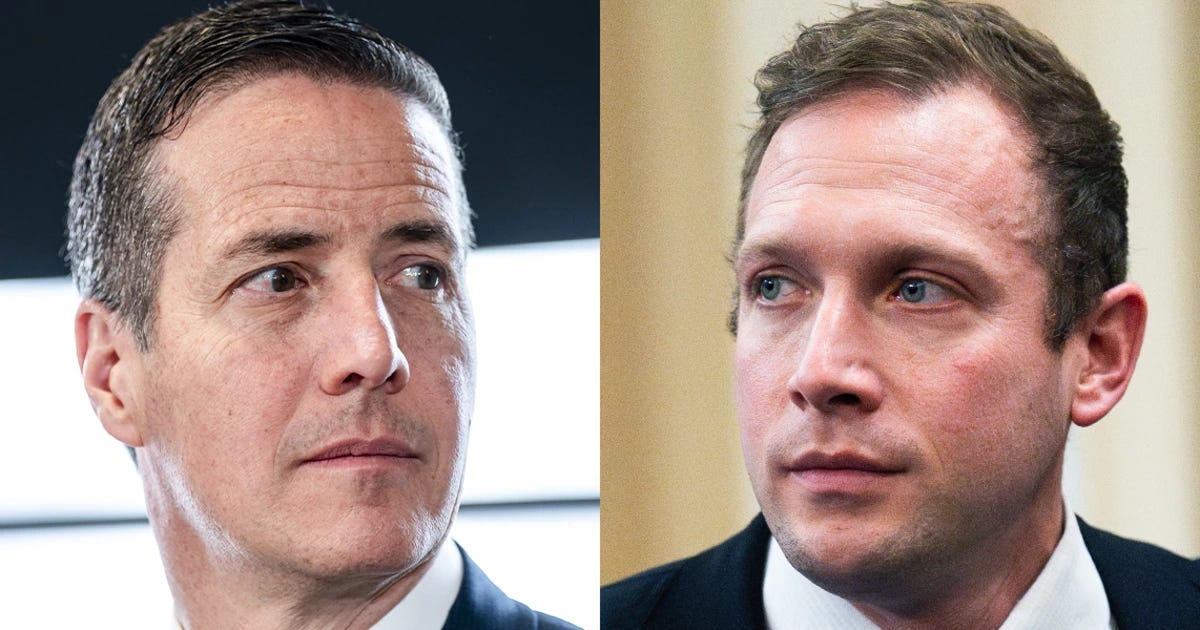
Sen. Bernie Moreno (R-OH) spent months saying almost nothing about the man his daughter Emily has accused of scalding her with water and holding a gun to her head. On Sunday, that changed. Hours after Rep. Max Miller (R‑OH) went on a nearly 20‑minute livestream denying every allegation of abuse, his former father‑in-law published a statement calling for his resignation, writing that Miller “needs serious psychological help” and “should not serve in the House of Representatives.”
The timing could hardly be worse for Republicans. Moreno is now the first GOP member of Congress to call for Miller’s ouster, with a House Republican majority of just three votes. The national spotlight is now on the entire Ohio delegation, tarnishing the party’s standing just as the midterms are revving up.
But Miller apparently is not going anywhere. He used Sunday’s livestream to reaffirm that he’s staying on the ballot ahead of a Wednesday deadline for Ohio Republicans to replace him. It sets up a stark contrast with the way Democrats have held their own candidates accountable for credible accusations of abuse.
But she cooked me dinner!
Miller’s livestream ran nearly 20 minutes, and by multiple accounts he slurred through parts of it. His central argument was based on the absence of any legal consequences, which these days is so often proof of exactly nothing.
“These are incredibly serious criminal accusations, and if these accusations were true, I would be in jail,” Miller argued. He pointed to his continued joint custody and his ex-wife’s behavior as proof of his innocence. “My former wife would not have been offering to cook me dinner and inviting me to playgrounds. Think about that,” he declared.
On the allegation that he threw boiling water on Emily Moreno, Miller offered a competing account:
“The boiling water story the media has run with—that story is about an incident in June of 2024 while we were still married, and here’s the truth, and this is the absolute truth: It was horseplay in our kitchen. I sprayed water at her from the sprayer attached to our kitchen sink. Tap water, which does not reach boiling temperature or scalding.”
He added that she “didn’t call the police” and “didn’t go to the hospital” afterward, and instead “went straight to a child’s birthday party.”
On the allegation that he held a gun to her head, Miller’s rebuttal again leaned on the absence of a criminal charge rather than a specific counter‑account: “That never happened and is absolutely outrageous.” He similarly denied breaking his daughter’s collarbone, saying she wasn’t in his care when the injury was discovered. Miller framed the broader pattern of allegations as originating from an unreliable witness. “Every one of these allegations traces back to a single source: my former wife,” he said, adding, “I’m not getting out of this race, and I’m winning in November.”
Miller also used the livestream to directly question his ex‑wife’s credibility, saying she has struggled with “significant mental health challenges” that he suggested contributed to the allegations. He framed his attack as motivated by concern for their daughter rather than an attempt to discredit his ex-wife.
Until Sunday, Sen. Moreno’s posture toward the allegations had been notably spineless. As recently as July 31, asked by NOTUS whether Republicans should replace Miller on the ballot, his answer was a flat “I don’t know.” Before that, his office had been even more guarded, with a spokeswoman saying only that the senator “will not litigate these matters in the media or respond to baseless public attacks.”
Moreno changed his tune on Sunday with a flat rejection of Miller’s framing. “As he has admitted privately, Max Miller needs serious psychological help,” Moreno wrote. “He is a danger to my daughter, and I hold my breath every minute he has custody of my granddaughter.” He added that the “clear pattern of abuse” Miller has “left in his wake” meant Miller “should not be free to continue endangering others” until he sought help.
Moreno’s language suggests the truth isn’t limited to what has played out publicly. By noting that Miller has “admitted privately” to needing psychological help, Sen. Moreno has opened the door to facts and events beyond what’s in the public court records. Emily Moreno’s spokesman, Stefan Mychajliw, was similarly unambiguous, calling Miller’s livestream a “bizarre and lie‑filled rant” and adding: “There is a documented trove of evidence that Miller has a history of violent and dangerous behavior and no amount of victim shaming will change that.”
Why “she was nice to me” isn’t the slam dunk Miller thinks
Miller’s central rhetorical argument is that Emily Moreno’s continued contact with him after the alleged incidents proves the incidents didn’t happen. He treats her behavior as a kind of gotcha.
But it isn’t. Decades of clinical research on how abusive relationships actually function suggest the opposite. Continued contact after an incident is a well‑documented pattern, not an indicator that the incident was fabricated.
Kristen Houser, chief public affairs officer for the National Sexual Violence Resource Center, explained the dynamic in general terms that apply directly here. Abusers, she says, often control victims through power over other aspects of their lives. This includes finances, careers and custody of children, and it can force victims to continue a relationship, or at least remain in contact, even after a violent incident. Houser adds that victims in this position are frequently “trying to rationalize what happened, make sense of it all, and control the narrative,” while also remaining wary of further consequences if they speak out.
The clinical literature backs this up. Psychologist Lenore Walker’s landmark study of 1,500 women who experienced domestic violence identified a recurring pattern researchers call the cycle of abuse: a tension-building phase, an incident, then a reconciliation or “honeymoon” phase in which the relationship appears calm or even affectionate before tension builds again. Reconciliation gestures, such as cooking, maintaining a normal schedule and agreeing to see the person again, are a documented stage of that cycle, not evidence that an incident never occurred.
Clinicians who study these dynamics describe victims’ post-incident behavior as frequently protective rather than voluntary. They continue contact, avoid confrontation and perform ordinary domestic routines as a way to de-escalate a volatile person, particularly when children and custody arrangements are involved. None of that requires the victim to have stopped believing the incident happened.
None of this proves the specific allegations against Miller are true. That remains a matter for the courts and, potentially, the House Ethics Committee. But it does mean the logic Miller offered as exculpatory doesn’t hold up against what’s known about how victims behave.
The broader credibility record
Miller’s arguments run into a far deeper complication: The record already includes a judge’s finding that undercuts his version of events. Miller filed a domestic violence petition against Moreno in February, seeking a protective order against her. But he withdrew it in May, and when Cuyahoga County Domestic Relations Court Judge Debra Boros formally dismissed it, she didn’t simply close the file. She wrote that Miller “was not under any apparent infirmity and did not appear to have been threatened by or in fear of” Moreno. In short, she called B.S. on his petition.
Separately, according to sworn testimony Moreno gave at a May hearing, Miller “admitted he was abusive to her and admitted to being abusive in writing.”
The behavior also predates the Moreno marriage. Stephanie Grisham, Trump’s former White House press secretary, dated Miller from 2019 to 2020. She wrote in her 2021 memoir that a partner, whom she didn’t initially name, had been physically abusive to her; she later described the relationship in a Washington Post op-ed that made clear she was referring to Miller. He then sued her for defamation over the memoir.
Going back still further, an even starker pattern emerges. A 2021 Politico investigation based on more than 60 interviews, as well as police and court records, documented a consistent pattern of allegations. Former classmates, White House colleagues and campaign staff independently described him in strikingly similar terms, from “scary” and “volatile” to someone people didn’t want to be alone with.
Multiple people who were present at a high school party in Miller’s own home told Politico that he became enraged when a female classmate resisted his advances and shoved her hard enough that she fell down a set of stairs. There was no hospital visit and no police report at the time, but several attendees described the incident as a well‑known story among their peers for years afterward. One called it “the boiling‑over point of exactly who he was in high school.” Miller’s attorney denied on his behalf that the incident occurred.
Politico’s reporting also surfaced a previously unreported 2011 police report from Miami University of Ohio, where Miller crashed a Jeep into a light pole. Officers noted signs consistent with intoxication, and Miller was initially charged with the Ohio equivalent of a DUI before pleading down to a lesser traffic offense. A separate 2007 charge from his senior year of high school, stemming from a physical altercation and an attempt to flee from police, had been previously reported by the Washington Post in 2018, but that case was also resolved with a plea to lesser misdemeanors.
On the Grisham relationship, Politico’s account adds detail beyond what became public through Miller’s later defamation suit against her. Three sources described a specific altercation in April 2020 in which Miller allegedly pushed and slapped her amid a dispute over infidelity, after which Grisham left his apartment without a coat. The outlet also reviewed email exchanges between the two from the days that followed, in which Grisham told Miller she was struggling to process how much he’d hurt her, without explicitly describing physical violence in writing. Miller’s attorney has pointed to that gap as undercutting her allegation, a point that Politico’s reporter also noted while including the emails in full context.
The extortion‑shaped question mark
Another question hangs over the history of abuse. Why did Sen. Moreno wait the better part of a year to say anything in defense of a daughter making detailed, corroborated allegations of abuse? Was this just another case of a MAGA loyalist not having the guts to defend his own daughter publicly, for fear of scandalizing the party and losing support from Donald Trump?
Or was there a Lindsey Graham-like element to his behavior?
Michelangelo Signorile, the longtime LGBTQ+ political journalist, has floated an answer rooted in one detail buried in Emily Moreno’s court filings. Included as an exhibit in Emily Moreno’s restraining‑order motion was a text Miller sent to his father‑in‑law.
“I’m sick of this, you know I never hurt our daughter. Take this however you want, everyone is going to get to know you better than your wife does,” Miller wrote, adding, “Enjoy the ride brother, I wouldn’t have to do this if you could keep your lying daughter under control.”
Miller doesn’t specify what he means. But Signorile connects it to a specific, highly public episode from Moreno’s 2024 Senate run. An Associated Press investigation, published days before that year’s Ohio primary, found a profile seeking “1‑on‑1” sexual encounters with men on Adult Friend Finder. The profile had been created using Moreno’s work email address under a username referencing his first name and birth year, with geolocation data pointing to a part of Fort Lauderdale where Moreno’s parents owned a home.
Moreno’s campaign said a former intern, Dan Ricci, had created the profile as what Ricci called “an aborted prank.” Signorile finds that explanation hard to credit, both then and now. “What was the prank? How does it work? And wouldn’t the profile have been more elaborate and exaggerated if it were a prank? Why a simple solicitation for sex? And why would an intern prank their boss like this—it’s not a ‘prank,’ after all, it’s sexual harassment—in a way that would surely get him fired, but instead he’s now a friend and campaign donor?” (Ricci went on to donate to Moreno’s campaign.)
Signorile also notes the reversal in Moreno’s own record on the underlying issue. Moreno once “contributed to the [LGBTQ+] cause, promoted marriage equality and defended his own gay son in years past,” before becoming, in Signorile’s words, a MAGA‑aligned hardliner who “threw his son under the bus” on LGBTQ rights as his political ambitions grew.
I should caution that no one with any direct knowledge of what Miller meant by his text has confirmed the link to the 2024 scandal Signorile is drawing. It remains his inference, not a verified fact. But it certainly would help explain an otherwise puzzling silence that ended only after Miller’s livestream.
The GOP response: “The key word there is allegation”
While Moreno’s Sunday reversal broke new ground, national Republican leadership has held a consistent line for weeks. House Republicans have refused to condemn, let alone expel, either Miller or Rep. Cory Mills (R‑FL), who faces his own domestic violence allegations. Asked twice by reporters why this is so, Speaker Mike Johnson (R-LA) gave nearly identical answers. “The key word there is ‘allegation,’” Johnson said. “We have a process here. The House Ethics Committee works on those things. If allegations are made, they work through a process. So I’m not in the business of commenting on investigations as they’re in process, and we’ll see how that shakes out.”
Johnson has made a point of framing this as an even‑handed standard rather than a shield for his own conference: “That’s how this always works. And by the way, it’s done for Rs and Ds — both sides of the aisle.”
But no such “process” has been publicly announced in Miller’s case. The House Ethics Committee has announced no action regarding him, and the independent Office of Congressional Conduct has declined to comment on whether it’s investigating him.
Rep. Anna Paulina Luna (R‑FL), who says she knows both Miller and Moreno personally, framed her concern less around the allegations’ credibility than around the toll of public scrutiny: “What I hate about this entire situation is that these articles the press are putting out have been very nasty especially with accusations and it is only hurting one person… their daughter.”
Ohio Gov. Mike DeWine, asked about the allegations before Sunday’s developments, offered a similarly noncommittal read: They were “troubling accusations,” and “people of the district are having to weigh the facts.”
Outside the GOP, the pressure has been more direct. The gun violence prevention group Giffords, founded by former Rep. Gabby Giffords, called on Miller to resign, with executive director Emma Brown stating: “Congress is no place for violent abusers who attack their family and hold a gun to their wife’s head. Max Miller needs to resign now — and if he refuses, the House should expel him.”
The Democratic contrast
Johnson’s claim that the process “is done for Rs and Ds — both sides of the aisle” runs into recent counterexamples.
In July, a Politico investigation reported that Jenny Racicot, a Maine woman who had previously dated Democratic Senate nominee Graham Platner, alleged he entered her home uninvited in 2021, intoxicated, and sexually assaulted her. I covered the Platner collapse as it happened. As I wrote at the time, “Platner had withstood months of controversy without losing his standing in the race. But this time was different.” Within a day of the Politico story, the Maine Democratic Party, the Democratic Senatorial Campaign Committee and Planned Parenthood Action Fund withdrew their endorsements and called on him to exit the race. Senate Minority Leader Chuck Schumer and DSCC Chair Kirsten Gillibrand said jointly that Platner “needs to immediately withdraw as the Democratic nominee for Senate,” and even Bernie Sanders, Platner’s most prominent backer, said he’d spoken with the candidate directly and “recommended that he step aside.”
Platner denied the allegation as “categorically false.” He suspended his campaign within days anyway.
The Platner situation echoed an earlier case. Rep. Eric Swalwell (D‑CA) resigned from Congress and suspended his campaign for California governor earlier this year after a former staffer alleged a series of sexual encounters while she worked for him, including two occasions she said occurred while she was too intoxicated to consent. Swalwell denied the allegations but exited both races regardless.
That contrast has not gone unnoticed. A reporter put it to Johnson directly: “Dems ditched Graham Platner after sexual assault allegations. Two members of your conference—Max Miller and Cory Mills—face domestic violence allegations. Why keep them in your conference?” Johnson’s answer was the same line he’s used throughout: “The key word there is ‘allegation.’”
The comparison isn’t perfect. Platner never held office, and Swalwell’s exit followed a specific reported pattern involving a staffer under his direct supervision, a workplace‑power dynamic distinct from the domestic abuse allegations Miller and Mills face. But the willingness to move quickly and decisively is stark nonetheless: Democratic leadership acted on Platner within hours of a single news story, without a judicial or ethics finding of any kind. Republican leadership has spent months declining to act on Miller despite sworn testimony, the dismissal of his own domestic violence petition and now his own former father‑in‑law calling for his resignation.
Political stakes
Ohio’s 7th District isn’t supposed to be competitive. Trump carried it by roughly 11 points in 2024, the same year Miller himself won reelection with only 51 percent of the vote. That margin was padded by a fractured opposition, with the Democratic nominee taking 36 percent and former Democratic Rep. Dennis Kucinich, running as an independent, pulling 13 percent.
This cycle, Miller faces a single Democratic challenger: Brian Poindexter, a union ironworker and Brook Park city councilman who’s picked up an endorsement from Bernie Sanders along with support from a PAC aligned with the centrist Blue Dog Coalition.
The numbers have moved fast. A June poll from the Democratic‑aligned firm GBAO found the race a statistical tie, with Miller ahead of Poindexter by just one point, 44 percent to 43 percent. But a more recent survey, conducted last week by a Republican polling firm after Emily Moreno’s restraining‑order filing and before Sunday’s livestream, found the race had flipped entirely: Poindexter led 44 percent to 39 percent, with Miller’s favorability rating 15 points underwater.
Poindexter has largely avoided leading with the allegations against Miller, saying he entered the race over policy rather than Miller’s personal conduct. But he hasn’t stayed silent either. In May, he said the allegations “deserve the attention of law enforcement,” and after Miller’s Sunday livestream, he went further: “No one credibly accused of holding a gun to his wife’s head and breaking their 2‑year‑old daughter’s collarbone belongs in the halls of power.”
National Democrats have been considerably less restrained. The House Majority PAC told ABC News it is “willing to do whatever it takes to take back the House, and nothing is off the table,” predicting flatly that “Brian Poindexter will defeat the scandal plagued Max Miller.” The pro‑labor Battleground Alliance PAC has already run robocalls to roughly 100,000 households in the district recounting the allegations from both Moreno and Grisham.
All of this is unfolding against a hard deadline: Ohio Republicans have until this Wednesday to replace Miller on the ballot if he withdraws. Names already being floated as potential replacements include state Rep. Mike Dovilla and former state Sen. Kevin Coughlin. As of Sunday’s livestream, however, Miller has shown no intention of stepping aside.
Somehow the scandalous is now normalized by Republicans desperate to hold on to power. Power at any price seems to be the watchword.
The whole MAGA Republican Party is just disgusting from top to the bottom-They’ll justify anything to keep control, no matter who gets hurt.