
The ICE Men Cometh… Illegally
A blockbuster whistleblower complaint reveals the secret internal ICE memo behind the brutal forced home entries we are seeing.

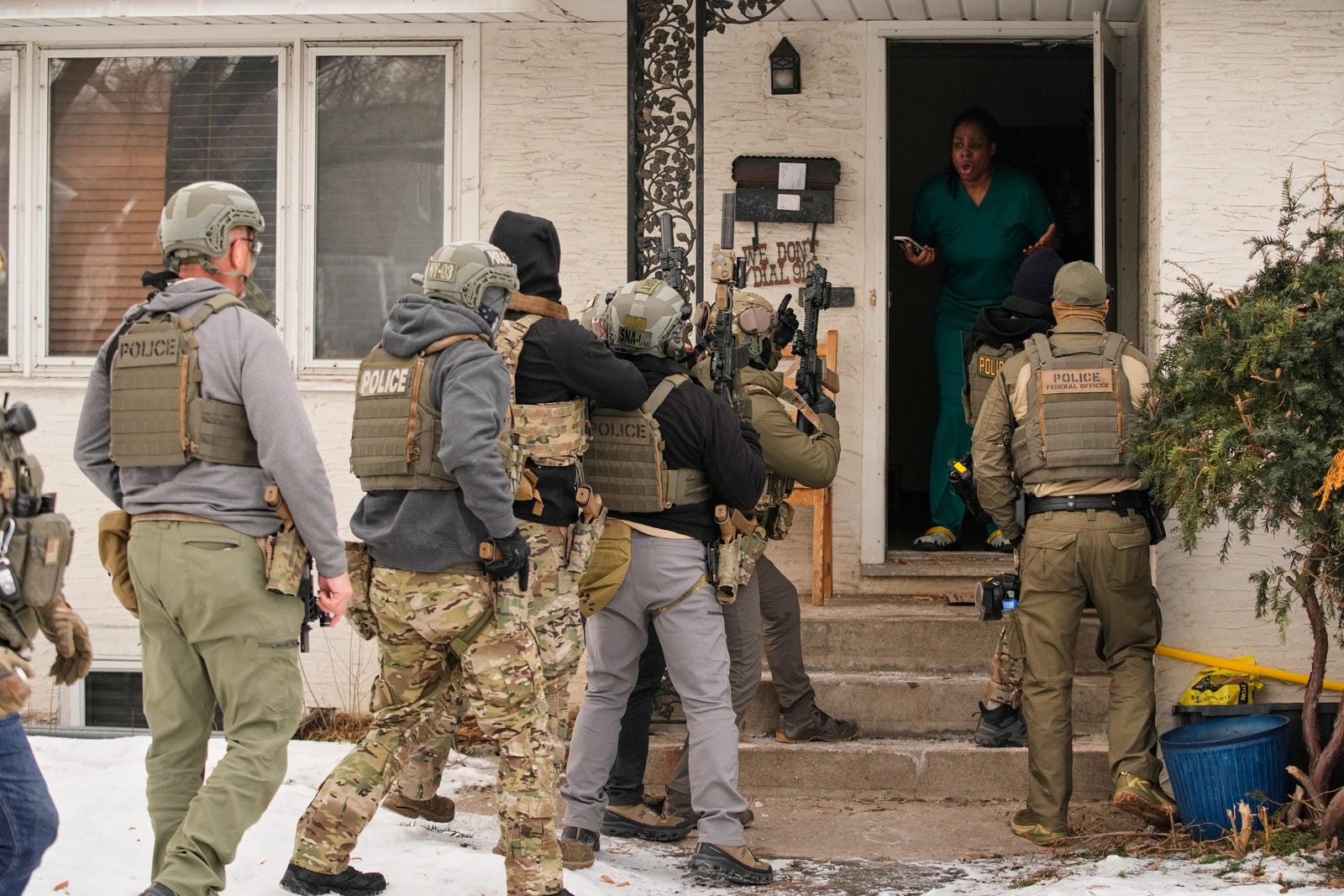
Not much shocks me lately, but yesterday’s bombshell about a secret ICE memo did.
We’ve all seen recent disturbing reports and horrifying footage of ICE blatantly violating constitutional rights and norms. In Minneapolis, its agents, led by Greg Bovino, have been deploying battering rams to break into families’ homes, dragging out occupants, even in the absence of judicial warrants authorizing home arrests.
The victims of these assaults recently included an elderly Hmong man—a naturalized U.S. citizen—whom they forced out into the cold, detaining him in his bathrobe.
This is a vile practice by fascist thugs, and the legal guardrails are failing. Those guardrails were put in place long ago by the Supreme Court to prevent precisely this kind of abusive law enforcement overreach. The Court emphasized, in the landmark ruling of Payton v. New York, that under controlling Fourth Amendment law, the home is a specially protected place. There, protections against illegal searches and seizures are constitutionally guaranteed at the highest levels.
In 2026, ICE agents are thumbing their noses at this ruling and committing constitutional violations daily. But now we understand why.
Per a blockbuster report by the Associated Press, ICE agents have received actual secret instructions from their higher-ups to disregard established Fourth Amendment home protections. This is not just a violation of our cherished constitutionally guaranteed liberties. It suggests a conspiracy within ICE leadership to deprive people of their civil rights—all while hiding the evidence, in the form of a written departmental memo, purporting to authorize the conduct.
Let’s lay this out plainly. We’ll talk about what the law has said for 40 years about home entry in the absence of a judicial warrant. Then we’ll take a look at how the ICE memo tries to get around those same rules. We’ll examine DHS’s likely defenses and why those arguments collapse quickly. Finally, we’ll discuss what actions are already underway to put an end to the abhorrent constitutional violations.
Payton and the “firm line” at your front door
The Supreme Court decided Payton v. New York in 1980, and it’s been “black letter law” ever since. The question in Payton was straightforward. New York sought authority for its police to enter homes without a warrant in order to make routine felony arrests, so long as police had “probable cause.” That would have been a huge expansion of police power, and the Supreme Court rejected it.
The justices, in a 6-3 opinion, drew “a firm line at the entrance to the house,” holding that the government cannot cross that threshold to arrest someone inside the home without a warrant—absent narrow exceptions like consent or what’s known as “exigent circumstances” such as hot pursuit or immediate threats to safety.
In other words, even if the government believes you’ve committed a crime, it doesn’t get to take a battering ram to your door unless it has gone to a judge and obtained permission first. Importantly, it’s judges who get to make that call, not the police. Their assertion of “probable cause” in the moment is not enough, by itself, to justify a home intrusion. Moreover, a warrant requirement isn’t some abstract thing; it’s a constitutional check to prevent the government from acting as judge, jury and executioner on the scene.
Zooming out a bit to basic constitutional principles, the Fourth Amendment exists for a reason. It was drafted in response to state power being used as a weapon, including British soldiers barging into private homes and searching and seizing at will. Given that experience, American constitutional law has always treated the home as a special place. Indeed, if the Fourth Amendment has any core to it, it’s the right to be secure and at peace in your own home.
Payton draws the distinction that DHS and its ICE memo, discussed below, are seeking to erase. An arrest may be lawful, but the method matters. The Fourth Amendment doesn’t just govern whether the government may arrest you; it governs whether it may invade your home to do it.
The consequences of a forced home entry can be grave. We’re seeing this play out in real time in Minnesota with ICE raids: Battering rams. Drawn guns. Terrified kids. Citizens dragged out into the cold. Mistaken addresses. Injuries and, likely soon, deaths within people’s own homes. The constitutional rule announced in Payton exists because those harms are not hypothetical, but entirely real and foreseeable.
If ever the Supreme Court has been clear about a “line” that the government cannot casually cross, it’s the one at our front doors.
Replacing a judge with “paperwork”
The public now has a far clearer picture of why ICE has been behaving as though Payton does not exist. Per the AP’s reporting, ICE leadership has actively been telling agents, in writing, that it doesn’t.
According to a whistleblower complaint, there is an ICE memo that claims agents can rely solely on an administrative document called Form I-205—Warrant of Removal/Deportation—to barge their way into a home using any “necessary and reasonable amount of force.” From there, the memo asserts, ICE agents can arrest any person subject to a “final order of removal,” even without a judge-signed warrant.
Pay attention to how this inverts the Payton protections. It substitutes a paper process inside the executive branch (a form signed by an immigration officer who is an employee of DHS) and treats it as a substitute for the constitutional judicial warrant requirement for home entry. This amounts to a rewrite of the Constitution.
ICE agents are not making up this new rule on the fly. Rather, they are responding to a top-down policy choice, one that creates a new default: forced home entry for civil immigration arrests, even without prior judicial authorization.
Assuming the whistleblower report is accurate, DHS did everything to ensure there would be zero accountability for this policy and practice. Per the report, the memo itself was treated as a controlled document and circulated only to select senior personnel. Instructions to agents to disregard Fourth Amendment protections came via verbal training rather than written policy, meaning no paper trail. In some cases, the memo was shown to personnel who were told to read it and then return it rather than retain a copy. At least one person was implicitly threatened with retaliation for objecting to the policy.
This sure doesn’t look like valid DHS policy. It looks like a cover-up. Were the policy lawful under Payton, DHS would not need such secrecy in the memo’s handling. It would act with confidence. It would cite the law. It would publish its reasoning rather than hide the legal opinion giving the policy legs. Then it would defend the policy openly in court.
That it did the opposite suggests a conspiracy to willfully violate civil rights. We need to learn more about this, but we should keep criminal prosecution as a valid option here. After all, the memo’s authors understood precisely what they were doing: taking settled constitutional law and trying to create an end-run around it through administrative fiat.
But but but… there’s still a warrant!
We can already predict what the White House, through such gems as Karoline Leavitt and Kristi Noem, will say in response to this reporting. They’ll seek to confuse the public by arguing that these forced home entries weren’t “warrantless” because ICE agents actually have a warrant—just an “administrative” one.
A few key points here. A warrant is not some magic talisman that lets ICE vampires cross thresholds just because it is labeled a “warrant.” It grants that power only if it represents independent judicial authorization before the government invades a home. That’s the entire purpose of Payton, and why an I-205 form is not make constitutionally equivalent to a judge-signed warrant.
If this ever reaches a court, as is now highly likely, look for ICE to assert several arguments in its own defense.
(1) “Immigration is civil, not criminal.”
Sure, that’s true in a formal sense. But it still doesn’t dissolve the Fourth Amendment at the doorstep. Our Constitution protects “the people” against unreasonable searches and seizures. It doesn’t have an asterisk saying “unless the government calls what it’s doing civil enforcement.” If anything, the need for an independent judicial check grows even more urgent when the government is trying to normalize home raids without pending criminal charges.
(2) “There is a final removal order for the person in question.”
This argument is a red herring. It doesn’t answer the Payton question, which concerns limits on home entry. In other words, having authority to take someone into custody somewhere is not the same as authority to invade a home without judicial permission. Again: Payton is about how the government may approach a home, not whether people can be arrested generally.
(3) “We have administrative authority.”
This is the core theory behind the ICE memo. But the Supreme Court has already warned against exactly this kind of move, which treats basic arrest authority as a skeleton key that unlocks all front doors.
The Supreme Court case of Steagald v. United States is instructive here. Steagald held that even when the police have an arrest warrant for a suspect, they can’t enter a third party’s home to search for that suspect without a judicial search warrant, absent consent or exigent circumstances. Because an arrest warrant for one party does not nullify the privacy rights of a third party homeowner. And the arrest warrant cannot be turned into a roaming license to enter other residences searching for the suspect.
In short, even a judicial arrest warrant issued for a criminal suspect doesn’t automatically give law enforcement the right to invade another person’s home.
This is why the DHS memo’s logic falls apart quickly. It seeks to authorize, with just an administrative form, what the Supreme Court said you cannot do with a far more powerful judge-issued arrest warrant.
In sum, Payton established the home-entry rule, while Steagald blocked any “arrest warrant equals home entry authority” work-around. Together, they leave ICE with only one argument: classic exceptions such as consent (someone let them in), exigent circumstances (true emergencies), and other narrow and recognized doctrines.
Notably, all of those are individualized defenses tied to specific facts of a specific raid. They can’t be used to justify a blanket policy authorizing forced entry as a standard DHS practice. Moreover, the moment ICE made forced entry its actual policy, it can’t later argue “exigent circumstances.” An emergency can’t become policy, and necessity can’t be contained within an agency memo.
Moving to stop this
Congress is already on the ball on this, but fair warning that the pace and process will feel frustrating. Sen. Richard Blumenthal’s (D-CT) office sent a letter to Kristi Noem demanding the underlying legal analysis from DHS and ICE, including any Office of General Counsel determinations that allegedly authorize this new home-entry practice. The letter also requested training materials and data on how often ICE has used administrative paperwork to enter homes.
These demands are not academic. They go to the heart of whether DHS is carrying out a sweeping constitutional change through a secret memo—and whether that change is being implemented nationwide. They also set things up for future litigation and potential criminal prosecutions.
The ACLU loves a good internal memo like this. It makes it possible to turn individualized cases into class actions, all flowing from the same illegal policy. The State of Minnesota and the City of Minneapolis will also likely incorporate this fact and additional allegations into their existing suit to halt ICE’s conduct. Such cases, if they can proceed successfully, will force discovery, expose who authored the memo and any OLC opinion supporting it, identify who approved it, and reveal what warnings were raised internally and ignored.
In response to motions by the plaintiffs, courts can also issue temporary restraining orders or preliminary injunctions to stop the widespread practice of forced home entry immediately. That relief is far better than waiting years as cases filed by victims wind their way through the system, with things like qualified immunity still standing as big roadblocks to significant damage awards. Plaintiffs will now be armed with what appears on its face to be a secret written policy designed to avoid accountability. That’s litigation gold.
But we should also be clear about what this moment demands. The Constitution does not defend itself. Payton and Steagald are not self-enforcing. We need lawyers, judges, legislators, journalists, and ordinary people to insist that the home threshold and Fourth Amendment protections matter.
If ICE believes it has discovered a new theory allowing it to bypass the requirement for judicial warrants before forced home entries, then let it put that theory to the test publicly. If it cannot survive legal scrutiny, as it should not, its practice of battering down home doors must end and soon.
And if DHS and ICE leadership knowingly and willfully authorized unconstitutional raids while keeping the evidence secret, that is not merely “controversial policy.” It is a potential civil rights conspiracy—and it should be investigated and prosecuted after we retake our government and the Justice Department is no longer in the hands of Trump’s lackeys.
I really, really hate swearing here. This is a community built around civility and peaceful defiance, and all credit must go to Jay for fostering such a great place.
But I fucking DESPISE this latest run-around attempt even more than the illegal deportations. This is a planned, thorough, active middle finger to the rule of law. This is, as Steve Shives often says, NAZI SHIT.
Steven Miller should be locked up for life for this alone. What a despicable little fascist coward of a man.
Why can't local and state police arrest the ICE goons for breaking and entering? Or any local law they've broken? And the argument that it will escalate a situation doesn't work. It's already escalated. Also, does a homeowner have the right to shoot an ICE goon who breaks into their home?