
Tofu Dreg Corruption
What happens when the priority is profit and spectacle, and not public safety? The Great American State Fair gives us a taste.

In August 2007, a highway bridge over the Tuo River in Hunan Province, China collapsed while workers were completing it. The project had been rushed so it could open in time for the 50th anniversary of the local prefecture’s founding. Sixty-four people died.
An investigation found that officials had cut corners to hit the anniversary deadline, and that the men running the state-owned company building it had taken bribes for the contract. Two years later, they were convicted and sentenced to up to 19 years in prison. The Chinese have a term for construction like this: tofu-dreg construction. Solid enough for a ribbon-cutting, but built by people incentivized to spend as little as possible on the parts nobody checks until they fail.
When I was working in China decades ago, corruption and shoddy execution went hand in hand. People entrusted with public funds often saw them as their golden ticket, and then maximized their take by skimping on quality and safety.
That’s what we are starting to see here in the U.S.
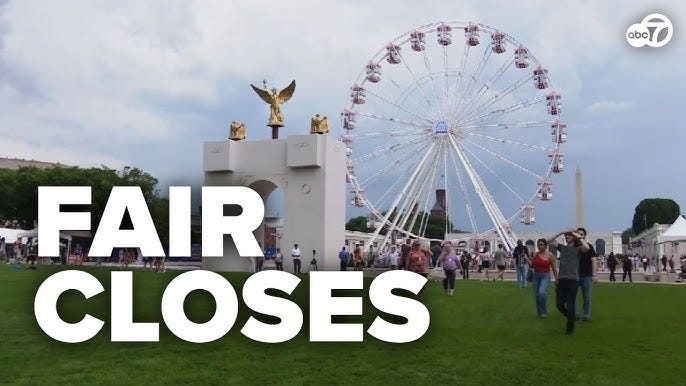
Over 16 days this summer, the federal government threw the country a 250th birthday party on the National Mall. It didn’t go well. The Great American State Fair opened to sparse crowds and bare exhibits, closed repeatedly because of extreme heat, and culminated on the Fourth of July with a storm evacuation, a nearly four-hour delay and a record-setting fireworks show that vanished into its own smoke and left Washington under choking air pollution.
Reporters have covered the money trail separately from the failures. On the one hand, there were no-bid contracts and $10 million donor access fees, and on the other, in stark juxtaposition given that kind of budget, there were empty crowds, broken air conditioning and a stage panel that nearly struck a group of performers.
But these are two parts of the same story. Freedom 250, the organization behind the fair, extracted revenue from wherever it could reach, while delivering something underfunded, threadbare and dangerous.
Where the Money Went
Congress created America250 a decade ago as a nonpartisan commission to plan the country’s 250th birthday. The One Big Beautiful Bill allocated $150 million to the Interior Department for 250th anniversary events, and White House officials initially agreed America250 would get $100 million of it. By November, Democrats alleged the White House told America250 it would receive only $50 million. So far, it’s gotten just $25 million.
Where did the rest go? Enter “Freedom 250.” Launched by the White House in December as a “subsidiary” of the National Park Foundation, it has received at least $68.3 million in taxpayer funds funneled through the Interior Department. Doug Burgum, the Interior Secretary who sits on the foundation’s board, told Congress in May he wasn’t sure who’d decided to create it at all: “Not aware of the final decision maker.”
A House Natural Resources Committee report released July 2, “From Vanity to Insanity: How the White House Cheated the American People out of their 250th Birthday,” alleged corrupt dealing with Freedom 250 was widespread. The report alleged that donors who intended to give to the original America250 commission were given the wrong bank information, and that their money was instead routed to Freedom 250 without their knowledge. If true, that could amount to wire fraud and charitable solicitation fraud. Freedom 250 called the allegations “categorically false” and said the claim that donors were misled was “unequivocally false.”
The access itself came in tiers, according to Freedom 250 fundraising materials first reported by the New York Times: $500,000 bought VIP access and preferred seating; $1 million added a photo opportunity and an invitation to a private “thank you” reception with Trump; $2.5 million bought a speaking role at the July 4 event; $10 million or more bought all of it, plus logo rights and a tailored press release. Sponsors with business before the administration include Palantir and United Airlines, both of which hold major federal contracts.
States got billed too. Massachusetts, North Carolina, Washington, Illinois, Oregon and Connecticut all declined to send delegations, most citing cost. Exhibit fees reportedly ran from $100,000 to $1 million. Massachusetts Gov. Maura Healey was indignant. Trump “invited all the states to participate and wants to charge us — charge us! — to put something on his exhibit... This is taxpayer money.”
Then there’s the contractor. Per reporting by the New York Times, Event Strategies, Inc., a Virginia firm run by former Trump campaign aides, helped organize Trump’s 2015 campaign kickoff and handled logistics for the January 6, 2021 rally, where Trump told his supporters to march on the Capitol. When Trump returned to office, he named one of the firm’s partners, Justin Caporale, executive producer for major events and public appearances.
The firm organized Freedom 250’s major events, including the fair and the July 4 program. A company spokeswoman declined to say how much it was paid, but said the firm is earning a 3.5 percent profit margin on the work. An internal planning document from early last year estimated the fair and the July 4 festivities would cost a combined $45 million to stage. Freedom 250 did not respond to the Times’s questions about the actual cost.
None of this has to be disclosed because Freedom 250 isn’t a government agency. Legally, it’s a subsidiary of the National Park Foundation, so its contracts aren’t public record. Rep. Jared Huffman (D-CA), the House Natural Resources Committee’s top Democrat, put the objection simply: “Public dollars are involved. Public agencies are involved. That’s something the public has a distinct interest in knowing about.” The full amount paid to Event Strategies may not surface until the foundation’s annual filings next year.
Separately, per the Times reporting, Event Strategies has taken in roughly $39 million in federal contracts since the start of 2025, with more than $13 million of it through no-bid awards the firm was guaranteed to win. That includes over $10 million from the Pentagon to stage the Navy’s 250th anniversary celebrations. A White House spokesman said Trump did not influence those contracts and was not involved in selecting the firm for the Freedom 250 role.
That $39 million doesn’t include the largest number attached to the firm’s name. Wired reported in March that Event Strategies had separately negotiated a General Services Administration contract that could be worth up to $100 million over the next 15 years. Before Trump’s return to office, the firm had taken in roughly $50,000 in government contracts over the prior decade, so its shift in fortune is dramatic by any measure.
Wired found the company won its new federal business with very little competition. According to Wired’s analysis using HigherGov, a contract-tracking tool, Event Strategies was the only bidder on 8 of the 11 contracts the site tracked. A White House spokesman nevertheless insisted, “There is a proper federal competitive bidding process, and the White House expects all agencies to comply with it,” and referred further questions to GSA, which did not respond.
Where the Money Didn’t Go
What arrived at the National Mall looked nothing like what the kind of money spent implied. The Washington Post, reviewing the fair in progress, called it “oddly sterile” and “crushingly dull,” comparing it to “a trade show for Christian groups, tourist boards and the military industrial complex.” A reviewer from the Washingtonian called it “bleaker than I expected.”
On July 2, during a rehearsal for the same stage the president would use two days later, a large panel broke loose from the overhead rigging and crashed onto the stage, narrowly missing a group of roughly 18 young dancers mid-routine. Video captured at least one dancer glancing up, seeing it fall, and running clear before it hit. Freedom 250 insisted everyone was safe and that the work “was taking place on the backside of the stage, separate from the front thrust where performers were rehearsing,” adding that “additional safeguards and senior technical oversight are now in place.” The video itself shows the panel landing in the same area where the dancers were performing.
The heat made everything worse for the visitors, and the fair wasn’t prepared for it. On July 3, the day before Trump’s speech, D.C. Fire and EMS logged 44 patient contacts before the fair closed for the afternoon. Eleven were transported to hospitals, with seven of them requiring advanced life support. Local media reported pallets of bottled water sitting in direct sun near the grounds, with some seating areas offering little shade. Security rules banned coolers, folding chairs, metal water containers and spray sunscreen, compounding the exposure for people standing in line.
On July 4, the mercury hit 102 degrees, making it the hottest Fourth of July on record in Washington, D.C. A woman was treated by D.C. Fire and EMS after collapsing in line for the Ferris wheel. Trump had told reporters days earlier he wouldn’t be deterred: “It’s going to be approximately 107 degrees out, and I’m going to go, and I’m going to make a really long speech just to show that I can do anything.”
On the evening of July 4, as storms approached, Freedom 250 ordered an evacuation of the National Mall. “Due to approaching severe weather, we are temporarily pausing the event for your safety,” an overhead announcement said. Inside the security perimeter, DC Fire and EMS transported 34 people to local hospitals, many for heat-related ailments, and treated another 58 on-site. The evacuation itself was chaotic. “Show is over. Please keep moving,” one official called, while another yelled “Rally canceled” to irate attendees. National Guard troops flipped over tables trying to move people along, and shelter sites including the IRS building reached capacity and began turning people away.
One of the designated shelter sites was, rather ironically, the National Museum of African American History and Culture. It also filled to capacity, leaving more than 1,000 people standing outside in the rain.
The Washington Post interviewed Mary Collins, 68, who has a brain tumor and had traveled from Indiana hoping to see the celebration in person while still well enough to attend. As the evacuation unfolded, she and her daughter-in-law, Gretchen, couldn’t get clear directions out. “If we asked them how to get out, they’d just yell at us to keep moving,” Gretchen said. The two sheltered for nearly two hours inside the Natural History Museum; unnerved by the experience, they didn’t return for the finale, watching a different fireworks display from their Airbnb instead.
There was no real plan for a forecast that had been known for days. Anthony Guglielmi, a Secret Service spokesman, said that “there’s never an event when you have to move more than 100,000 people on short notice, that it doesn’t cause some type of bump in the road.”
The Spectacle Must Go On
If safety was underfunded everywhere, spectacle wasn’t. As the evacuation played that night, Trump decided he would still go on. That decision overrode staff recommendations. A senior White House official told the Washington Post that “all the entities involved” had recommended canceling the event altogether once the evacuation began. “When POTUS heard this, he told all involved to invite everyone back in and the speech would take place, even if it meant waiting until 2 a.m.” Trump confirmed the account the next day: “When I heard that it was cancelled, I immediately overturned that decision.” A Freedom 250 spokesperson did not respond to the Post’s questions about his account.
He then posted on Truth Social: “Storms bring luck to whatever the occasion. They also make events a little bit more exciting! We will wait it out, I don’t care if it’s 2:00 O’Clock in the morning, or in one hour from now.” He added: “It’s Saturday night, LETS HAVE SOME FUN, even if we are out late tonight. They say 11:00 O’Clock for the speech. Who cares???” Asked about the delay, he told Fox’s Bret Baier: “I don’t care. It’s America 250. If they can storm the beaches on D-Day, I can deliver a speech and we can keep this program going.”
Trump took the stage at 11:15 p.m., roughly four hours behind schedule. As usual, his speech was a campaign-style rally filled with misinformation. “For two and a half centuries, our American Republic has stood as the crowning achievement of human history,” he said. “And we’re doing better now than we’ve ever done before.” Later in the speech, he told the crowd, “And as our Declaration of Independence tells us, we are all made in the image of one Almighty God.” The document says nothing of the kind; it insists that all men are “endowed by their Creator with certain unalienable Rights.” Separately, Trump warned that communism was “the greatest threat to our country” and endorsed the SAVE America Act, which would require proof of citizenship to vote and bar most mail-in ballots.
The speech ran about 30 minutes. The fireworks—the one piece of the night’s budget that had not been shortchanged—followed immediately after. Freedom 250 had planned a fireworks show of roughly 850,000 shells over 40 minutes, launched from ten sites—about ten times the size of Macy’s Fourth of July show in New York City and explicitly chasing the Guinness World Record of 810,904 shells set in the Philippines in 2016. The same organization that couldn’t keep water stations stocked in a heat wave knew in advance, according to its own internal paperwork, that a show this size would cause “hazardous pollution” and respiratory harm.
And it did. By Sunday, Washington briefly registered the worst air quality of any major city in the world, according to the pollution-tracking service IQAir, and the District issued a Code Red Air Quality Alert warning that the general public could experience health effects. Monitors near the launch sites recorded a reading of 179 during the show, climbing to as high as 288, which registered as “very unhealthy.” By sunrise, visibility fell from more than 10 miles to under a mile.
All in all, emergency responders logged hundreds of patient contacts tied to the National Mall over the course of the weekend. DC Fire and EMS reported 96 contacts and 40 transports between Friday night and Sunday morning alone, while George Washington University Hospital and the Department of Health and Human Services separately reported 289 and 314 patient contacts from the Mall, respectively. That there were no fatalities is welcome news, given the risks and the event's failure to prepare for them.
Trump’s own review of the show, posted after it ended, acknowledged none of this. He wrote, “the Most Spectacular Fireworks Show I have ever seen, and I’ve seen them all. Congratulations on a job well done!”
Tofu dreg nation
The Great American State Fair isn’t an isolated case of corruption and poor execution. For weeks, the nation has been subjected to the saga of the Lincoln Memorial Reflecting Pool, a few hundred yards away. That body of water was renovated under a no-bid contract to a firm with no prior federal experience and no swimming-pool expertise, after the firm the government first approached turned the job down as “technically unfeasible” on the timeline it was given. As we have all seen, the coating began peeling within weeks and a severe algae bloom followed, pushing costs up from under $2 million to more than $16 million. A second no-bid contract for the cleanup went to a company owned by a Trump neighbor who had previously pleaded guilty to bribing a member of Congress.
Similarly, in Florida, the migrant detention center known commonly as “Alligator Alcatraz” was built under an emergency order that suspended the state’s normal competitive-bidding rules. It cost at least $245 million, including by the AP’s estimate $50 million for bathrooms alone. One contractor gave $10,000 to the Florida Republican Party and signed a $1.1 million state contract the same day, then landed $5.1 million more in follow-on work. Despite $50 million spent on toilets, detainees described units that didn’t flush and floors flooded with fecal waste. Like the Great American State Fair, the air conditioning failed in the heat of a humid summer. After journalists began asking questions about the spending, contracts tied to the facility disappeared from Florida’s public database entirely.
We haven’t reached the point where our public buildings and bridges are collapsing from tofu dreg construction. But that may be only because the corruption hasn’t yet seeped into our larger infrastructure projects. So we must remain vigilant.
Come to think of it, Trump’s White House ballroom is a $500 million project with a no-bid contract behind much of it.
Just saying.
We’re gonna have to clone Jack Smith. It’s gonna take a hella lot of prosecutors to get to every last dreg of corruption and lock them all the fuck up (if found guilty in a court of law, of course).
Who could have known DC in July would be hot and humid?